Español Uno (1):
Today’s Agenda:
1. Review a list of Spanish classroom sayings to help us stay in Spanish as much as possible. What phrases are missing that you’d like to know how to say?
2. Listen to our new song of the week: “Bikini a lunares amarillo diminuto.” Nice job catching the first three missing words: vi, pude, nadie.
3. Practice our irregular yo song, both singing it and writing it.
4. Edit our stories. While it is not expected that your level 1 stories be perfect (that would be unlikely to happen!), there are some important corrections you are accountable for.
--(if needed) Make sure you included the word “that” (que) in your introductory phrase. For instance, “Había una mujer que se llamaba Betty.” Many level 1 students forget this important connecting word.
--(if needed) Do titles have proper notation? If you included a movie or TV show title, it should be in quotations. If you included a book title, it should be underlined.
--Do you have consistent gender & # agreement. Make sure everything matches in gender (una chica simpática) and number (unos calcetines feos).
--Is the story consistently in the PAST (with the possible exception of dialogue)?
--Check off the high-frequency phrases you used. How many did you include? Which could you have easily included as well?
5. Receive our pink packet for chapter 9 and begin to define some of our new vocabulary.
Homework: It would be wise to make flashcards for the ch. 9 vocabulary we defined in class.
Español Dos (2):
Today’s Agenda:
1. Review a list of Spanish classroom sayings to help us stay in Spanish as much as possible. What phrases are missing that you’d like to know how to say?
2. Listen to our new song of the week: “No.” Nice job catching the first three missing phrases: jueges, me mires, pedirte.
3. Tackle 8-8 (positive & negative words) in table groups.
4. Finish defining our ch. 9 vocabulary on our new pink packet.
5. Establish new gestures for:
--tiene músculos fuertes
--tiene músculos débiles
--tose
--estornuda
--se siente enfermo/a
--tiene hipo
Homework: It would be wise to make flashcards for the ch. 9 vocabulary we defined in class.
skip to main |
skip to sidebar

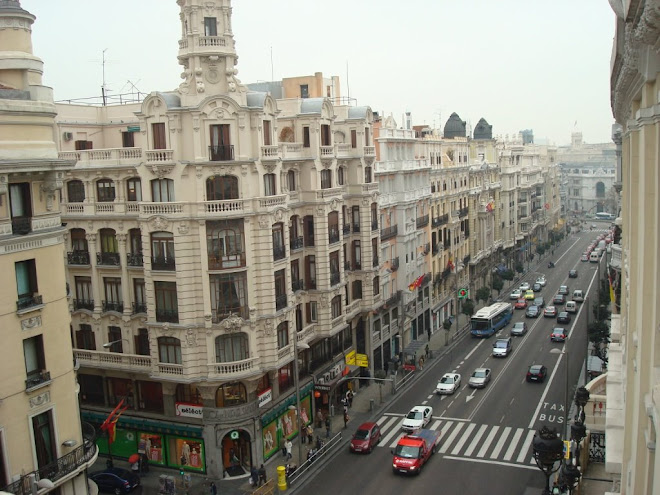
Not far from my apartment in 2002-2003
A Resource for All of Profe Nick's Spanish Students in Washington

Si tuviera un millón de dólares.... (If I had a million dollars....) [Cool, but not for free]
- Comcast "Selecto Pack"
Archivo del blog
-
▼
2010
(148)
- ► septiembre (20)
-
▼
abril
(19)
- jueves, el veintinueve de abril del dos mil diez
- miércoles, el veintiocho de abril del dos mil diez
- martes, el veintisiete de abril del dos mil diez
- lunes, el veintiséis de abril del dos mil diez
- viernes, el veintitrés de abril del dos mil diez
- jueves, el veintidós de abril del dos mil diez
- miércoles, el veintiuno de abril del dos mil diez
- martes, el veinte de abril del dos mil diez
- lunes, el diecinueve del dos mil nueve
- viernes, el dieciséis de abril del dos mil diez
- jueves, el quince de abril del dos mil diez
- miércoles, el catorce de abril del dos mil diez
- martes, el trece de abril del dos mil diez
- lunes, el doce de abril del dos mil diez
- viernes, el ocho de abril del dos mil diez
- jueves, el ocho de abril del dos mil diez
- miércoles, el siete de abril del dos mil diez
- martes, el seis de abril del dos mil diez
- lunes, el cinco de abril del dos mil diez
-
►
2009
(164)
- ► septiembre (18)
Spanish Is All Around Us...Have You Considered...?
- -- Peeking at the Spanish Directions of a Purchased Household Item/Appliance and Trying to Make Sense of Some of It
- -- Setting Your TV to Spanish and Navigating It...Ask For Permission First
- -- Setting Your Cell Phone to Spanish and Navigating It
- -- Purchasing Food from the "Hispanic Foods" Supermarket Aisle and Following the Cooking Directions in Spanish
- -- Subscribing to "People en español" o "National Geographic en español"
- -- Checking out Spanish Children's Books at the Local Library
- -- Perusing a Free Spanish Newspaper from a Store Specializing in Latin American Groceries
- -- Using the Grocery Store Self Check-Out in Spanish
- -- Installing iTunes in Spanish
Spanish Study Links
Local Spanish Resources
- Univisión -- Canal 29 en la Tele en "el Eastside"
- "Día de los Muertos" Festival -- November 1-2, 2008 -- Seattle Center
- "Seattle Fiestas Patrias" Festival -- September 13-14, 2008 -- Seattle Center
- KWMG "La Magia" -- 1210 AM -- A Fusion of International Spanish
- KKMO "Radio Sol" -- 1360 AM -- Regional Mexican Music
- KXPA "La Buena" -- 1540 AM -- 88 hrs. Spanish Programming Weekly
- KDOW "La Jefa" -- 1680 AM -- Spanish Coverage of Seattle Sounders and Seattle Mariners Games
- KDDS "La Gran D" -- Radio 99.3 FM -- Modeled After Mexican Radio
Authentic Spanish Sources
Spanish Entertainment Links
Datos personales

- Señora Nick
- Any questions about the content of this blog should be directed via email to Profe Nick, not the Issaquah School District.
Madrid: Calle Gran Vía
Not far from my apartment in 2002-2003