Español Uno (1):
Reminder: I will be at GLAD training all next week. You will have the same substitute all week. Good job to those of you who came prepared to class with your book. If you did not come prepared with your book, find it before next week. You will be using it in class.
Today’s Learning Objectives:
1. Discuss weekend plans: “¿Qué vas a hacer?"
2. Listen to and sing our song of the week: “Geografía” by La oreja de Van Gogh
3. Create a list of high-frequency words in the present & past. How well can you already produce the verbs in the past without first looking at your resources?
PRESENT............................................................................ PAST
hay (there is / there are) ...................................................había (there was / there were)
se llama (s/he calls him/herself) ......................................se llamaba (s/he called him/herself)
es guapo/a (s/he is attractive) .........................................era guapo/a (s/he was attractive)
está enojado/a (s/he is mad) ............................................estaba enojado/a (s/he was mad)
se pone la ropa (s/he puts the clothes on him/herself) ..se puso la ropa (s/he put the c. on him/herself)
quiere (s/he wants) ............................................................quería (s/he wanted)
ve la televisión (s/he “sees” TV) ......................................vio la televisión (s/he “saw” TV)
anda (s/he walks) ...............................................................anduvo (s/he walked)
va (s/he goes) ......................................................................fue (s/he went)
tiene que (s/he has to) .......................................................tuvo que (s/he had to)
puede (s/he can) .................................................................pudo (s/he managed to)
hace calor (it’s warm) .........................................................hacía calor (it was warm)
4. Listen to a new story (in the past) as Profe Nick reads aloud two times.
Había una muchacha que se llamaba Alex. Alex era muy linda e inteligente. A Alex le gustaba practicar los deportes. Le gustaba practicar al sófbol y le gustaba la natación. Nadaba todos los días en una piscina, y después practicaba con su equipo de sófbol.
Un día Alex fue a una tienda de ropa. Hacía buen tiempo así que anduvo. Quería comprar ropa nueva. Vio una blusa anaranjada. Le gustaba mucho. Agarró la blusa y vio que la blusa costaba ochenta dólares. ¡Qué caro! No quería pagar ochenta dólares por la blusa. No tenía ochenta dólares por la blusa. Sólo tenía veintiséis dólares. Así que no se puso la blusa anaranjada.
Alex se fue. Anduvo a la tienda de descuentos. En la tienda de descuentos no había una blusa anaranjada. Alex estaba triste. Quería una blusa anaranjada. Pero Alex vio otra blusa. Era una blusa morada. A Alex no le gustaba mucho, pero necesitaba ropa nueva. Anduvo a la blusa morada. La agarró. Vio que costaba exactamente veintiséis dólares. Se puso la blusa. Le quedó bien. No le gustaba mucho, pero le quedó bien, así que la compró. El fin.
5. Take a quick listening quiz on the story students heard in class.
6. Complete a dictation with the following phrases, working on accuracy of spelling:
--Había un profesor que se llamaba Fred.
--Un día anduvo al parque.
--Hacía mucho frío.
--Así que se puso su suéter.
--Estaba muy contento.
7. Practice writing a story in the past, using our writing folders.
(1st period): Retell last week’s class story (“¡Josh quería alguna ropa nueva!")
(2nd period): Retell last week’s class story (“Las aventuras de Jimmy")
Homework: Bring your text book to class all next week.
Español Dos (2):
Reminder: I will be at GLAD training all next week. You will have the same substitute all week. Good job to those of you who came prepared to class with your book. If you did not come prepared with your book, find it before next week. You will be using it in class.
Today’s Learning Objectives:
1. Profe Nick wants to say “thank you” for working so diligently in class. Also, as it is my birthday this week, I want to share with you the Spanish tradition of how birthdays are celebrated. In Spain it is the birthday boy/girl’s responsibility to throw the party! That's a bit reversed from what we’re used to here in the U.S. Enjoy the clementines and brownies as a “thank you” from me, the birthday girl!
2. Listen to and sing our song(s) of the week: “La paga” by Juanes and “One, two, three, go!” by Belanova.
3. Listen to a new story (in the past) as Profe Nick reads aloud two times.
Había una consejera que trabajaba en una escuela. Se llamaba Alex. Alex era una persona muy honesta. Nunca le mentía a nadie. Alex, además, era muy trabajadora y divertida. Le gustaba divertirse mucho. Se divertía todos los días. Algunos días saltaba a la cuerda con sus estudiantes. Otros días jugaba a los bolos. Unos días les contaba cuentos originales a sus estudiantes. A Alex le gustaba todo…excepto los animales.
Un día Alex, la consejera, se puso un poco triste. Se puso triste porque iba a ir de vacaciones, pero tuvo que cancelar las vacaciones. Las tuvo que cancelar porque su gato murió. No estaba muy triste que su gato muriera….pues, era un gato bastante antipático, y a Alex no le gustaban los animales. Pero el esposo de Alex, Bob, sí se puso triste que el gato estuviera muerto. Cuando Bob oyó que su gato murió, se puso a llorar mucho. Alex lo abrazó y le dijo “Bob, está bien. Podemos comprar otro gato.”
Decidieron ir a la tienda de mascotas. Había peces, gatos, perros…aún había pingüinos y leopardos en la tienda de mascotas. Bob no podía escoger. Alex quería que Bob escogiera, así que esperó y esperó y esperó. Por fin Bob eligió una mascota…eligió una mascota pequeña. Era un ratoncito que olía muy mal. Alex no estaba contenta que Bob escogiera un ratoncito. De hecho, Alex estaba un poco enojada que escogiera un ratoncito que olía muy mal. Pero Alex estaba muy enamorada de Bob y quería que Bob estuviera muy contento. Así que le dijo: “Vale, cómpralo.” Y se fueron a casa. El fin.
4. Take a quick listening quiz on the story students heard in class.
5. Complete a dictation with the following phrases, working on accuracy of spelling:
--Ellos se dieron la mano cuando se despidieron.
--Cuando éramos pequeños, siempre lanzábamos fuegos artificiales.
--Ellos se besaron el uno al otro.
--Celebramos la Nochebuena en la casa de mi bistía.
--Me dijo “Discúlpame” para pedirme perdón.
6. Practice writing a story in the past, using our writing folders. Rewrite the story we heard in class today.
7. Begin the homework
Homework: Using the handout from yesterday, write the verbs for the second story (“¿Dónde está la nieve?”) in the past.
skip to main |
skip to sidebar

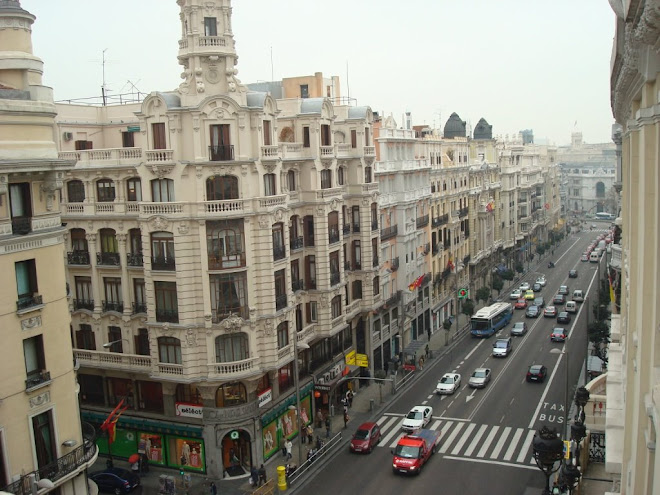
Not far from my apartment in 2002-2003
A Resource for All of Profe Nick's Spanish Students in Washington

Si tuviera un millón de dólares.... (If I had a million dollars....) [Cool, but not for free]
- Comcast "Selecto Pack"
Archivo del blog
-
►
2010
(148)
- ► septiembre (20)
-
▼
2009
(164)
- ► septiembre (18)
-
▼
febrero
(18)
- viernes, el veintisiete de febrero del dos mil nueve
- jueves, el veintiséis de febrero del dos mil nueve
- miércoles, el veinticinco de febrero del dos mil n...
- martes, el veinticuatro de febrero del dos mil nueve
- lunes, el veintitrés de febrero del dos mil nueve
- viernes, el veinte de febrero del dos mil nueve
- jueves, el diecinueve de febrero del dos mil nueve
- miércoles, el dieciocho de febrero del dos mil nueve
- viernes, el trece de febrero del dos mil nueve
- jueves, el doce de febrero del dos mil nueve
- miércoles, el once de febrero del dos mil nueve
- martes, el diez de febrero del dos mil nueve
- lunes, el nueve de febrero del dos mil nueve
- viernes, el seis de febrero del dos mil nueve
- jueves, el cinco de febrero del dos mil nueve
- miércoles, el cuatro de febrero del dos mil nueve
- martes, el tres de febrero del dos mil nueve
- lunes, el dos de febrero del dos mil nueve
Spanish Is All Around Us...Have You Considered...?
- -- Peeking at the Spanish Directions of a Purchased Household Item/Appliance and Trying to Make Sense of Some of It
- -- Setting Your TV to Spanish and Navigating It...Ask For Permission First
- -- Setting Your Cell Phone to Spanish and Navigating It
- -- Purchasing Food from the "Hispanic Foods" Supermarket Aisle and Following the Cooking Directions in Spanish
- -- Subscribing to "People en español" o "National Geographic en español"
- -- Checking out Spanish Children's Books at the Local Library
- -- Perusing a Free Spanish Newspaper from a Store Specializing in Latin American Groceries
- -- Using the Grocery Store Self Check-Out in Spanish
- -- Installing iTunes in Spanish
Spanish Study Links
Local Spanish Resources
- Univisión -- Canal 29 en la Tele en "el Eastside"
- "Día de los Muertos" Festival -- November 1-2, 2008 -- Seattle Center
- "Seattle Fiestas Patrias" Festival -- September 13-14, 2008 -- Seattle Center
- KWMG "La Magia" -- 1210 AM -- A Fusion of International Spanish
- KKMO "Radio Sol" -- 1360 AM -- Regional Mexican Music
- KXPA "La Buena" -- 1540 AM -- 88 hrs. Spanish Programming Weekly
- KDOW "La Jefa" -- 1680 AM -- Spanish Coverage of Seattle Sounders and Seattle Mariners Games
- KDDS "La Gran D" -- Radio 99.3 FM -- Modeled After Mexican Radio
Authentic Spanish Sources
Spanish Entertainment Links
Datos personales

- Señora Nick
- Any questions about the content of this blog should be directed via email to Profe Nick, not the Issaquah School District.
Madrid: Calle Gran Vía
Not far from my apartment in 2002-2003