Español Uno (1):
Today's Learning Objectives:
1. Do our "para empezar" ("in order to begin") warm-up:
**When writing in Spanish class, there are two important things to keep in mind: 1) When possible, write in complete sentences. 2) If you're stuck, use the vocabulary in a question to help you write your answer.
Escribe tus respuestas (your answers) en español.
¿Cómo estás hoy? [Answer: Estoy bien/contento/enferma /triste....]
¿Dónde estás? [Answer: Estoy en la clase de español/en PCFC/en Issaquah....]
¿Cómo eres? [Answer: Soy impaciente / generoso / amable....]
¿Cuál es la fecha de hoy? [Answer: Hoy es el veintidós de octubre.]
¿Qué tiempo hace? [Answer: Hace sol / mal tiempo / buen tiempo / fresco....]
¿A qué hora empieza la clase? [Answer: La clase empieza a las once y veinte.]
2. Practice our numbers. Can you numerically write the following numbers without hearing their pronunciation?
Práctica con los números:
cuarenta y seis [Answer: 46]
noventa y ocho [Answer: 98]
ciento veintiuno [Answer: 121]
ciento y cinquenta [Answer: 150]
treinta y siete [Answer: 37]
ciento once [Answer: 111]
ochenta y dos [Answer: 82]
sesenta y cinco [Answer: 65]
setenta y cuatro [Answer: 74]
cien [Answer: 100]
3. Listen to our song of the week: "Colores, colores."
4. Practice our gestures.
5. Read a bit more in Pobre Ana.
New words (2nd period only):
--manzana (apple)
--ropa (clothes)
Homework: Practice your numbers with your mini number flashcards.
Español Dos (2):
Today's Learning Objectives:
1. Do our "para empezar" ("in order to begin") warm-up:
Escribe “la canción de yo”
me caigo, conozco, digo, doy
hago, pongo, salgo, soy
tengo, traigo, vengo, veo
oigo, sigo, sé, voy, estoy
2. Briefly become introduced to "verbos reflexivos" ("reflexive verbs"). First translate the following sentences.
¿Cómo se dice…?
--Me llamo John. [I call myself John.]
--¿Cómo te llamas? [How do you call yourself?]
--Se llama George. [He calls himself George.]
--Se llaman Ana y Miguel. [They call themselves Ana and Miguel.]
--Nos llamamos “The Beatles.” [We call ourselves “The Beatles.”]
**You have already had exposure to "reflexive verbs." In addition to what's above, you've also seen se levanta, se sienta, se cae, se pone triste....
**All that is distinct with "reflexive verbs" is that we use a "reflexive pronoun" (me, te, se, nos, se) with the action to communicate "-self."
_____me llamo__________nos llamamos_______
_____te llamas____________________________
_____se llama___________se llaman__________
**Reflexive verbs exist in English, too. Here are some you were able to come up with: to sit oneself down, to stand oneself up, to wake oneself up, to look at oneself, to dress oneself, to shower oneself, to brush oneself, to talk to oneself, to see oneself, to hear oneself, to grab oneself, to wash oneself
3. Listen to our song of the week, "Colores, colores."
4. Read yesterday's class-created stories from the other class periods. Which was your favorite?
5. Quickly hear our class-created story again. Good job giving me choral responses to all my questions!
Homework: None.
skip to main |
skip to sidebar

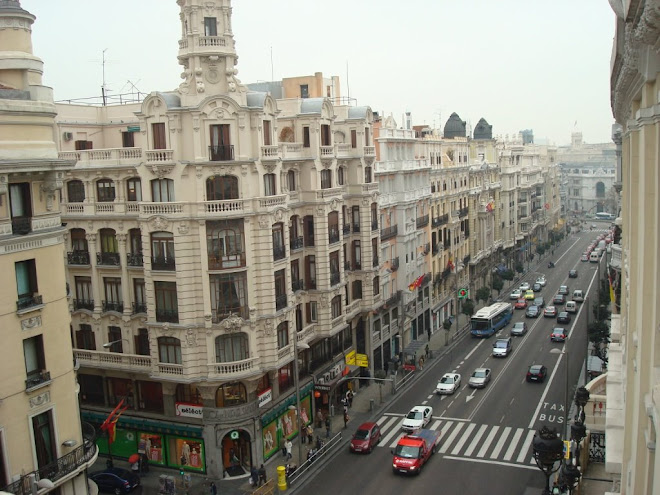
Not far from my apartment in 2002-2003
A Resource for All of Profe Nick's Spanish Students in Washington

Si tuviera un millón de dólares.... (If I had a million dollars....) [Cool, but not for free]
- Comcast "Selecto Pack"
Archivo del blog
-
►
2010
(148)
- ► septiembre (20)
-
►
2009
(164)
- ► septiembre (18)
-
▼
2008
(72)
-
▼
octubre
(23)
- viernes, el treinta y uno de octubre del dos mil ocho
- jueves, el treinta de octubre del dos mil ocho
- jueves, el veintinueve de octubre del dos mil ocho
- martes, el veintiocho de octubre del dos mil ocho
- lunes, el veintisiete de octubre
- viernes, el veinticuatro de octubre del dos mil ocho
- jueves, el veintitrés de octubre del dos mil ocho
- miércoles, el veintidós de octubre del dos mil ocho
- martes, el veintiuno de octubre del dos mil ocho
- lunes, el veinte de octubre del dos mil ocho
- viernes, el diecisiete de octubre del dos mil ocho
- jueves, el dieciséis de octubre del dos mil ocho
- miércoles, el quince de octubre del dos mil ocho
- martes, el catorce de octubre del dos mil ocho
- lunes, el trece de octubre del dos mil ocho
- viernes, el diez de octubre del dos mil ocho
- jueves, el nueve de octubre de dos mil ocho
- miércoles, el ocho de octubre del dos mil ocho
- martes, el siete de octubre del dos mil ocho
- lunes, el seis de octubre del dos mil ocho
- viernes, el tres de octubre del dos mil ocho
- jueves, el dos de octubre del dos mil ocho
- miércoles, el primero de octubre del dos mil ocho
- ► septiembre (20)
-
▼
octubre
(23)
Spanish Is All Around Us...Have You Considered...?
- -- Peeking at the Spanish Directions of a Purchased Household Item/Appliance and Trying to Make Sense of Some of It
- -- Setting Your TV to Spanish and Navigating It...Ask For Permission First
- -- Setting Your Cell Phone to Spanish and Navigating It
- -- Purchasing Food from the "Hispanic Foods" Supermarket Aisle and Following the Cooking Directions in Spanish
- -- Subscribing to "People en español" o "National Geographic en español"
- -- Checking out Spanish Children's Books at the Local Library
- -- Perusing a Free Spanish Newspaper from a Store Specializing in Latin American Groceries
- -- Using the Grocery Store Self Check-Out in Spanish
- -- Installing iTunes in Spanish
Spanish Study Links
Local Spanish Resources
- Univisión -- Canal 29 en la Tele en "el Eastside"
- "Día de los Muertos" Festival -- November 1-2, 2008 -- Seattle Center
- "Seattle Fiestas Patrias" Festival -- September 13-14, 2008 -- Seattle Center
- KWMG "La Magia" -- 1210 AM -- A Fusion of International Spanish
- KKMO "Radio Sol" -- 1360 AM -- Regional Mexican Music
- KXPA "La Buena" -- 1540 AM -- 88 hrs. Spanish Programming Weekly
- KDOW "La Jefa" -- 1680 AM -- Spanish Coverage of Seattle Sounders and Seattle Mariners Games
- KDDS "La Gran D" -- Radio 99.3 FM -- Modeled After Mexican Radio
Authentic Spanish Sources
Spanish Entertainment Links
Datos personales

- Señora Nick
- Any questions about the content of this blog should be directed via email to Profe Nick, not the Issaquah School District.
Madrid: Calle Gran Vía
Not far from my apartment in 2002-2003