Español Uno (1):
Today's Learning Objectives:
1. Practice spelling unfamiliar words in Spanish, keeping in mind what we know about the following letters: a, e, i, o, u, rr, ñ. Additionally, we learned today that we'll rarely see w or k in Spanish, as they're only in words borrowed from other languages.
--tram-po-lín
--muñ-e-cas
--am-bu-lan-cie-ro
--ca-rre-te-ra
--me-di-ca-men-to
2. Practice writing some of our numbers. Can you look at the numerical representation and write the Spanish? If this is tough, use your number flashcards!
--58 [Answer: cinquenta y ocho]
--62 [Answer: sesenta y dos]
--100 [Answer: cien]
--49 [Answer: cuarenta y nueve]
--37 [Answer: treinta y siete]
3. Listen to our song of the week: "Colores, colores"
4. Practice our old gestures and learn some new gestures.
New gestures:
Son las dos y media. (It’s two and a half hour)
la clase de ciencias (science class)
Es difícil. (It's difficult.)
termina (s/he/it finishes/ends)
Son las dos y cuarto. (It’s two and a quarter.)
la clase de educación física (P.E. class)
la clase de ciencias de la salud (health class)
Es para mí. (It’s for me.)
Es para ti. (It’s for you.)
enseña (s/he teaches)
usa la calculadora (s/he uses the calculator)
rompe los lápices (s/he breaks the pencils.)
5. Read a bit more in Pobre Ana.
New words:
Ayúdame. (Help me.)
se ríe (s/he laughs)
nunca (never)
toma la camisa (s/he takes the shirt)
lleva (s/he wears)
después de las clases (after school)
su dormitorio (her bedroom)
6. Begin the homework: workbook pages 2-1 and 2-3, ALL translated to English as well.
Homework: 2-1 & 2-3, ALL additionally translated to English.
Español Dos (2):
Today's Learning Objectives:
1. Do our "para empezar" warm-up.
¿Cómo se dice s/he was going to….? [Answer: iba a ___r]
¿Cómo se dice I was going to….? [Answer: iba a ___r]
Yes, the forms are the same. To clarify, you’d just add in yo or ella if it was unclear.
What do all the forms look like?
_____iba__________íbamos_____
_____ibas___________________
_____iba__________iban_______
Escribe cinco excusas creativas para explicarme por qué no hiciste la tarea.
Las excusas mejores:
--Iba a hacer la tarea pero mi casa explotó (exploded).
--Iba a hacer la tarea pero estoy muerta (dead).
--Iba a hacer la tarea pero mi tarea se levantó y anduvo al parque.
--Iba a hacer la tarea pero la tarea trató de (tried to) comerme.
--Iba a hacer la tarea pero mi hermano la usó en vez del (instead of) papel higiénico (toilet paper).
--Iba a hacer la tarea pero un ladrón (thief) me la robó.
--Iba a hacer la tarea pero mi madre tenía hambre y la comió.
--Iba a hacer la tarea pero mi perro la comió, y mi gato comió el perro, y mi hermano comió el gato.
--Iba a hacer la tarea pero la tarea se me cayó en el inodoro (toilet).
2. Practice regular verb endings (present & preterite) from last year. It is an expectation that you are 100% confident with the regular verb endings from last year. If not, you need to have those regular endings memorized ASAP.
**Remember, there's a LOT of meaning in those endings. One single letter can often tell you both who did an action and when the action happened.
HABLAR___(presente)_______
hablo.............. hablamos
hablas
habla.............. hablan
HABLAR___(pretérito)_______
hablé............. hablamos
hablaste
habló............. hablaron
COMER___(presente)________
como............. comemos
comes
come............. comen
COMER___(pretérito)________
comí.............. comimos
comiste
comió............ comieron
3. Listen to our song of the week: "Colores, colores"
4. Learn some new gestures with reflexive verbs.
New gestures:
se baña (s/he bathes him/herself)
se lava la cara (s/he washes his/her face)
se seca el pelo (s/he dries his/her hair)
se cepilla los dientes (s/he brushes his/her teeth)
se acuesta tarde (s/he goes him/herself to sleep late)
Write new gestures down.
5. Spend the last few minutes of class working on conjugating six regular verbs in both the present and past. (tomar, arreglar, cocinar, vivir, subir, escribir)
Homework: Finish your regular verb practice for tomorrow.
skip to main |
skip to sidebar

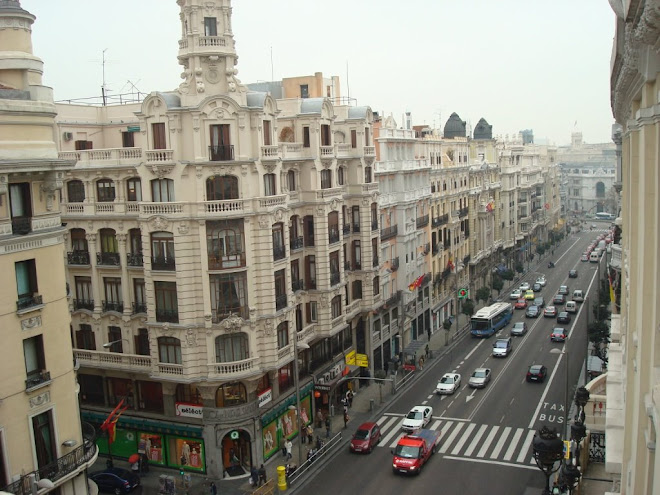
Not far from my apartment in 2002-2003
A Resource for All of Profe Nick's Spanish Students in Washington

Si tuviera un millón de dólares.... (If I had a million dollars....) [Cool, but not for free]
- Comcast "Selecto Pack"
Archivo del blog
-
►
2010
(148)
- ► septiembre (20)
-
►
2009
(164)
- ► septiembre (18)
-
▼
2008
(72)
-
▼
octubre
(23)
- viernes, el treinta y uno de octubre del dos mil ocho
- jueves, el treinta de octubre del dos mil ocho
- jueves, el veintinueve de octubre del dos mil ocho
- martes, el veintiocho de octubre del dos mil ocho
- lunes, el veintisiete de octubre
- viernes, el veinticuatro de octubre del dos mil ocho
- jueves, el veintitrés de octubre del dos mil ocho
- miércoles, el veintidós de octubre del dos mil ocho
- martes, el veintiuno de octubre del dos mil ocho
- lunes, el veinte de octubre del dos mil ocho
- viernes, el diecisiete de octubre del dos mil ocho
- jueves, el dieciséis de octubre del dos mil ocho
- miércoles, el quince de octubre del dos mil ocho
- martes, el catorce de octubre del dos mil ocho
- lunes, el trece de octubre del dos mil ocho
- viernes, el diez de octubre del dos mil ocho
- jueves, el nueve de octubre de dos mil ocho
- miércoles, el ocho de octubre del dos mil ocho
- martes, el siete de octubre del dos mil ocho
- lunes, el seis de octubre del dos mil ocho
- viernes, el tres de octubre del dos mil ocho
- jueves, el dos de octubre del dos mil ocho
- miércoles, el primero de octubre del dos mil ocho
- ► septiembre (20)
-
▼
octubre
(23)
Spanish Is All Around Us...Have You Considered...?
- -- Peeking at the Spanish Directions of a Purchased Household Item/Appliance and Trying to Make Sense of Some of It
- -- Setting Your TV to Spanish and Navigating It...Ask For Permission First
- -- Setting Your Cell Phone to Spanish and Navigating It
- -- Purchasing Food from the "Hispanic Foods" Supermarket Aisle and Following the Cooking Directions in Spanish
- -- Subscribing to "People en español" o "National Geographic en español"
- -- Checking out Spanish Children's Books at the Local Library
- -- Perusing a Free Spanish Newspaper from a Store Specializing in Latin American Groceries
- -- Using the Grocery Store Self Check-Out in Spanish
- -- Installing iTunes in Spanish
Spanish Study Links
Local Spanish Resources
- Univisión -- Canal 29 en la Tele en "el Eastside"
- "Día de los Muertos" Festival -- November 1-2, 2008 -- Seattle Center
- "Seattle Fiestas Patrias" Festival -- September 13-14, 2008 -- Seattle Center
- KWMG "La Magia" -- 1210 AM -- A Fusion of International Spanish
- KKMO "Radio Sol" -- 1360 AM -- Regional Mexican Music
- KXPA "La Buena" -- 1540 AM -- 88 hrs. Spanish Programming Weekly
- KDOW "La Jefa" -- 1680 AM -- Spanish Coverage of Seattle Sounders and Seattle Mariners Games
- KDDS "La Gran D" -- Radio 99.3 FM -- Modeled After Mexican Radio
Authentic Spanish Sources
Spanish Entertainment Links
Datos personales

- Señora Nick
- Any questions about the content of this blog should be directed via email to Profe Nick, not the Issaquah School District.
Madrid: Calle Gran Vía
Not far from my apartment in 2002-2003