Español Uno (1):
Today’s Agenda:
1. Receive the final exams and review them.
2. Listen to our song of the week: “Bonito.” Nice job catching the last three missing phrases: el fin, escucha, da.
3. Write more precise cultural notes for yesterday’s discussion about the pronunciation difference (distinción) that we hear the song "Bonito," and in many parts of Spain. If you were absent, please copy a neighbor’s notes upon returning.
4. Finish defining most of our chapter 6 vocabulary.
5. Establish gestures for:
--la falda larga
--los pantalones cortos
--trabaja en una tienda
--recibe
--está de moda
6. Begin the homework.
Homework: 6-1 & 6-2 in the workbook.
Español Dos (2):
Today’s Agenda:
1. Practice applying accents to unfamiliar words based upon our current (and still incomplete, just to be clear) knowledge of accent rules:
ACCENT RULES
--90% of the time, accents are used to tell us where to “punch” the word. They help us pronounce a word correctly! This makes pronouncing new words in Spanish very easy for us.
--10% of the time accents are used to distinguish a different meaning of a word pronounced the same way (él/el, sólo/solo, sí/si, etc.)
--You must HEAR a word to know whether an accent is needed or not.
--Any words ending in a vowel, n or s have the natural stress on the 2nd to last syllable. If the word doesn’t follow this rule, we MUST write in an accent mark where we hear the stress / “punch.”
--Any words ending in a different letter have the natural stress on the last syllable. If the word doesn’t follow this rule, we MUST write in an accent mark where we hear the stress / “punch.”
--A dipthong is the combination of a “weak” vowel (i, u) with a “strong” vowel (a, e, o) to make just ONE SOUND. A dipthong is also the combination of two “weak vowels” (i, u) to make just ONE SOUND. Examples include: “ciu/dad,” “bai/le,” “fuer/te,” & “es/tu/dian.”
2. Listen to our song of the week: “Desde que llegaste.” Nice job catching the last three missing phrases: palabras, desde, despertarme.
3. Use our blue, imperfect packet to practice writing some imperfect & preterite verbs. First decide whether it communicates something in the preterite (over-with ACTION) or the imperfect (DESCRIPTION in the past).
--I was jumping……………..[imperfecto]………………….saltaba
--he jumped…………………..[pretérito]……………………..saltó
--we were listening………...[imperfecto]………………….escuchábamos
--they used to listen……….[imperfecto]………………….escuchaban
--you bought………………….[pretérito]……………………..compraste
--you would buy (past)…...[imperfecto]………………….comprabas
--y’all found……………………[pretérito]…………………….encontraron
4. Review yesterday’s homework: 5-7 & 5-8.
5. Begin the homework.
Homework: 5-9 #1 (EVERYTHING translated).
skip to main |
skip to sidebar

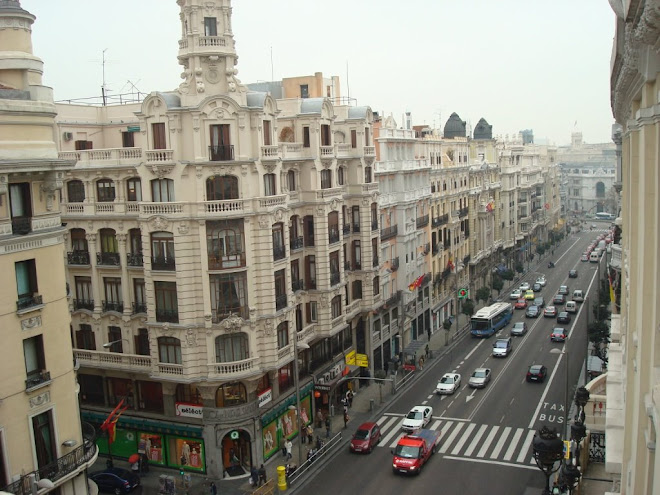
Not far from my apartment in 2002-2003
A Resource for All of Profe Nick's Spanish Students in Washington

Si tuviera un millón de dólares.... (If I had a million dollars....) [Cool, but not for free]
- Comcast "Selecto Pack"
Archivo del blog
-
▼
2010
(148)
- ► septiembre (20)
-
▼
enero
(16)
- viernes, el veintinueve de enero del dos mil diez
- jueves, el veintiocho de enero del dos mil diez
- miércoles, el veintisiete de enero del dos mil diez
- martes, el veintiséis de enero del dos mil diez
- lunes, el veinticinco de enero del dos mil diez
- martes, el diecinueve de enero del dos mil diez
- viernes, el quince de enero del dos mil diez
- jueves, el catorce de enero del dos mil diez
- miércoles, el trece de enero del dos mil diez
- martes, el doce de enero del dos mil diez
- lunes, el once de enero del dos mil diez
- viernes, el ocho de enero del dos mil diez
- jueves, el siete de enero del dos mil diez
- miércoles, el seis de enero del dos mil diez
- martes, el cinco de diciembre del dos mil diez
- lunes, el cuatro de enero del dos mil diez
-
►
2009
(164)
- ► septiembre (18)
Spanish Is All Around Us...Have You Considered...?
- -- Peeking at the Spanish Directions of a Purchased Household Item/Appliance and Trying to Make Sense of Some of It
- -- Setting Your TV to Spanish and Navigating It...Ask For Permission First
- -- Setting Your Cell Phone to Spanish and Navigating It
- -- Purchasing Food from the "Hispanic Foods" Supermarket Aisle and Following the Cooking Directions in Spanish
- -- Subscribing to "People en español" o "National Geographic en español"
- -- Checking out Spanish Children's Books at the Local Library
- -- Perusing a Free Spanish Newspaper from a Store Specializing in Latin American Groceries
- -- Using the Grocery Store Self Check-Out in Spanish
- -- Installing iTunes in Spanish
Spanish Study Links
Local Spanish Resources
- Univisión -- Canal 29 en la Tele en "el Eastside"
- "Día de los Muertos" Festival -- November 1-2, 2008 -- Seattle Center
- "Seattle Fiestas Patrias" Festival -- September 13-14, 2008 -- Seattle Center
- KWMG "La Magia" -- 1210 AM -- A Fusion of International Spanish
- KKMO "Radio Sol" -- 1360 AM -- Regional Mexican Music
- KXPA "La Buena" -- 1540 AM -- 88 hrs. Spanish Programming Weekly
- KDOW "La Jefa" -- 1680 AM -- Spanish Coverage of Seattle Sounders and Seattle Mariners Games
- KDDS "La Gran D" -- Radio 99.3 FM -- Modeled After Mexican Radio
Authentic Spanish Sources
Spanish Entertainment Links
Datos personales

- Señora Nick
- Any questions about the content of this blog should be directed via email to Profe Nick, not the Issaquah School District.
Madrid: Calle Gran Vía
Not far from my apartment in 2002-2003