Español Uno (1):
Today’s Learning Objectives:
1. Discuss “El Día de los Santos Inocentes”…Spain’s “April Fools’ Day,” which falls on Dec. 28th.
2. Practice pronouncing words in Spanish with “ge” (gemelas, gente, generación, etc.) and “ce” (calcetín, cero, cena, cereal, etc.) Discussion of the H sound in “ge” and the S sound in “ce” and how these sounds cause a small issue for some preterite verbs.
3. Fill out the “-CAR, -GAR, -ZAR” section of our new blue preterite verb packet.
With a partner, brainstorm any -CAR, -GAR, -ZAR verbs that we have already learned.
(empezar, jugar, apagar, pagar, tocar, sacar, buscar, practicar)
Write in the special “yo” endings for the -CAR, -GAR, -ZAR verbs:
-CAR
qué…………….amos
aste………………….
ó………………aron
(busqué, practiqué, saqué, toqué)
-GAR
gué……………amos
aste…………………
ó………………aron
(jugué, pagué, apagué)
-ZAR
cé……………..amos
aste………………..
ó………………aron
(empecé)
4. Listen to our new song of the week: “Perdido sin ti” by Menudo
5. Tackle listening activity 7.3 from Paso a paso.
6. Begin the homework
Homework: 7-5 & 7-6 in the workbook (with everything additionally translated)
Español Dos (2):
Today’s Learning Objectives:
1. Discuss some picky details regarding ser & estar.
--While we use estar for emotions, there is one exception. With feliz (happy), it is perfectly correct to say “es feliz” (or “está feliz”).
--While we use estar for location, there is one exception. For the location of events we use ser, as in “¿Dónde es el baile?”
2. Quick practice with ser & estar. Which is needed: ¿es o está?
3. Listen to our new song of the week: “Perdido sin ti” by Menudo.
4. Practice choosing between the preterite and the imperfect with a Curious George story.
Homework: If you did not finish the Curious George story, do so for tomorrow.
skip to main |
skip to sidebar

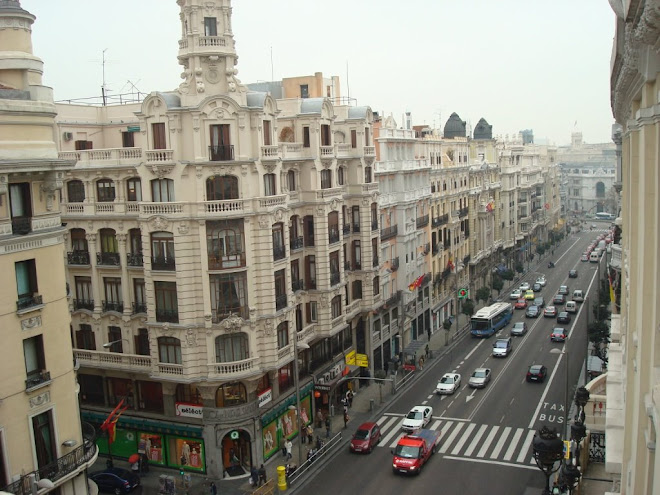
Not far from my apartment in 2002-2003
A Resource for All of Profe Nick's Spanish Students in Washington

Si tuviera un millón de dólares.... (If I had a million dollars....) [Cool, but not for free]
- Comcast "Selecto Pack"
Archivo del blog
-
►
2010
(148)
- ► septiembre (20)
-
▼
2009
(164)
- ► septiembre (18)
-
▼
abril
(16)
- miércoles, el veintinueve de abril del dos mil nueve
- martes, el veintiocho de abril del dos mil nueve
- lunes, el veintisiete de abril del dos mil nueve
- viernes, el veinticuatro de abril del dos mil nueve
- jueves, el veintitrés de abril del dos mil nueve
- miércoles, el veintidós de abril del dos mil nueve
- martes, el veintiuno de abril del dos mil nueve
- lunes, el veinte de abril del dos mil nueve
- viernes, el diecisiete de abril del dos mil nueve
- jueves, el dieciséis de abril del dos mil nueve
- miércoles, el quince de abril del dos mil nueve
- martes, el catorce de abril de dos mil nueve
- lunes, el trece de abril del dos mil nueve
- viernes, el tres de abril del dos mil nueve
- jueves, el dos de abril del dos mil nueve
- miércoles, el primero de abril del dos mil nueve
Spanish Is All Around Us...Have You Considered...?
- -- Peeking at the Spanish Directions of a Purchased Household Item/Appliance and Trying to Make Sense of Some of It
- -- Setting Your TV to Spanish and Navigating It...Ask For Permission First
- -- Setting Your Cell Phone to Spanish and Navigating It
- -- Purchasing Food from the "Hispanic Foods" Supermarket Aisle and Following the Cooking Directions in Spanish
- -- Subscribing to "People en español" o "National Geographic en español"
- -- Checking out Spanish Children's Books at the Local Library
- -- Perusing a Free Spanish Newspaper from a Store Specializing in Latin American Groceries
- -- Using the Grocery Store Self Check-Out in Spanish
- -- Installing iTunes in Spanish
Spanish Study Links
Local Spanish Resources
- Univisión -- Canal 29 en la Tele en "el Eastside"
- "Día de los Muertos" Festival -- November 1-2, 2008 -- Seattle Center
- "Seattle Fiestas Patrias" Festival -- September 13-14, 2008 -- Seattle Center
- KWMG "La Magia" -- 1210 AM -- A Fusion of International Spanish
- KKMO "Radio Sol" -- 1360 AM -- Regional Mexican Music
- KXPA "La Buena" -- 1540 AM -- 88 hrs. Spanish Programming Weekly
- KDOW "La Jefa" -- 1680 AM -- Spanish Coverage of Seattle Sounders and Seattle Mariners Games
- KDDS "La Gran D" -- Radio 99.3 FM -- Modeled After Mexican Radio
Authentic Spanish Sources
Spanish Entertainment Links
Datos personales

- Señora Nick
- Any questions about the content of this blog should be directed via email to Profe Nick, not the Issaquah School District.
Madrid: Calle Gran Vía
Not far from my apartment in 2002-2003