Español Uno (1):
Announcement: Classes shortened to 50 minutes due to Stanford testing.
Today’s Agenda:
1. Practice “this/these/that/those.” Remember, there’s NO shame in repeating our refrain to help you get the correct form!
Refrain: “This” & “these” have t’s; “that” & “those” don’t.
this……..este/esta
these…..estos/estas…..(estes is NOT a form!)
that…….ese/esa
those ….esos/esas………(eses is NOT a form!)
¿Cómo se dice…?
--these girls……………………………estas muchachas
--those dresses……………………….esos vestidos
--this shoe……………………………...este zapato
--that sweater………………………..ese suéter
--these socks………………………….estos calcetines
2. Listen to our song of the week: “Geografía.” Nice job catching the first four missing words: me gustaría, para mí, mil & nunca.
3. Rewrite the story of “Ana” in the past, using only our artwork and our list of 15 high-frequency verbs in the past:
Writing a 100+ word story in the past will form the basis of our second semester writing assessments. The difference is that you will not be able to use the list of verbs…you’ll have to know them by that point!
Homework: Using only your pictures and the list above of 15 verbs in the past, retell the story of “Ana” to an adult. Have them sign to confirm that you retold the story in your best Spanish aloud. (You are NOT just reading the Spanish from the story!)
Español Dos (2):
Announcement: Classes shortened to 50 minutes due to Stanford testing.
Today’s Agenda:
1. Tackle 6-5 in the workbook (preterite “sandal” verbs).
2. Listen to our new song of the week: “Volveré junto a ti.” Nice job catching the first three missing phrases: elegir, me fui, de nuevo.
Cultural note: Quick discussion about the subtle pronunciation difference in this song! Distinción is the term used to describe the “th” sound you heard for ce, ci, and z. This pronunciation difference (distinción) is typical of Spanish speakers from Spain. It is not used in Latin America. Careful not to term it a lisp!!! It is technically not a lisp (it is intentional, and the th does not apply to s sounds). It is sometimes considered offensive if distinción is termed a lisp.
3. Take a grammar assessment over 1) imperfect endings, 2) stem-changing preterite verbs, 3) irregular preterite verbs & 4) irregular present tense verbs.
Homework: If you haven’t already made flashcards for chapter 6, consider doing so!
skip to main |
skip to sidebar

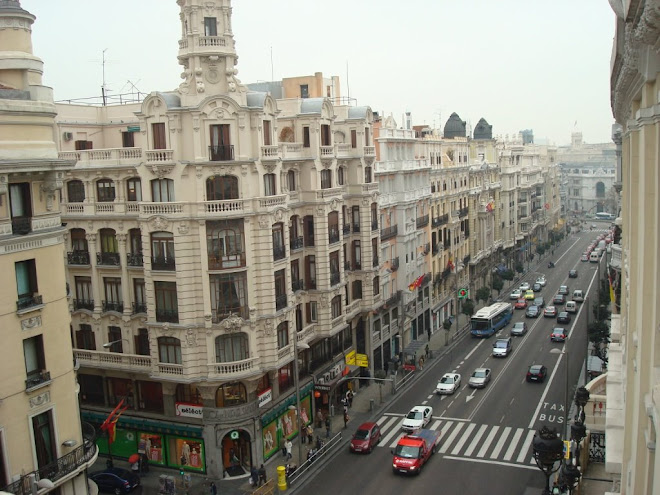
Not far from my apartment in 2002-2003
A Resource for All of Profe Nick's Spanish Students in Washington

Si tuviera un millón de dólares.... (If I had a million dollars....) [Cool, but not for free]
- Comcast "Selecto Pack"
Archivo del blog
-
▼
2010
(148)
- ► septiembre (20)
-
▼
febrero
(15)
- viernes, el veintiséis de febrero del dos mil diez
- jueves, el veinticinco de febrero del dos mil diez
- miércoles, el veinticuatro de febrero del dos mil ...
- martes, el veintitrés de febrero del dos mil diez
- lunes, el veintidós de febrero del dos mil diez
- viernes, el doce de febrero del dos mil diez
- jueves, el once de febrero del dos mil diez
- miércoles, el diez de febrero del dos mil diez
- martes, el nueve de febrero del dos mil diez
- lunes, el ocho de febrero del dos mil diez
- viernes, el cinco de febrero del dos mil diez
- jueves, el cuatro de febrero del dos mil diez
- miércoles, el tres de febrero del dos mil diez
- martes, el dos de febrero del dos mil diez
- lunes, el primero de febrero del dos mil diez
-
►
2009
(164)
- ► septiembre (18)
Spanish Is All Around Us...Have You Considered...?
- -- Peeking at the Spanish Directions of a Purchased Household Item/Appliance and Trying to Make Sense of Some of It
- -- Setting Your TV to Spanish and Navigating It...Ask For Permission First
- -- Setting Your Cell Phone to Spanish and Navigating It
- -- Purchasing Food from the "Hispanic Foods" Supermarket Aisle and Following the Cooking Directions in Spanish
- -- Subscribing to "People en español" o "National Geographic en español"
- -- Checking out Spanish Children's Books at the Local Library
- -- Perusing a Free Spanish Newspaper from a Store Specializing in Latin American Groceries
- -- Using the Grocery Store Self Check-Out in Spanish
- -- Installing iTunes in Spanish
Spanish Study Links
Local Spanish Resources
- Univisión -- Canal 29 en la Tele en "el Eastside"
- "Día de los Muertos" Festival -- November 1-2, 2008 -- Seattle Center
- "Seattle Fiestas Patrias" Festival -- September 13-14, 2008 -- Seattle Center
- KWMG "La Magia" -- 1210 AM -- A Fusion of International Spanish
- KKMO "Radio Sol" -- 1360 AM -- Regional Mexican Music
- KXPA "La Buena" -- 1540 AM -- 88 hrs. Spanish Programming Weekly
- KDOW "La Jefa" -- 1680 AM -- Spanish Coverage of Seattle Sounders and Seattle Mariners Games
- KDDS "La Gran D" -- Radio 99.3 FM -- Modeled After Mexican Radio
Authentic Spanish Sources
Spanish Entertainment Links
Datos personales

- Señora Nick
- Any questions about the content of this blog should be directed via email to Profe Nick, not the Issaquah School District.
Madrid: Calle Gran Vía
Not far from my apartment in 2002-2003