Español Uno (1):
Announcement: Classes shortened to 49 minutes due to 10th grade registration presentations.
Today’s Agenda:
1. Read, in Spanish, for nine minutes during SSR.
2. Discuss what we did over the Mid-Winter Break, answering some of our fundamental questions, as well as a new one:
¿Qué hiciste para divertirte?.................What did you do in order to have fun?
……….Para divertirme………………………….In order to have fun (I)….
¿Qué querías hacer que no pudiste hacer?
¿Qué tuviste que hacer?
3. Describe the clothing of an Argentinean family pictured in a photo displayed.
Homework: If you haven’t yet made flaschcards for chapter 6, consider doing so! We will be moving into chapter seven next week.
Español Dos (2):
Announcement: Classes shortened to 49 minutes due to 10th grade registration.
Today’s Agenda:
1. (all but 5th due to the fire drill): Read, in Spanish, for ten minutes during SSR.
2. Discuss what we did over Mid-Winter Break, answering the following fundamental questions:
--¿Qué hiciste para divertirte?
------Para divertirme, (yo)….
--¿Qué querías hacer que no pudiste hacer?
--¿Qué tuviste que hacer?
3. Practice choosing whether unfamiliar words in Spanish need accent marks, based upon Profe Nick's pronunciation and our knowledge of accent rules.
Accent Rules:
--You can only know if a word needs an accent if you’ve heard the word pronounced.
-- If a word ends in a vowel, n or s, the natural stress (no accent needed) goes on the second to last syllable.
--If a word ends in any other letter, the natural stress (no accent needed) goes on the last syllable.
--When dividing a word into its syllables, we have to keep dipthongs (and tripthongs) in mind. A dipthong is when two vowels combine to make one sound. A dipthong happens in either of the two scenarios:
............a. A weak + a weak vowel
............b. A weak + a strong vowel
.......................i. weak vowels = i, u
.......................ii. strong vowels = a, e, o
.............c. A tripthong is when three vowels combine (two weak and a strong or three weak)
--(NEW INFORMATION) If you want to separate a dipthong (or tripthong), you write in an accent. For instance, if the word agua (a-gua) were supposed to be pronounced (a-gu-a), we’d write in an accent (agúa). (Clearly that’s NOT how we write the word, but hopefully that example helps.)
Students listened to the words on the left, and decided if an accent was needed.
--valido……………………………válido
--imagen………………………….imagen
--naturaleza……………………..naturaleza
--esquian………………………….esquían
--epoca…………………………….época
--impresionista…………………impresionista
--se gradua………………………se gradúa
--muerta………………………….muerta
--me reuno………………………me reúno
--imaginacion…………………..imaginación
Homework: If you haven’t yet made flaschcards for chapter 6, consider doing so! We will be moving into chapter seven next week.
skip to main |
skip to sidebar

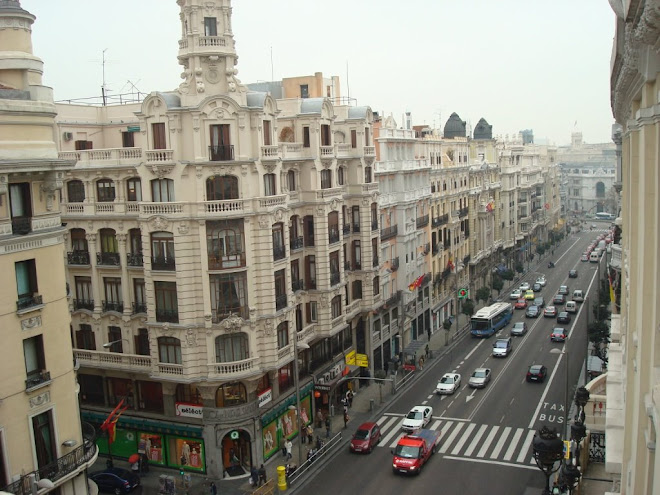
Not far from my apartment in 2002-2003
A Resource for All of Profe Nick's Spanish Students in Washington

Si tuviera un millón de dólares.... (If I had a million dollars....) [Cool, but not for free]
- Comcast "Selecto Pack"
Archivo del blog
-
▼
2010
(148)
- ► septiembre (20)
-
▼
febrero
(15)
- viernes, el veintiséis de febrero del dos mil diez
- jueves, el veinticinco de febrero del dos mil diez
- miércoles, el veinticuatro de febrero del dos mil ...
- martes, el veintitrés de febrero del dos mil diez
- lunes, el veintidós de febrero del dos mil diez
- viernes, el doce de febrero del dos mil diez
- jueves, el once de febrero del dos mil diez
- miércoles, el diez de febrero del dos mil diez
- martes, el nueve de febrero del dos mil diez
- lunes, el ocho de febrero del dos mil diez
- viernes, el cinco de febrero del dos mil diez
- jueves, el cuatro de febrero del dos mil diez
- miércoles, el tres de febrero del dos mil diez
- martes, el dos de febrero del dos mil diez
- lunes, el primero de febrero del dos mil diez
-
►
2009
(164)
- ► septiembre (18)
Spanish Is All Around Us...Have You Considered...?
- -- Peeking at the Spanish Directions of a Purchased Household Item/Appliance and Trying to Make Sense of Some of It
- -- Setting Your TV to Spanish and Navigating It...Ask For Permission First
- -- Setting Your Cell Phone to Spanish and Navigating It
- -- Purchasing Food from the "Hispanic Foods" Supermarket Aisle and Following the Cooking Directions in Spanish
- -- Subscribing to "People en español" o "National Geographic en español"
- -- Checking out Spanish Children's Books at the Local Library
- -- Perusing a Free Spanish Newspaper from a Store Specializing in Latin American Groceries
- -- Using the Grocery Store Self Check-Out in Spanish
- -- Installing iTunes in Spanish
Spanish Study Links
Local Spanish Resources
- Univisión -- Canal 29 en la Tele en "el Eastside"
- "Día de los Muertos" Festival -- November 1-2, 2008 -- Seattle Center
- "Seattle Fiestas Patrias" Festival -- September 13-14, 2008 -- Seattle Center
- KWMG "La Magia" -- 1210 AM -- A Fusion of International Spanish
- KKMO "Radio Sol" -- 1360 AM -- Regional Mexican Music
- KXPA "La Buena" -- 1540 AM -- 88 hrs. Spanish Programming Weekly
- KDOW "La Jefa" -- 1680 AM -- Spanish Coverage of Seattle Sounders and Seattle Mariners Games
- KDDS "La Gran D" -- Radio 99.3 FM -- Modeled After Mexican Radio
Authentic Spanish Sources
Spanish Entertainment Links
Datos personales

- Señora Nick
- Any questions about the content of this blog should be directed via email to Profe Nick, not the Issaquah School District.
Madrid: Calle Gran Vía
Not far from my apartment in 2002-2003