Español Uno (1):
Today’s Agenda:
1. Practice using the correct definite article (“the”) with our food words. How well can you remember whether the following words are masculine or feminine?: pan, cereal, café, té, leche, chocolate, sándwich, arroz, postre, carne, maíz.
Remember: For next Thursday’s vocabulary quiz, you need to be able to write our food/tableware words correctly with their corresponding definite article (“the”).
Remember: El agua doesn’t follow the normal rules. It’s irregular.
2. Discuss food preferences, answering the following question:
--¿Cuál prefieres tomar? (tomar = beber/comer)……Which do you prefer to eat/drink?
------Prefiero tomar ….. ……………….............……………. I prefer to eat/drink ….
------No prefiero tomar ninguna. …………….......……… I don’t prefer to eat/drink either.
Quick self-assessment of the following food words from today’s discussion: la sal, la pimienta, el té helado, los refrescos, el aguacate, el queso, las papas al horno, las cebollas, el jamón, el bistec, los guisantes, las judías verdes, los tomates, los pimientos.
3. Listen to our first song of the week: “Ocho Kandelikas.”
This Hannukah song has some important cultural information up top.
4. Listen to our second song of the week: “Lágrimas.” Nice job catching the first two missing words: canción, fuiste.
5. Practice our spelling in Spanish. You’ll remember that we don’t use K in Spanish (unless it is a word borrowed from another language.)
Nice job guessing how we would spell the following "K" sounds in Spanish:
KA ---> CA
KE ---> QUE
KI ---> QUI
KO ---> CO
KU ---> CU
Nice work spelling the following words.
--ma-ri-qui-ta
--pan-que-ques
--ca-sti-llo
--co-co-dri-lo
--cú-pi-do
6. (2nd period only): Review 4-1 & 4-2 in the workbook.
Homework: Study your food flashcards for next Thursday’s vocabulary quiz.
Español Dos (2):
Today’s Agenda:
1. Review our basic questions: ¿Cómo estabas (ayer)? / ¿Cómo eras (de pequeño/a)? Atop each page, we wrote out the following verb forms:
ESTAR (“was/were”…feeling/location)
estaba………………..estábamos
estabas……………………………….
estaba……………….estaban
SER (“was/were”….physical description, personality description, identity)
era………………………éramos
eras…………………………………
era……………………….eran
2. Build upon our knowledge of “was/were” from activity #1. The forms above are what are technically called the “imperfect tense.” (We’ll learn the rest of the imperfect tense in chapter five, though know that you’ve already learned some other forms, too.)
Chapter four introduces us to the preterite forms of the verbs above. These were copied onto our blue, preterite packet.
ESTAR (“was/were”…feeling/location…BUT IT’S OVER)
estuve……………………estuvimos
estuviste……………………………….
estuvo…………………..estuvieron
Marta estuvo enferma. ………………………(Marta was sick.—but it’s OVER, she’s no longer sick.)
Estuvimos enojados. …………………………..(We were angry.—but it’s OVER, and we’re at peace now.)
SER (“was/were”….physical description, personality description, identity…BUT IT’S OVER)
fui………………………….fuimos
fuiste………………………………..
fue………………………..fueron
Fui astronauta. …………………………………..(I was an astronaut. – but it’s OVER, and I’ve changed careers.)
Jacobo fue miembro del coro. ……………(Jacob was a member of the choir.—but it’s OVER, and he no longer is.)
HABER (“there was / there were”…..BUT IT’S OVER, AS WITH AN EVENT)
X………………………………X
X………………………………..
hubo………………………hubo
Hubo una liquidación en Macy’s. ……….(There was a sale at Macy’s.—but it’s OVER.)
Hubo una fiesta en la casa de Laura. …..(There was a party at Laura’s house.—but it’s OVER.)
3. Listen to our first song of the week: “Ocho Kandelikas.” This Hannukah song has some important cultural information up top.
Listen to our second song of the week: “La historia de Juan.” Nice job catching the first three missing words: Ésta, nadie, fue.
4. Practice our spelling in Spanish. You’ll remember that we don’t use K in Spanish (unless it is a word borrowed from another language.)
Nice job guessing how we would spell the following "K" sounds in Spanish:
KA ---> CA
KE ---> QUE
KI ---> QUI
KO ---> CO
KU ---> CU
Nice work spelling the following words.
--ma-ri-qui-ta
--pan-que-ques
--ca-sti-llo
--co-co-dri-lo
--cú-pi-do
5. Practice our gestures, establishing new gestures for: le presta ____, la fiesta de disfraces, lo atrapa, pega el disco de hockey, el campeón, se quita los patines, se pone el casco.
6. Begin the homework.
Homework: 4-1 & 4-2 in the workbook.
skip to main |
skip to sidebar

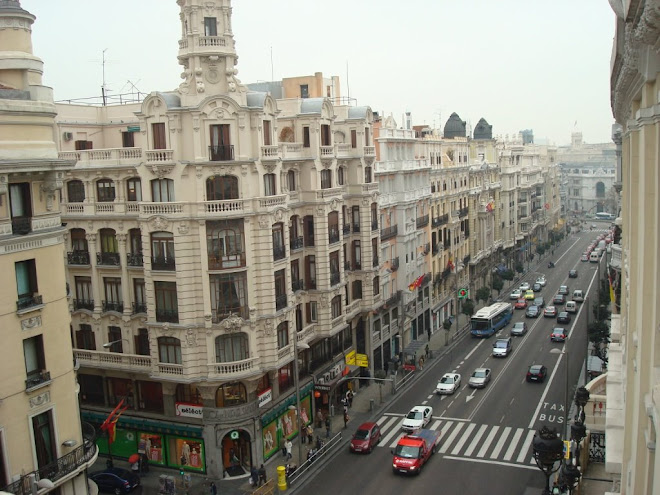
Not far from my apartment in 2002-2003
A Resource for All of Profe Nick's Spanish Students in Washington

Si tuviera un millón de dólares.... (If I had a million dollars....) [Cool, but not for free]
- Comcast "Selecto Pack"
Archivo del blog
-
►
2010
(148)
- ► septiembre (20)
-
▼
2009
(164)
-
▼
diciembre
(14)
- viernes, el dieciocho de diciembre del dos mil nueve
- jueves, el veintisiete de diciembre del dos mil nueve
- miércoles, el dieciséis de diciembre del dos mil n...
- martes, el quince de diciembre del dos mil nueve
- lunes, el catorce de diciembre del dos mil nueve
- viernes, el once de diciembre del dos mil nueve
- jueves, el diez de diciembre del dos mil nueve
- miércoles, el nueve de diciembre del dos mil nueve
- martes, el ocho de diciembre del dos mil nueve
- lunes, el siete de diciembre del dos mil nueve
- viernes, el cuatro de diciembre del dos mil nueve
- jueves, el tres de noviembre del dos mil nueve
- miércoles, el dos de diciembre del dos mil nueve
- martes, el primero de diciembre del dos mil nueve
- ► septiembre (18)
-
▼
diciembre
(14)
Spanish Is All Around Us...Have You Considered...?
- -- Peeking at the Spanish Directions of a Purchased Household Item/Appliance and Trying to Make Sense of Some of It
- -- Setting Your TV to Spanish and Navigating It...Ask For Permission First
- -- Setting Your Cell Phone to Spanish and Navigating It
- -- Purchasing Food from the "Hispanic Foods" Supermarket Aisle and Following the Cooking Directions in Spanish
- -- Subscribing to "People en español" o "National Geographic en español"
- -- Checking out Spanish Children's Books at the Local Library
- -- Perusing a Free Spanish Newspaper from a Store Specializing in Latin American Groceries
- -- Using the Grocery Store Self Check-Out in Spanish
- -- Installing iTunes in Spanish
Spanish Study Links
Local Spanish Resources
- Univisión -- Canal 29 en la Tele en "el Eastside"
- "Día de los Muertos" Festival -- November 1-2, 2008 -- Seattle Center
- "Seattle Fiestas Patrias" Festival -- September 13-14, 2008 -- Seattle Center
- KWMG "La Magia" -- 1210 AM -- A Fusion of International Spanish
- KKMO "Radio Sol" -- 1360 AM -- Regional Mexican Music
- KXPA "La Buena" -- 1540 AM -- 88 hrs. Spanish Programming Weekly
- KDOW "La Jefa" -- 1680 AM -- Spanish Coverage of Seattle Sounders and Seattle Mariners Games
- KDDS "La Gran D" -- Radio 99.3 FM -- Modeled After Mexican Radio
Authentic Spanish Sources
Spanish Entertainment Links
Datos personales

- Señora Nick
- Any questions about the content of this blog should be directed via email to Profe Nick, not the Issaquah School District.
Madrid: Calle Gran Vía
Not far from my apartment in 2002-2003