Español Uno (1):
Today’s Agenda:
1. Practice our spelling of our core numbers 0-50:
--9 + (más) 4 = (son) _______....[trece]
--11 – (menos) 7 = (son) _______....[cuatro]
--20 + 10 = (son) _______....[treinta]
--19 - 5 = (son) _______....[catorce]
--11 - 9 = (son) _______....[dos]
--10 + 5 = (son) _______....[quince]
--50 - 30 = (son) _______....[veinte]
--30 + 20 = (son) _______....[cinquenta]
--10 + 9 = (son) _______....[diecinueve / diez y nueve]
--20 - 20 = (son) _______....[cero]
2. Listen to our song of the week: “Vivir” by Belinda. Nice job catching the first three missing phrases: quiero, diez & a veces.
3. Brainstorm in table groups all the cultural information we have received since the first day of school. Later this week there will be a cultural knowledge assessment. Here’s an outline of what you came up with in class:
EL MUNDO HISPANOHABLANTE (The Spanish-speaking world)
--“Fiestas patrias” (Independence Day celebrations)
------seven countries celebrate their Indpendence Days in September: México, Costa Rica, El Salavador, Nicaragua, Guatemala, Honduras & Chile
------México celebrates its independence day on September 16th
------------“El cinco de mayo” is NOT México’s Independence Day
--Soap operas are very popular in the Spanish-speaking world
------Soap operas are watched during prime time television hours in the evening, such as on “canal 29: Univisión”
------Soap operas are often watched together in a family setting. Many generations watch together.
------Soap operas are short-lived stories of often 3-9 months. Once the story is over, a new soap opera begins.
--Spanish is spoken in many parts of the United States.
------Miami (many have family origins from Cuba)
------Tejas (many have family origins from México)
-----California (many have family origins from México)
------Chicago (many have family origins from México)
------------There are ONE MILLION Spanish speakers in the Chicago metro area!
------New York (many have family origins from Puerto Rico or la República Dominicana)
------Arizona, New Mexico (many have family origins from México)
--“El Día de los Inocentes”
------celebrated December 28th
------it’s the Spanish-speaking world’s equivalent of April Fool’s Day
------it began as a religious holiday but has transformed to a secular holiday
--Tuesday the 13th
------it’s the Spanish-speaking world’s equivalent of Friday the 13th
--“¡Qué rico!”
------one of the nicest compliments you can give a Spanish speaking individual when wanting to compliment food
--filler words
------In the U.S., the words “um…” and “uh….” are often used as filler words
------In the Spanish-speaking world, “em….” or “eh….” are used instead.
------“Pues” (Well….) is another filler word in Spanish.
--music
------it is considered perfectly “macho” to sing love songs
------música ranchera
------------Origins in México
------------VERY popular historically, as well as today
------------began on the “ranchos” in the mid-1800’s
------------“música mariachi” is música ranchera performed live
-------------------popular songs include: “Cielito lindo,” “El rey” & “Las mañanitas”
-------------------instruments include: accordian, violin/fiddle, trumpets, guitar, bass guitar
------“Las mañanitas”
------------birthday song sung traditionally in México as an early morning serenade
------------also sung on an individual’s “saint day”
------------------“saint days” are based off of your first name (whatever is closest if there is no match)
------------------Catholic tradition
4. (1st hour only): Take a very quick numbers quiz.
(2nd hour only): Practice our gestures for a few minutes.
5. (1st hour only): Review P-3 in the workbook.
Homework: None, other than to study your cultural information page. We will be having an assessment later this week.
Español Dos (2):
Today’s Agenda:
1. Receive yesterday’s quiz.
2. Practice “frases verbales” (wants to, needs to, is going to, is able to, ought to, plans to, knows how to, etc.)
3. Listen to our new song of the week: “Andar conmigo.”
4. Brainstorm in table groups all the cultural information we have received since the first day of school. Later this week there will be a cultural knowledge assessment. Please view the outline above (in the Spanish 1 section) of what you came up with in class.
Homework: Study your cultural notes. Study your pink packet!
skip to main |
skip to sidebar

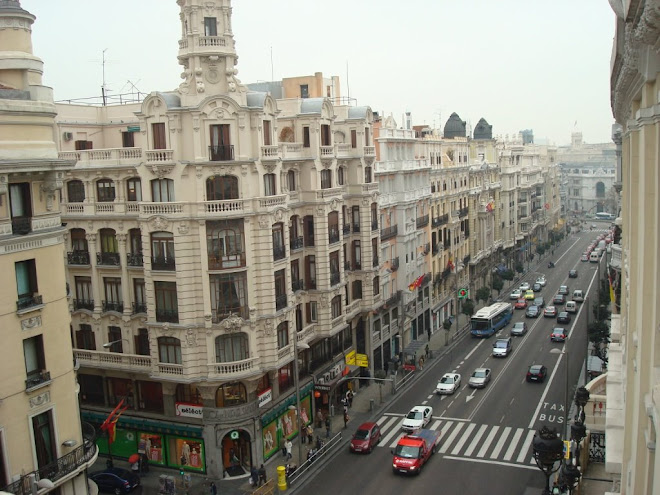
Not far from my apartment in 2002-2003
A Resource for All of Profe Nick's Spanish Students in Washington

Si tuviera un millón de dólares.... (If I had a million dollars....) [Cool, but not for free]
- Comcast "Selecto Pack"
Archivo del blog
-
►
2010
(148)
- ► septiembre (20)
-
▼
2009
(164)
-
▼
octubre
(19)
- miércoles, el veintiocho de octubre del dos mil nueve
- martes, el veintisiete de octubre del dos mil nueve
- lunes, el veintiséis de octubre del dos mil nueve
- viernes, el veintitrés de octubre del dos mil nueve
- miércoles, el veintiuno de octubre del dos mil nueve
- martes, el veinte de octubre del dos mil nueve
- lunes, el veintinueve de octubre del dos mil nueve
- viernes, el dieciseis de octubre del dos mil nueve
- jueves, el quince de octubre del dos mil nueve
- miércoles, el catorce de octubre del dos mil nueve
- martes, el trece de octubre del dos mil nueve
- lunes, el doce de octubre del dos mil nueve
- viernes, el nueve de octubre del dos mil nueve
- jueves, el ocho de octubre del dos mil nueve
- miércoles, el siete de octubre del dos mil nueve
- martes, el seis de octubre del dos mil nueve
- lunes, el cinco de octubre del dos mil nueve
- viernes, el dos de octubre del dos mil nueve
- jueves, el primer de octubre del dos mil nueve
- ► septiembre (18)
-
▼
octubre
(19)
Spanish Is All Around Us...Have You Considered...?
- -- Peeking at the Spanish Directions of a Purchased Household Item/Appliance and Trying to Make Sense of Some of It
- -- Setting Your TV to Spanish and Navigating It...Ask For Permission First
- -- Setting Your Cell Phone to Spanish and Navigating It
- -- Purchasing Food from the "Hispanic Foods" Supermarket Aisle and Following the Cooking Directions in Spanish
- -- Subscribing to "People en español" o "National Geographic en español"
- -- Checking out Spanish Children's Books at the Local Library
- -- Perusing a Free Spanish Newspaper from a Store Specializing in Latin American Groceries
- -- Using the Grocery Store Self Check-Out in Spanish
- -- Installing iTunes in Spanish
Spanish Study Links
Local Spanish Resources
- Univisión -- Canal 29 en la Tele en "el Eastside"
- "Día de los Muertos" Festival -- November 1-2, 2008 -- Seattle Center
- "Seattle Fiestas Patrias" Festival -- September 13-14, 2008 -- Seattle Center
- KWMG "La Magia" -- 1210 AM -- A Fusion of International Spanish
- KKMO "Radio Sol" -- 1360 AM -- Regional Mexican Music
- KXPA "La Buena" -- 1540 AM -- 88 hrs. Spanish Programming Weekly
- KDOW "La Jefa" -- 1680 AM -- Spanish Coverage of Seattle Sounders and Seattle Mariners Games
- KDDS "La Gran D" -- Radio 99.3 FM -- Modeled After Mexican Radio
Authentic Spanish Sources
Spanish Entertainment Links
Datos personales

- Señora Nick
- Any questions about the content of this blog should be directed via email to Profe Nick, not the Issaquah School District.
Madrid: Calle Gran Vía
Not far from my apartment in 2002-2003