Español Uno (1):
Today’s Agenda:
1. Practice our essential questions and discuss the significance of today’s date. In the U.S., Friday the 13th is considered an ominous day. In Spain, it’s Tuesday the 13th (today!), which is considered ominous.
2. Practice pronouncing new words using our knowledge of Spanish phonetics.
Already established phonetic knowledge:
--vowel sounds are consistent: a, e, i, o, u
--the “j” is pronounced like an English “h”
--the “h” is silent
--the “rr” has a rolled sound
--the “v” is pronounced like a soft “b”
--the “ñ” is pronounced like “ny” in English
--the “ll” is pronounced like “ll” in English
--an accent mark tells you where to "punch" the word
¿Cómo se pronuncian?
--instalará
--último
--pantalla
--línea
--pavimentada
--empujó
--carretera
--velocidad
--enseñar
--haga
3. Receive our new song of the week: “Colores, colores.” Nice job catching the first three missing words: hay, pero, niños.
4. Practice our gestures. Establish new gestures for: estudia, va al cine, lee, patina & toca la guitarra.
5. (1st period): Review 1-3 in the workbook. We will review 1-4 tomorrow.
….(2nd period): Review 1-4 in the workbook.
6. (2nd period only): Practice answering our circled basic questions in anticipation of Thursday & Friday’s one-on-one speaking assessment.
Homework: Practice those basic questions!!!
Español Dos (2):
Today’s Agenda:
1. Practice our basic questions & discuss the cultural significance of Tuesday the 13th. In the U.S., Friday the 13th is considered an ominous day. In Spain, it’s Tuesday the 13th (today!), which is considered ominous.
2. Practice pronouncing new words, using our knowledge of phonetics & accents.
¿Cómo se pronuncian?
--instalará
--último
--pantalla
--línea
--pavimentada
--enpujara
--carretera
--velocidad
--yeso
--hagamos
Establish our first accent rule: The 2nd to last syllable gets the natural stress in all words that end in a vowel.
3. Listen to our new song of the week: “Colores, colores.” Nice job catching the first five missing words: azul, rojas, verde, pelo, dentro.
Quick tangent: Notice how the song says “verde vida” instead of “vida verde.” This is a stylistic choice to not put verde after vida. Once you’ve become much more proficient with Spanish you can choose when to be stylistic in such cases, but for now, just observe.
Quick tangent: Notice the word for “and” in the third verse. Unlike the “y” which you normally see, you see “e.” This happens very infrequently. It only happens when the next word after “y” begins with the same sound. So, for instance, instead of “y ideas,” you have to say “e ideas.”
4. Practice our gestures in our pink packet, as well as our irregular yo song.
5. Review some of our core vocabulary for telling stories in the past:
--había (there was / there were)
--tuvo una idea (s/he got an idea)
--se llamaba (s/he called him/herself)
--tenía (s/he had)
--estaba enfermo/a (s/he was sick)
--era astronauta (s/he was an astronaut)
--le dio (s/he gave to him/her)
--anduvo (s/he walked)
--fue (s/he went)
--vio (s/he saw)
--le dijo (s/he said to him/her)
--le preguntó (s/he asked him/her)
--hacía viento (it was windy)
--eran las nueve (it was nine o’clock)
6. Illustrate a story as Profe Nick reads aloud:
--Había una mujer que era muy linda.
--La mujer se llamaba Stephanie. Stephanie tenía mucha sed.
--Eran las seis de la tarde. Stephanie fue a Fred Meyer. No anduvo. Fue en el autobús.
--Llegó a Fred Meyer a las siete. Entró en Fred Meyer y anduvo a la sección de refrescos.
--Un hombre vio a Stephanie. Stephanie le dijo: “Quiero una Coca-Cola, por favor.” El hombre le dio una Coca-Cola.
--Stephanie no estaba contenta. El hombre le preguntó: “¿Hay un problema?” Stephanie le dijo: “Quiero cinco más.”
7. (4th & 6th periods): Practice telling the story aloud.
Homework: Take the illustrated story and write a paragraph worth of notes about how you could “stretch” it to be in the A (“Exceeds Target”) category. What other description could you provide? How could you impress me?
skip to main |
skip to sidebar

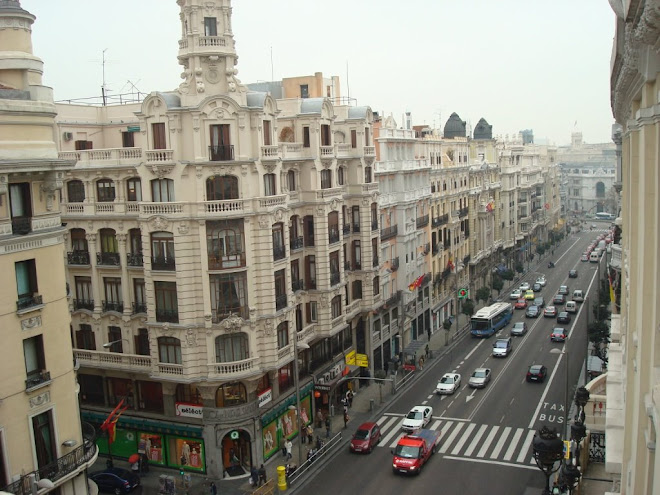
Not far from my apartment in 2002-2003
A Resource for All of Profe Nick's Spanish Students in Washington

Si tuviera un millón de dólares.... (If I had a million dollars....) [Cool, but not for free]
- Comcast "Selecto Pack"
Archivo del blog
-
►
2010
(148)
- ► septiembre (20)
-
▼
2009
(164)
-
▼
octubre
(19)
- miércoles, el veintiocho de octubre del dos mil nueve
- martes, el veintisiete de octubre del dos mil nueve
- lunes, el veintiséis de octubre del dos mil nueve
- viernes, el veintitrés de octubre del dos mil nueve
- miércoles, el veintiuno de octubre del dos mil nueve
- martes, el veinte de octubre del dos mil nueve
- lunes, el veintinueve de octubre del dos mil nueve
- viernes, el dieciseis de octubre del dos mil nueve
- jueves, el quince de octubre del dos mil nueve
- miércoles, el catorce de octubre del dos mil nueve
- martes, el trece de octubre del dos mil nueve
- lunes, el doce de octubre del dos mil nueve
- viernes, el nueve de octubre del dos mil nueve
- jueves, el ocho de octubre del dos mil nueve
- miércoles, el siete de octubre del dos mil nueve
- martes, el seis de octubre del dos mil nueve
- lunes, el cinco de octubre del dos mil nueve
- viernes, el dos de octubre del dos mil nueve
- jueves, el primer de octubre del dos mil nueve
- ► septiembre (18)
-
▼
octubre
(19)
Spanish Is All Around Us...Have You Considered...?
- -- Peeking at the Spanish Directions of a Purchased Household Item/Appliance and Trying to Make Sense of Some of It
- -- Setting Your TV to Spanish and Navigating It...Ask For Permission First
- -- Setting Your Cell Phone to Spanish and Navigating It
- -- Purchasing Food from the "Hispanic Foods" Supermarket Aisle and Following the Cooking Directions in Spanish
- -- Subscribing to "People en español" o "National Geographic en español"
- -- Checking out Spanish Children's Books at the Local Library
- -- Perusing a Free Spanish Newspaper from a Store Specializing in Latin American Groceries
- -- Using the Grocery Store Self Check-Out in Spanish
- -- Installing iTunes in Spanish
Spanish Study Links
Local Spanish Resources
- Univisión -- Canal 29 en la Tele en "el Eastside"
- "Día de los Muertos" Festival -- November 1-2, 2008 -- Seattle Center
- "Seattle Fiestas Patrias" Festival -- September 13-14, 2008 -- Seattle Center
- KWMG "La Magia" -- 1210 AM -- A Fusion of International Spanish
- KKMO "Radio Sol" -- 1360 AM -- Regional Mexican Music
- KXPA "La Buena" -- 1540 AM -- 88 hrs. Spanish Programming Weekly
- KDOW "La Jefa" -- 1680 AM -- Spanish Coverage of Seattle Sounders and Seattle Mariners Games
- KDDS "La Gran D" -- Radio 99.3 FM -- Modeled After Mexican Radio
Authentic Spanish Sources
Spanish Entertainment Links
Datos personales

- Señora Nick
- Any questions about the content of this blog should be directed via email to Profe Nick, not the Issaquah School District.
Madrid: Calle Gran Vía
Not far from my apartment in 2002-2003