Español Uno (1):
Submitted: Answers to Pobre Ana questions.
Today's Learning Objectives:
1. Practice answering our essential questions. Remember, very soon you'll be having a quick speaking assessment based on your ability to answer these questions.
Examples of questions you could draw:
¿Cómo te llamas?
¿Cómo estás?
¿Cómo eres?
¿De dónde eres?
¿Qué día es hoy?
¿Qué día fue ayer?
¿Qué día es mañana?
¿Cuál es la fecha de hoy?
¿Qué tiempo hace?
¿Qué hora es?
¿Cuántos años tienes?
¿Cuándo es tu cumpleaños?
A ti, ¿te gusta nadar?
¿Qué clase tienes en la primera hora?
¿Cómo se llama tu profesor de matemáticas?
¿Qué hiciste durante el fin de semana?
¿Qué vas a hacer hoy?
¿Qué hay aquí en la sala de clases?
2. Learn some new gestures.
New gestures:
va de pesca (s/he goes fishing)
el parque de diversiones (the amusement park)
por la mañana (during the morning)
por la tarde (during the afternoon)por la noche (during the evening)
está ocupado/a (s/he is busy)
el centro comercial (the mall, Literally: the commercial center)
el verano (the summer)
la playa (the beach)
¡Claro que sí! (Of course!)
¡Genial! (Great!)
(Monday’s gestures for 2nd period to copy):
la primavera (the spring)
solo/a (alone)
el otoño (the fall)
¡No me digas! (Really?!?!, Literally: Don’t tell me!)
el campo (the countryside)
Homework: Keep preparing yourself for our first, graded speaking assessment.
Español Dos (2):
Today's Learning Objectives:
1. Review "this / these / that / those" from Spanish 1. Learn relevant new information.
Review:
“This and these have t’s; that and those don’t.”
aquí = here
allí = there
este / esta = this
estos / estas = these
ese / esa = that
esos / esas = those
New information:
acá = here (just another version)
ahí = there (just another version)
allá = over there
aquel / aquella = that (far away)
aquellos / aquellas = those (far away)
In order to use a pronoun, to communicate “this one” instead of “this book,” you simply write an accent on the first “e.” Example: este (this) becomes éste (this one)
**Additionally, there are two very common forms you should know about:
esto = this (in an abstract or undefined way)
Example: ¿Qué es esto? (What is this?...we're not clearly defining what "this" is.)
eso = that (in an abstract or undefined way)
Example: Dame eso. (Give me that...we're not clearly labeling what "that" is.)
2. Review Monday's new gestures.
3. Read a bit more in Pobre Ana bailó tango.
Homework: Review, review, review!
skip to main |
skip to sidebar

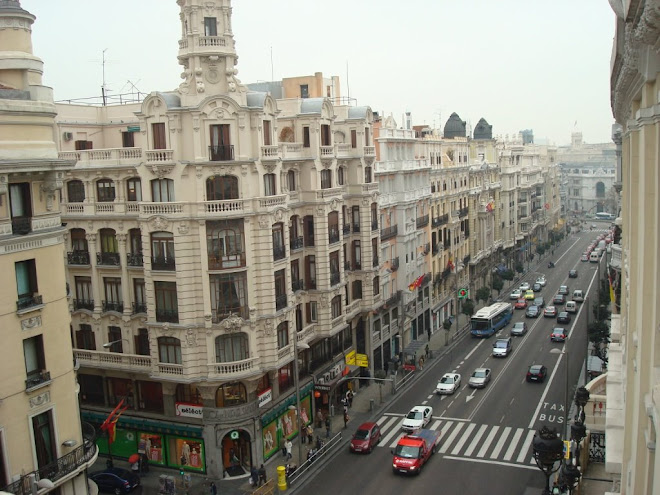
Not far from my apartment in 2002-2003
A Resource for All of Profe Nick's Spanish Students in Washington

Si tuviera un millón de dólares.... (If I had a million dollars....) [Cool, but not for free]
- Comcast "Selecto Pack"
Archivo del blog
-
►
2010
(148)
- ► septiembre (20)
-
►
2009
(164)
- ► septiembre (18)
-
▼
2008
(72)
-
▼
noviembre
(15)
- lunes, el veinticuatro de noviembre del dos mil ocho
- viernes, el veintiuno de noviembre del dos mil ocho
- jueves, el veinte de noviembre del dos mil ocho
- miércoles, el diecinueve de noviembre del dos mil ...
- martes, el dieciocho de noviembre del dos mil ocho
- lunes, el diecisiete de noviembre del dos mil ocho
- viernes, el catorce de noviembre del dos mil ocho
- jueves, el trece de noviembre del dos mil ocho
- miércoles, el doce de noviembre del dos mil ocho
- lunes, el diez de noviembre del dos mil ocho
- viernes, el siete de noviembre del dos mil ocho
- jueves, el seis de noviembre del dos mil ocho
- miércoles, el cinco de noviembre
- martes, el cuatro de noviembre del dos mil ocho
- lunes, el tres de noviembre de dos mil ocho
- ► septiembre (20)
-
▼
noviembre
(15)
Spanish Is All Around Us...Have You Considered...?
- -- Peeking at the Spanish Directions of a Purchased Household Item/Appliance and Trying to Make Sense of Some of It
- -- Setting Your TV to Spanish and Navigating It...Ask For Permission First
- -- Setting Your Cell Phone to Spanish and Navigating It
- -- Purchasing Food from the "Hispanic Foods" Supermarket Aisle and Following the Cooking Directions in Spanish
- -- Subscribing to "People en español" o "National Geographic en español"
- -- Checking out Spanish Children's Books at the Local Library
- -- Perusing a Free Spanish Newspaper from a Store Specializing in Latin American Groceries
- -- Using the Grocery Store Self Check-Out in Spanish
- -- Installing iTunes in Spanish
Spanish Study Links
Local Spanish Resources
- Univisión -- Canal 29 en la Tele en "el Eastside"
- "Día de los Muertos" Festival -- November 1-2, 2008 -- Seattle Center
- "Seattle Fiestas Patrias" Festival -- September 13-14, 2008 -- Seattle Center
- KWMG "La Magia" -- 1210 AM -- A Fusion of International Spanish
- KKMO "Radio Sol" -- 1360 AM -- Regional Mexican Music
- KXPA "La Buena" -- 1540 AM -- 88 hrs. Spanish Programming Weekly
- KDOW "La Jefa" -- 1680 AM -- Spanish Coverage of Seattle Sounders and Seattle Mariners Games
- KDDS "La Gran D" -- Radio 99.3 FM -- Modeled After Mexican Radio
Authentic Spanish Sources
Spanish Entertainment Links
Datos personales

- Señora Nick
- Any questions about the content of this blog should be directed via email to Profe Nick, not the Issaquah School District.
Madrid: Calle Gran Vía
Not far from my apartment in 2002-2003