Español Uno (1):
Today’s Agenda:
1. Practice spelling unknown words in Spanish, using our knowledge of Spanish phonetics.
--le-van-ta-mien-to
--re-lám-pa-go
--ca-ba-lli-to
--bar-ba-co-a
--na-ta-ción
2. Practice our basic questions, especially our updated version of “¿Cómo estás?”
--¿Cómo estás? (How are you?)
--¿Cómo estabas? (How were you?)……Estaba….(I/She/He was….)
**Another question was updated today:
--¿Cómo eres?....(What are you like?)
--¿Cómo eras?....(What were you like?)….Era….(I/She/He was…)
3. Listen to our new song of the week: “Vive el verano.” Nice job catching the first three missing words: luna, mil, miraste.
**Quick tangent: If “miraste” communicates “you looked,” how would we say the following?
--you danced?..........bailaste
--you cooked?..........cocinaste
--you listened?........escuchaste
--you helped?.........ayudaste
--you sang?...............cantaste
4. Practice our chapter 3 gestures, establishing new gestures for:
--¡Claro que sí!
--¡Claro que no!
--A mí me gustaría
--A ti te gustaría
--¡No me digas!
--¡Genial!
5. Review 3-3 & 3-4 in the workbook.
**An important rule was discussed and written on top of page 3-3. This rule is very helpful for BEGINNERS in Spanish, though do know that the rule will become less absolute mid-Spanish 2.
RULE: If the first verb is conjugated (specifically I, you, s/he, we, they, y'all…does an action), then the second verb has to be an infinitive.
--quieren estudiar
--puedo cantar
--necesitas comer
6. Begin the homework.
Homework: 3-5 & 3-6 in the workbook.
Español Dos (2):
Today’s Agenda:
1. Practice spelling unknown words in Spanish, using our knowledge of Spanish phonetics.
--le-van-ta-mien-to
--re-lám-pa-go
--ca-ba-lli-to
--bar-ba-co-a
--na-ta-ción
**Discussion about the first accent rule we know and how it applies to these words. [First Accent Rule: All word ending in a vowel, n or s have a natural stress on the second to last syllable.]
2. Practice our basic quesitons in the past:
--¿Cómo eras (de pequeño/a)?
--¿Cómo estabas (ayer)?
--¿Qué tiempo hacía (ayer)?
--¿Qué hora era (cuando te despertaste hoy)?
3. Listen to our new song of the week: “Te busqué.” Nice job catching the first three missing words: di, fue, vi.
4. Finish defining our pink packet vocabulary for chapter 3.
5. Establish gestures for:
--lleva el bolso
--el botín
--saca su cartera de su bolsillo
--el chandal
--cuelga el chaquetón
--se prueba el cinturón
--la corbata
--la gorra
6. Begin the homework.
Homework: 3-1 & 3-2 in the workbook (evens transltaed, too)
skip to main |
skip to sidebar

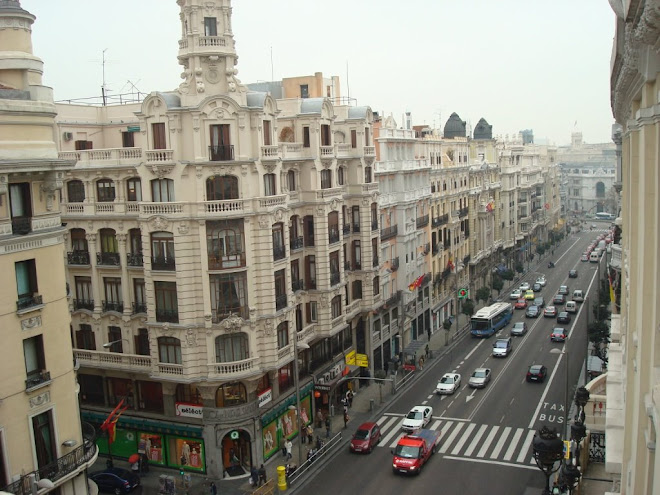
Not far from my apartment in 2002-2003
A Resource for All of Profe Nick's Spanish Students in Washington

Si tuviera un millón de dólares.... (If I had a million dollars....) [Cool, but not for free]
- Comcast "Selecto Pack"
Archivo del blog
-
►
2010
(148)
- ► septiembre (20)
-
▼
2009
(164)
-
▼
noviembre
(18)
- lunes, el treinta de noviembre del dos mil nueve
- miércoles, el veinticinco de noviembre del dos mil...
- martes, el veinticuatro de noviembre del dos mil n...
- lunes, el veintitrés de noviembre del dos mil nueve
- viernes, el veinte de noviembre del dos mil nueve
- jueves, el diecinueve de noviembre del dos mil nueve
- miércoles, el dieciocho de noviembre del dos mil n...
- martes, el diecisiete de noviembre del dos mil nueve
- lunes, el dieciséis de noviembre del dos mil nueve
- viernes, el trece de noviembre del dos mil nueve
- jueves, el doce de noviembre del dos mil nueve
- martes, el diez de noviembre del dos mil nueve
- lunes, el nueve de noviembre del dos mil nueve
- viernes, el seis de noviembre del dos mil nueve
- jueves, el cuatro de noviembre del dos mil nueve
- miércoles, el cuatro de noviembre del dos mil nueve
- martes, el tres de noviembre del dos mil nueve
- lunes, el dos de noviembre del dos mil nueve
- ► septiembre (18)
-
▼
noviembre
(18)
Spanish Is All Around Us...Have You Considered...?
- -- Peeking at the Spanish Directions of a Purchased Household Item/Appliance and Trying to Make Sense of Some of It
- -- Setting Your TV to Spanish and Navigating It...Ask For Permission First
- -- Setting Your Cell Phone to Spanish and Navigating It
- -- Purchasing Food from the "Hispanic Foods" Supermarket Aisle and Following the Cooking Directions in Spanish
- -- Subscribing to "People en español" o "National Geographic en español"
- -- Checking out Spanish Children's Books at the Local Library
- -- Perusing a Free Spanish Newspaper from a Store Specializing in Latin American Groceries
- -- Using the Grocery Store Self Check-Out in Spanish
- -- Installing iTunes in Spanish
Spanish Study Links
Local Spanish Resources
- Univisión -- Canal 29 en la Tele en "el Eastside"
- "Día de los Muertos" Festival -- November 1-2, 2008 -- Seattle Center
- "Seattle Fiestas Patrias" Festival -- September 13-14, 2008 -- Seattle Center
- KWMG "La Magia" -- 1210 AM -- A Fusion of International Spanish
- KKMO "Radio Sol" -- 1360 AM -- Regional Mexican Music
- KXPA "La Buena" -- 1540 AM -- 88 hrs. Spanish Programming Weekly
- KDOW "La Jefa" -- 1680 AM -- Spanish Coverage of Seattle Sounders and Seattle Mariners Games
- KDDS "La Gran D" -- Radio 99.3 FM -- Modeled After Mexican Radio
Authentic Spanish Sources
Spanish Entertainment Links
Datos personales

- Señora Nick
- Any questions about the content of this blog should be directed via email to Profe Nick, not the Issaquah School District.
Madrid: Calle Gran Vía
Not far from my apartment in 2002-2003