Español Uno (1):
Today’s Agenda:
1. Practice spelling unknown words in Spanish using our knowledge of phonetics.
--op-ti-mi-sta
--cho-rro
--pan-di-lla
--de-ma-sia-do
--car-ní-vo-ros
2. Practice answering our essential question “¿Qué vas a hacer?” (What are you going to do?).
Quick review of who goes where in our t-charts:
I……………..we
you……………
s/he………….they
What would the t-chart look like for “ir” (to go)?
voy………….vamos
vas…………………
va……………van…
Nice, beginner work phrasing sentences like:
Voy a mirar la tele.
Voy a jugar Xbox.
3. Listen & sing our song of the week: “El rey.”
4. Practice our gestures & our “¡Ay, ay, ay, ay!” song.
5. Finish reading “Ana, la astronauta enferma.”
Homework: Read, in ENGLISH, the story “Ana, la astronauta” to an adult (parent / neighbor / coach / teacher). You are reading in English to make sure you actually understand what is written, instead of just pronouncing the Spanish. Feel free to additionally read in Spanish.
Español Dos (2):
Today’s Agenda:
1. Turn in the homework (signed copy of “Ana, la astronauta enferma.”)
2. Practice spelling unknown words using our knowledge of phonetics.
--en-se-gui-da
--car-ní-vo-ros
--car-du-men
--gui-ja-rro
--ti-bu-ron-cín
3. Practice answering our Spanish 2 basic questions, adding a few new weather details.
New weather details:
--llovizna (it’s drizzling)
--lloviznó (it drizzled)
--lloviznaba (it was drizzling)
--llueve (it’s raining)
--llovió (it rained)
--llovía (it was raining)
--está nublado (it’s cloudy)
--estaba nublado (it was cloudy)
4. Listen & sing our song of the week: “El rey.”
5. Review key vocabulary from “Ana, la astronauta enferma.”
--había (there was/were)
--anduvo (s/he walked)
--le dio (s/he gave to him/her)
--tuvo una idea (s/he got an idea)
--era astronauta (s/he was an astronaut)
--no entendía (s/he didn’t understand)
--estaba enfermo/a (s/he was sick)
--le dijo (s/he said to him/her)
--vio (s/he saw)
--fue (s/he went)
--tenía medicina (s/he had medicine)
6. Illustrate key scenes from “Ana, la astronauta enferma” as the teacher reads aloud.
--Había una astronauta. Estaba muy enferma.
--Un día Ana anduvo a la oficina de Miguel. Le dijo que estaba enferma.
--Miguel era muy inteligene y tuvo una idea.
--Miguel agarró un suéter y le dio el suéter a Ana. Ana no entendía.
--Miguel tuvo otra idea. Miguel tenía medicina en su oficina.
--Miguel agarró la medicina y le dio la medicina a Ana. Ana estaba enferma.
7. Practice retelling the story with a partner.
8. Quick sharing of the story aloud by three brave volunteers.
9. Discussion about how the above retelling (as done by Profe Nick) would be assessed on a speaking quiz. A simple & correct retelling with NO English and very few errors would be “meets target” (B).
Discussion about what it would take to be at the “exceeds target” (A) range. Nice job brainstorming alternate vocabulary that could be used or other details not mentioned in the original version. Remember, you don’t have to stick with the script. You can always elaborate.
Homework: None.
skip to main |
skip to sidebar

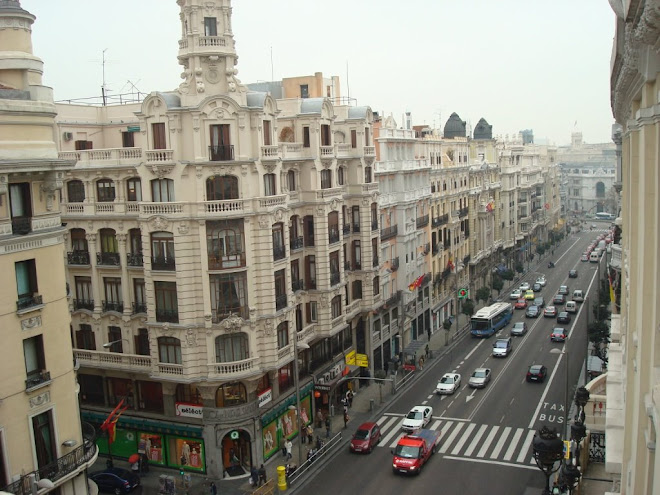
Not far from my apartment in 2002-2003
A Resource for All of Profe Nick's Spanish Students in Washington

Si tuviera un millón de dólares.... (If I had a million dollars....) [Cool, but not for free]
- Comcast "Selecto Pack"
Archivo del blog
-
►
2010
(148)
- ► septiembre (20)
-
▼
2009
(164)
-
▼
septiembre
(18)
- lunes, el veintiocho de septiembre del dos mil nueve
- viernes, el veinticinco de septiembre del dos mil ...
- jueves, el veinticuatro de septiembre del dos mil ...
- miércoles, el veintitrés de septiembre del dos mil...
- martes, el veintidós de septiembre del dos mil nueve
- lunes, el veintiuno de septiembre del dos mil nueve
- viernes, el dieciocho de septiembre del dos mil nueve
- jueves, el diecisiete de septiembre del dos mil nueve
- miércoles, el dieciséis de septiembre del dos mil ...
- martes, el quince de septiembre del dos mil nueve
- lunes, el catorce de septiembre del dos mil nueve
- viernes, el once de septiembre del dos mil nueve
- jueves, el diez de septiembre del dos mil nueve
- miércoles, el nueve de septiembre del dos mil nueve
- lunes, el ocho de septiembre del dos mil nueve
- viernes, el cuatro de septiembre del dos mil nueve
- jueves, el tres de septiembre del dos mil nueve
- miércoles, el dos de septiembre del dos mil nueve
-
▼
septiembre
(18)
Spanish Is All Around Us...Have You Considered...?
- -- Peeking at the Spanish Directions of a Purchased Household Item/Appliance and Trying to Make Sense of Some of It
- -- Setting Your TV to Spanish and Navigating It...Ask For Permission First
- -- Setting Your Cell Phone to Spanish and Navigating It
- -- Purchasing Food from the "Hispanic Foods" Supermarket Aisle and Following the Cooking Directions in Spanish
- -- Subscribing to "People en español" o "National Geographic en español"
- -- Checking out Spanish Children's Books at the Local Library
- -- Perusing a Free Spanish Newspaper from a Store Specializing in Latin American Groceries
- -- Using the Grocery Store Self Check-Out in Spanish
- -- Installing iTunes in Spanish
Spanish Study Links
Local Spanish Resources
- Univisión -- Canal 29 en la Tele en "el Eastside"
- "Día de los Muertos" Festival -- November 1-2, 2008 -- Seattle Center
- "Seattle Fiestas Patrias" Festival -- September 13-14, 2008 -- Seattle Center
- KWMG "La Magia" -- 1210 AM -- A Fusion of International Spanish
- KKMO "Radio Sol" -- 1360 AM -- Regional Mexican Music
- KXPA "La Buena" -- 1540 AM -- 88 hrs. Spanish Programming Weekly
- KDOW "La Jefa" -- 1680 AM -- Spanish Coverage of Seattle Sounders and Seattle Mariners Games
- KDDS "La Gran D" -- Radio 99.3 FM -- Modeled After Mexican Radio
Authentic Spanish Sources
Spanish Entertainment Links
Datos personales

- Señora Nick
- Any questions about the content of this blog should be directed via email to Profe Nick, not the Issaquah School District.
Madrid: Calle Gran Vía
Not far from my apartment in 2002-2003