Español Uno (1):
Today’s Agenda:
1. Answer our basic questions.
Expand our answer choices for “¿Cómo estás?”
--contento/a (happy)
--enfermo/a (sick)
--cansado/a (tired)
--triste (sad)
--mejor (better)
--peor (worse)
**Quick discussion of how the “o” in “contento” is masculine for boys, and how the “a” in “contenta” is feminine for girls.
New basic question: “¿Cómo eres?” (What are you like?) “Soy….” (I am….)
**Quick discussion of how we use this question for personality & physical descriptions:
Our current answer choices are limited to the words we’ve seen in class thus far:
personality description:
--atlético/a (athletic)
--bueno/a (good)
--malo/a (bad)
--arrogante (arrogant)
--cómico/a (funny)
--artístico/a (artistic)
--loco/a (crazy)
physical description:
atractivo/a (attractive)
2. Listen to our new song of the week: “El rey.” Quick discussion of “música mariachi / ranchera.” This song, like last week’s “Cielito lindo” is a classic “ranchera” song. The term “ranchera” comes from “rancho” (ranch). "Rancho" is a good example of a word that English took from Spanish. Ranches are very common in México and a specific type of music evolved on these ranches starting in the mid-1800’s. That music (still very popular today) is called “ranchera.” When it is performed live by a mariachi band, it can also be called “música mariachi.”
3. Learn some new gestures and copy those new phrases into our picture dictionary:
--le dice………………….…s/he says to him/her
--le pregunta………………..s/he asks him/her
--hay………………….……there is / there are
--tiene……………………....s/he has
--un montón de dinero……..a ton of money
--señala…………………….s/he points (to)
--quiere…………………….s/he wants
--se va……………………...s/he goes away
--¡Qué lástima!.....................What a shame!
--necesita…………………..s/he needs
Homework: Finish copying and illustrating our new gesture phrases into your picture dictionary.
Español Dos (2):
Today’s Agenda:
1. Establish some Spanish 2 “basic questions” and some possible responses.
--¿Cómo estabas (ayer)?.....(How were you (yesterday)?)
--¿Cómo eras (de pequeño/a)?.....(What were you like (as a kid)?)
2. Listen to our new song of the week: “El rey.” Nice job catching the first two missing words: estoy, triste.
Quick discussion of “música mariachi / ranchera.” This song, like last week’s “Cielito lindo” is a classic “ranchera” song. The term “ranchera” comes from “rancho” (ranch). "Rancho" is a good example of a word that English took from Spanish. Ranches are very common in México and a specific type of music evolved on these ranches starting in the mid-1800’s. That music (still very popular today) is called “ranchera.” When it is performed live by a mariachi band, it can also be called “música mariachi.”
3. Establish some new gestures:
lo besa = s/he kisses him
la besa = s/he kisses her
se va = s/he goes away
le muestra = s/he shows to him/her
señala = s/he points (to)
lo conoce = s/he knows him
la conoce = s/he knows her
un montón de dinero = a ton of money
Homework: Finish illustrating our new gestures in your picture dictionary.
skip to main |
skip to sidebar

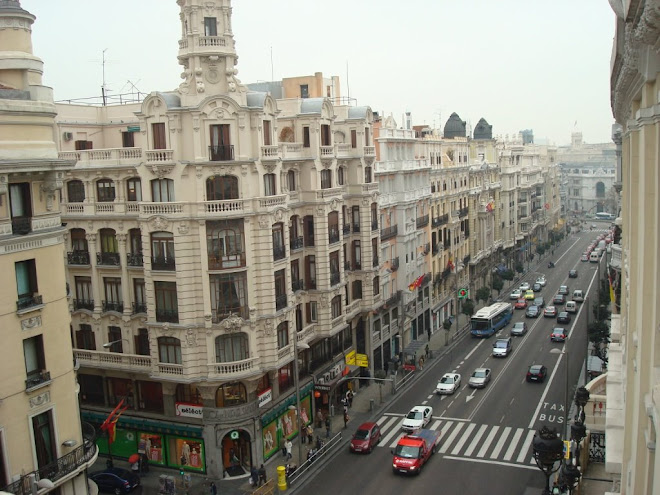
Not far from my apartment in 2002-2003
A Resource for All of Profe Nick's Spanish Students in Washington

Si tuviera un millón de dólares.... (If I had a million dollars....) [Cool, but not for free]
- Comcast "Selecto Pack"
Archivo del blog
-
►
2010
(148)
- ► septiembre (20)
-
▼
2009
(164)
-
▼
septiembre
(18)
- lunes, el veintiocho de septiembre del dos mil nueve
- viernes, el veinticinco de septiembre del dos mil ...
- jueves, el veinticuatro de septiembre del dos mil ...
- miércoles, el veintitrés de septiembre del dos mil...
- martes, el veintidós de septiembre del dos mil nueve
- lunes, el veintiuno de septiembre del dos mil nueve
- viernes, el dieciocho de septiembre del dos mil nueve
- jueves, el diecisiete de septiembre del dos mil nueve
- miércoles, el dieciséis de septiembre del dos mil ...
- martes, el quince de septiembre del dos mil nueve
- lunes, el catorce de septiembre del dos mil nueve
- viernes, el once de septiembre del dos mil nueve
- jueves, el diez de septiembre del dos mil nueve
- miércoles, el nueve de septiembre del dos mil nueve
- lunes, el ocho de septiembre del dos mil nueve
- viernes, el cuatro de septiembre del dos mil nueve
- jueves, el tres de septiembre del dos mil nueve
- miércoles, el dos de septiembre del dos mil nueve
-
▼
septiembre
(18)
Spanish Is All Around Us...Have You Considered...?
- -- Peeking at the Spanish Directions of a Purchased Household Item/Appliance and Trying to Make Sense of Some of It
- -- Setting Your TV to Spanish and Navigating It...Ask For Permission First
- -- Setting Your Cell Phone to Spanish and Navigating It
- -- Purchasing Food from the "Hispanic Foods" Supermarket Aisle and Following the Cooking Directions in Spanish
- -- Subscribing to "People en español" o "National Geographic en español"
- -- Checking out Spanish Children's Books at the Local Library
- -- Perusing a Free Spanish Newspaper from a Store Specializing in Latin American Groceries
- -- Using the Grocery Store Self Check-Out in Spanish
- -- Installing iTunes in Spanish
Spanish Study Links
Local Spanish Resources
- Univisión -- Canal 29 en la Tele en "el Eastside"
- "Día de los Muertos" Festival -- November 1-2, 2008 -- Seattle Center
- "Seattle Fiestas Patrias" Festival -- September 13-14, 2008 -- Seattle Center
- KWMG "La Magia" -- 1210 AM -- A Fusion of International Spanish
- KKMO "Radio Sol" -- 1360 AM -- Regional Mexican Music
- KXPA "La Buena" -- 1540 AM -- 88 hrs. Spanish Programming Weekly
- KDOW "La Jefa" -- 1680 AM -- Spanish Coverage of Seattle Sounders and Seattle Mariners Games
- KDDS "La Gran D" -- Radio 99.3 FM -- Modeled After Mexican Radio
Authentic Spanish Sources
Spanish Entertainment Links
Datos personales

- Señora Nick
- Any questions about the content of this blog should be directed via email to Profe Nick, not the Issaquah School District.
Madrid: Calle Gran Vía
Not far from my apartment in 2002-2003