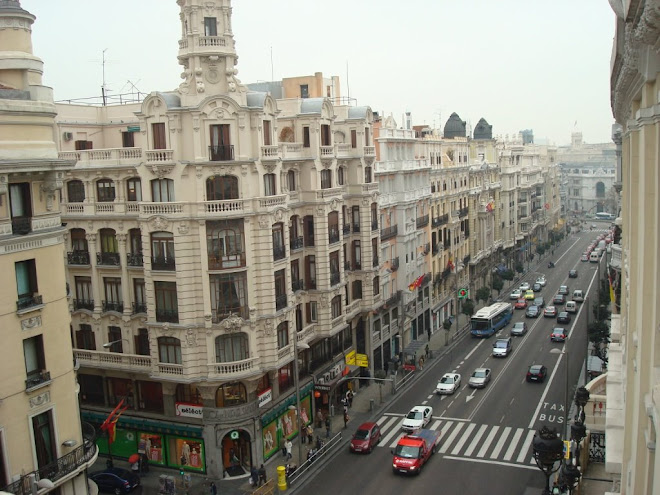
Español Uno (1):
Today’s Learning Objectives:
1. Practice spelling unknown words in Spanish
--a-ver-i-guar
--na-vi-deñ-a
--hu-ér-fa-no
--a-le-grí-a
--ca-lle-jón
2. Complete 4-5 in the workbook and check answers.
3. Sing our first holiday song: “Va a nevar”
4. Complete dictation #5.
5. Take our food vocabulary quiz (chapter 4 & 12 food vocabulary).
Homework: None
Español Dos (2):
Announcement: I am offering you a significant opportunity in regards to your final exam. This opportunity has been motivated by all of you who have worked very hard to significantly raise your skill level since the beginning of the year. Due to the comprehensive nature of your exams, I feel very comfortable letting your final exam score supersede your class average (assuming you perform better than your average). If you perform worse on the final exam than your class average going into the test, I will treat the final exam as it would have ordinarily been treated (10% of your grade). SEIZE THIS OPPORTUNITY!
Today’s Learning Objectives:
1. Expand our knowledge of accent marks in Spanish. You already have two significant rules (see previous posts). Today we received more information, pertaining to a third rule. This rule concerns dipthongs, and helps us more accurately divide a word into its syllables.
Rule #3:
--A,E and O are “strong” vowels.
--I and U are “weak” vowels.
--When a strong vowel combines with a weak vowel, they form a single sound (“dipthong”).
--When two weak vowels combine, they form a single sound (“dipthong”).
Examples: pia-no, viu-do
Break the following words into their syllables. (The dipthongs are underlined.):
--ciu-dad
--pie
--vein-te
--pin-güi-no
--au-to-mó-vil
--a-gua
--deu-das
--a-pa-guen
--gui-san-tes
--man-te-qui-lla
2. Sing our first holiday song: “Va a nevar”
3. Practice the skill of circumlocution with our chapter four vocabulary. Utilizing the suggested starter phrases for circumlocution (…for an activity back in chapter two), write ten definitions for you chapter four vocabulary. Students guess the target words of others’ definitions.
4. Illustrate ten scenes from chapter two of Pobre Ana bailó tango.
--Después de ir a México, Ana quería visitar otros países.
--Ana leyó un libro sobre la Argentina.
--Ana supo que el tango es muy popular en la Argentina.
--Ana supo que había un programa escolar para ir a la Argentina.
--Ana se puso muy contenta al oír eso.
--Ana escribió una lista de lo que quería saber.
--Quería saber más sobre la comida.
--Quería saber más sobre las diversiones.
--No tenía mucho dinero, pero eso no le importaba.
--Iba a vivir con una familia argentina.
5. (4th & 6th periods only): Practice retelling chapter two of Pobre Ana bailó tango to a partner.
Homework: None.
martes, 16 de diciembre de 2008
lunes, el quince de septiembre del dos mil ocho
Español Uno (1):
(30 minute classes due to inclement weather and assembly schedule.)
Today’s Learning Objectives:
1. Read, in Spanish, for nine minutes during SSR.
2. (1st hour): Sing our song of the week from last week.
(2nd hour): Preview tomorrow’s song
3. Discuss, in Spanish, what we did over the weekend. (Work collected.)
Homework: Prepare yourself for tomorrow’s vocabulary quiz.
Español Dos (2):
(30 minute classes due to inclement weather and assembly schedule.)
Today’s Learning Objectives:
1. Read, in Spanish, for ten minutes during SSR.
2. Discuss, in Spanish, what we did over the weekend.
Homework: None.
(30 minute classes due to inclement weather and assembly schedule.)
Today’s Learning Objectives:
1. Read, in Spanish, for nine minutes during SSR.
2. (1st hour): Sing our song of the week from last week.
(2nd hour): Preview tomorrow’s song
3. Discuss, in Spanish, what we did over the weekend. (Work collected.)
Homework: Prepare yourself for tomorrow’s vocabulary quiz.
Español Dos (2):
(30 minute classes due to inclement weather and assembly schedule.)
Today’s Learning Objectives:
1. Read, in Spanish, for ten minutes during SSR.
2. Discuss, in Spanish, what we did over the weekend.
Homework: None.

viernes, 12 de diciembre de 2008
viernes, el doce de diciembre del dos mil ocho
Español Uno (1):
Reminder: Tuesday is our chapter 4/12 food vocabulary quiz.
Announcement: If, by chance, school is cancelled on Monday, we will STILL have our vocabulary quiz on Tuesday. Prepare yourself!
Today’s Learning Objectives:
1. Do our “para empezar” warm-up. How well can you write the following:
--the tomato
--the egg
--the lettuce
--the corn
--the grapes
--the apple
--the orange juice
--the potato
--the butter
--the carrot
2. (1st hour): Listen to “Vivir”.
(2nd hour): Sing “Vivir”.
3. Review 4-4 in the workbook.
4. (1st hour): Illustrate ten scenes from chapter two of Pobre Ana as I narrate.
5. Practice retelling chapter two aloud to a partner.
6. Listen as three volunteers bravely retell chapter two for the class.
7. Timed writing: Retell chapter two in five minutes.
Homework: Prepare yourself for Tuesday’s quiz!
Español Dos (2):
Today’s Learning Objectives:
1. Practice writing words with or without accents, according to the two accent rules we have:
--más-ca-ra
--ne-u-má-ti-co
--car-tu-cho
--ca-nal
--trin-char
2. Listen and sing our song of the week: “Te busqué”.
3. Review yesterday’s homework: 4-5 & 4-7.
4. Finish yesterday’s practice worksheet on preterite verbs and ch. 3 & 4 vocabulary.
5. Review the answers to side one of the worksheet. Side two will be submitted on Monday to be graded.
6. Finish reading chapter two of Pobre Ana bailó tango.
Homework: If you did not finish the worksheet practicing the preterite & chapter 3/4 vocabulary, do so for Monday.
Reminder: Tuesday is our chapter 4/12 food vocabulary quiz.
Announcement: If, by chance, school is cancelled on Monday, we will STILL have our vocabulary quiz on Tuesday. Prepare yourself!
Today’s Learning Objectives:
1. Do our “para empezar” warm-up. How well can you write the following:
--the tomato
--the egg
--the lettuce
--the corn
--the grapes
--the apple
--the orange juice
--the potato
--the butter
--the carrot
2. (1st hour): Listen to “Vivir”.
(2nd hour): Sing “Vivir”.
3. Review 4-4 in the workbook.
4. (1st hour): Illustrate ten scenes from chapter two of Pobre Ana as I narrate.
5. Practice retelling chapter two aloud to a partner.
6. Listen as three volunteers bravely retell chapter two for the class.
7. Timed writing: Retell chapter two in five minutes.
Homework: Prepare yourself for Tuesday’s quiz!
Español Dos (2):
Today’s Learning Objectives:
1. Practice writing words with or without accents, according to the two accent rules we have:
--más-ca-ra
--ne-u-má-ti-co
--car-tu-cho
--ca-nal
--trin-char
2. Listen and sing our song of the week: “Te busqué”.
3. Review yesterday’s homework: 4-5 & 4-7.
4. Finish yesterday’s practice worksheet on preterite verbs and ch. 3 & 4 vocabulary.
5. Review the answers to side one of the worksheet. Side two will be submitted on Monday to be graded.
6. Finish reading chapter two of Pobre Ana bailó tango.
Homework: If you did not finish the worksheet practicing the preterite & chapter 3/4 vocabulary, do so for Monday.
jueves, 11 de diciembre de 2008
jueves, el once de diciembre del dos mil ocho
Español Uno (1):
Reminder: Next Tuesday is our vocabulary quiz for the chapter 4/12 food vocabulary! Prepare yourself!
Today’s Learning Objectives:
1. Quick practice assessment—how well can you recognize the following words? Remember, recognition precedes production. If you’re struggling in recognizing these, you need to put in more time memorizing this new vocabulary!
--las verduras
--el pescado
--el plátano
--el limón verde
--el agua
--el helado
--el aguacate
--el postre
--el pollo
--el pan
2. Listen to our second song of the week: “Vivir”. Good job catching the first six words: son, empezar, a veces, siempre, gente, a veces.
3. Finish reviewing 4-1 and 4-2 from yesterday. Review 4-3 for today. (We will review 4-4 tomorrow.)
4. Practice our gestures.
5. Finish reading chapter 2 of Pobre Ana.
6. (2nd hour only):
Illustrate ten details of Pobre Ana as the teacher reads aloud.
--Ana no sabe dónde está el libro de inglés.
--Ana habla con su hermano.
--Don no es amable. Don no le ayuda.
--La mamá de Ana está enojada y le grita.
--Ana va a la escuela en el autobús amarillo.
--Ana mira la ropa nueva de sus amigas. Quiere ropa nueva.
--Ana va a la clase de español. Le gusta la clase.
--La profesora habla de México. Ana quiere ir a México.
--El padre de Ana le dice: “No tengo dinero.”
--Ana le dice: “Papá, está bien. No necesitas dinero. La escuela tiene el dinero.”
Homework: Study for next Tuesday's vocabulary quiz on chapter 4/12 food words.
Español Dos (2):
Today’s Learning Objectives:
1. Practice spelling words with or without accents, according to our two new accent rules.
--ca-mi-són
--xi-ló-fo-no
--me-di-ca-men-to
--ma-qui-ni-sta
--ca-pó
--a-zú-car
2. Listen to our song of the week: “Te busqué”. Good job catching the remaining words: quería, sabía, mío, eso, encontré, llegaste.
3. Review yesterday’s homework: 4-3, 4-4
4. Practice our gestures.
5. Practice our verbs in the preterite with a preterite/vocab. worksheet.
Homework: 4-5, 4-7 in the workbook with multiples of two translated to English.
Reminder: Next Tuesday is our vocabulary quiz for the chapter 4/12 food vocabulary! Prepare yourself!
Today’s Learning Objectives:
1. Quick practice assessment—how well can you recognize the following words? Remember, recognition precedes production. If you’re struggling in recognizing these, you need to put in more time memorizing this new vocabulary!
--las verduras
--el pescado
--el plátano
--el limón verde
--el agua
--el helado
--el aguacate
--el postre
--el pollo
--el pan
2. Listen to our second song of the week: “Vivir”. Good job catching the first six words: son, empezar, a veces, siempre, gente, a veces.
3. Finish reviewing 4-1 and 4-2 from yesterday. Review 4-3 for today. (We will review 4-4 tomorrow.)
4. Practice our gestures.
5. Finish reading chapter 2 of Pobre Ana.
6. (2nd hour only):
Illustrate ten details of Pobre Ana as the teacher reads aloud.
--Ana no sabe dónde está el libro de inglés.
--Ana habla con su hermano.
--Don no es amable. Don no le ayuda.
--La mamá de Ana está enojada y le grita.
--Ana va a la escuela en el autobús amarillo.
--Ana mira la ropa nueva de sus amigas. Quiere ropa nueva.
--Ana va a la clase de español. Le gusta la clase.
--La profesora habla de México. Ana quiere ir a México.
--El padre de Ana le dice: “No tengo dinero.”
--Ana le dice: “Papá, está bien. No necesitas dinero. La escuela tiene el dinero.”
Homework: Study for next Tuesday's vocabulary quiz on chapter 4/12 food words.
Español Dos (2):
Today’s Learning Objectives:
1. Practice spelling words with or without accents, according to our two new accent rules.
--ca-mi-són
--xi-ló-fo-no
--me-di-ca-men-to
--ma-qui-ni-sta
--ca-pó
--a-zú-car
2. Listen to our song of the week: “Te busqué”. Good job catching the remaining words: quería, sabía, mío, eso, encontré, llegaste.
3. Review yesterday’s homework: 4-3, 4-4
4. Practice our gestures.
5. Practice our verbs in the preterite with a preterite/vocab. worksheet.
Homework: 4-5, 4-7 in the workbook with multiples of two translated to English.
miércoles, 10 de diciembre de 2008
miércoles, el diez de diciembre del dos mil ocho
Español Uno (1):
Today’s Learning Objectives:
1. Do a quick “para empezar” warm-up, practicing the word “the” in Spanish. You’ll remember that there are four words for the: “el” (masculine and singular), “la” (feminine and singular), “los” (masculine and plural) and “las” (feminine and plural).
Often it is easy to discern the gender of a word just by looking at the end of the word. Match the appropriate word for “the”:
___ cuchillo
___ cucharas
___ servilletas
___ platos
___ taza
Sometimes it is unclear what gender a word is. For words that don’t end in “o” or “a,” you just have to memorize the gender. Use your pink packet to find out the gender of the following words:
___ carne
___ tazón
___ aguacates
___ leche
___ guisantes
Quick self-assessment of how well you already know the meanings of the words above. Many of you reported already knowing many. Good job—that shows me that you are being diligent with your flashcards at home to learn these new food words. If you struggled, practice, practice, practice.
2. Discuss yesterday’s reading assessment for my classroom research. WOW—you have made very significant gains.
Here’s what I saw:
--ALL students performed at “exceeds,” “meets” or “approaches” target. That is fantastic!
--Your 2nd assessments were far more complete than the 1st assessments.
--Many of you were showing me good reading strategies: marking unknown words and underlining where you found your answers.
--Despite the 2nd assessment being linguistically more difficult (in my opinion), you performed better.
Discussion of what you feel helped you work better with the text on the 2nd assessment.
Here’s what I heard from you in class:
--most of you felt more confident about the 2nd assessment than the 1st
--hearing the text read aloud by me helped significantly with your comprehension
--marking an X for unknown words helped many of you
--most of you did look at the context to help you with guessing the meaning of unknown words
--many of you used word clues to help you
--having some extra time helped many of you
--some of you would like even more time with the next assessment, so you can review your answers
3. Listen to our song of the week: “Lágrimas”. Good job catching the remaining words: creo, estás.
4. Begin a review of yesterday’s homework…will finish tomorrow.
Homework: 4-3, 4-4 in the workbook with EVERYTHING additionally translated to English.
Español Dos (2):
Today’s Learning Objectives:
1. Learn a second rule regarding accent marks in Spanish.
Yesterday we learned our first accent mark rule: All words in Spanish that end in n, s, or a vowel have a natural stress on the 2nd to last syllable. If a word follows the rule, no accent is needed. If a word doesn’t follow the rule, you write in the accent mark where you hear the stress.
Not all words in Spanish, however, end in a vowel, n or s.
First divide these words into their distinct sounds:
--platicar
--feroz
--mantel
--actividad
Where do you hear the stress as I say them aloud?
--pla-ti-CAR
--fe-ROZ
--man-TEL
--ac-ti-vi-DAD
You hear the natural stress on the last syllable of the words above.
RULE #2: All other words have a natural stress on the last syllable.
Using rules 1 & 2, decide if/where the following words need an accent:
--ri-no-ce-ron-te
--psi-có-lo-ga
--gal-pón
--re-co-ge-dor
2. Listen to our song of the week: “Te busqué”. Good job catching the next three words: encontré, llegaste, quería.
3. Review yesterday’s homework (4-1 & 4-2 in the workbook).
4. Begin today’s homework.
Homework: 4-3 & 4-4 in the workbook with EVERYTHING
martes, 9 de diciembre de 2008
martes, el nueve de diciembre del dos mil ocho
Español Uno (1):
Collected: (2nd hour only): Yesterday's completed test reflections.
Today’s Learning Objectives:
1. Practice spelling unknown words in Spanish. Many of you are catching the accent marks now. WOW!
--ma-que-ta
--pre-ci-pi-tó
--pró-xi-mos
--dur-mien-do
--es-plén-di-das
2. Listen to the first of our two new songs of the week: “Lágrimas”. Nice job catching the first three missing words: fuiste, viste, estás.
3. Learn some new chapter 4 gestures, and practice our old gestures.
4. Tackle a second reading for my research on your decoding skills. Great work! Thank you for being so thoughtful with your answers.
5. Begin the homework.
Homework: Workbook pages 4-1 & 4-2 with everything additionally translated to English.
Español Dos (2):
Today’s Learning Objectives:
1. Learn one of the fundamental rules to applying accent marks in Spanish.
Accent marks are meant to HELP us correctly pronounce Spanish. We are lucky to have them in Spanish. Correctly pronouncing unknown words in Spanish, in this regard, is far easier than pronouncing unknown words in English.
All words (in Spanish & English) have a natural flow to how the word should be said. All words have a natural stress—one sound that gets the biggest emphasis. Think about the word “hippopotamus.” We know, by sound, that we say “hippoPOTamus.” We know, by sound, that it wouldn’t sound right to say “HIPpopotamus” or “hippopotaMUS.”
The same concept applies to Spanish. Every word has just one stress.
There are rules to where the stress should go.
---If a word follows the rule, there’s no accent mark needed.
---If the word does not follow the rule, we need an accent mark.
Initial steps for deciding whether an accent mark is needed:
Step One: Break the following words into syllables.
--entraron
--enemigos
--investigando
--decenas
--trataba
Step Two: Listen to the word and circle the syllable where you hear the stress:
--en-TRA-ron
--en-e-MI-gos
--in-ves-ti-GAN-do
--de-CE-nas
--tra-TA-ba
**You see a pattern: The natural stress always goes on the second to last syllable of the words above.
**RULE #1 FOR ACCENTS: For words ending in n, s or a vowel, the second-to-last syllable is naturally stressed. When a word follows the rule, no accent is needed. When a word doesn’t follow the rule, an accent is needed.
2. Listen to our new song of the week: “Te busqué”. Good job catching the first five missing words: di, fue, vi, mío, eso.
3. Review yesterday’s preterite/vocabulary review worksheet.
4. Begin the homework.
Homework: 4-1 & 4-2 in the workbook, with everything additionally translated to English.
Collected: (2nd hour only): Yesterday's completed test reflections.
Today’s Learning Objectives:
1. Practice spelling unknown words in Spanish. Many of you are catching the accent marks now. WOW!
--ma-que-ta
--pre-ci-pi-tó
--pró-xi-mos
--dur-mien-do
--es-plén-di-das
2. Listen to the first of our two new songs of the week: “Lágrimas”. Nice job catching the first three missing words: fuiste, viste, estás.
3. Learn some new chapter 4 gestures, and practice our old gestures.
4. Tackle a second reading for my research on your decoding skills. Great work! Thank you for being so thoughtful with your answers.
5. Begin the homework.
Homework: Workbook pages 4-1 & 4-2 with everything additionally translated to English.
Español Dos (2):
Today’s Learning Objectives:
1. Learn one of the fundamental rules to applying accent marks in Spanish.
Accent marks are meant to HELP us correctly pronounce Spanish. We are lucky to have them in Spanish. Correctly pronouncing unknown words in Spanish, in this regard, is far easier than pronouncing unknown words in English.
All words (in Spanish & English) have a natural flow to how the word should be said. All words have a natural stress—one sound that gets the biggest emphasis. Think about the word “hippopotamus.” We know, by sound, that we say “hippoPOTamus.” We know, by sound, that it wouldn’t sound right to say “HIPpopotamus” or “hippopotaMUS.”
The same concept applies to Spanish. Every word has just one stress.
There are rules to where the stress should go.
---If a word follows the rule, there’s no accent mark needed.
---If the word does not follow the rule, we need an accent mark.
Initial steps for deciding whether an accent mark is needed:
Step One: Break the following words into syllables.
--entraron
--enemigos
--investigando
--decenas
--trataba
Step Two: Listen to the word and circle the syllable where you hear the stress:
--en-TRA-ron
--en-e-MI-gos
--in-ves-ti-GAN-do
--de-CE-nas
--tra-TA-ba
**You see a pattern: The natural stress always goes on the second to last syllable of the words above.
**RULE #1 FOR ACCENTS: For words ending in n, s or a vowel, the second-to-last syllable is naturally stressed. When a word follows the rule, no accent is needed. When a word doesn’t follow the rule, an accent is needed.
2. Listen to our new song of the week: “Te busqué”. Good job catching the first five missing words: di, fue, vi, mío, eso.
3. Review yesterday’s preterite/vocabulary review worksheet.
4. Begin the homework.
Homework: 4-1 & 4-2 in the workbook, with everything additionally translated to English.
lunes, 8 de diciembre de 2008
lunes, el ocho de diciembre del dos mil ocho
Español Uno (1):
Announcements: Your final exam will look much like exams 1 & 2. There is one distinct difference. Due to final exams needing to be worth exactly 10% of your semester grade, your final exam will be a composite score (score = points earned out of total points possible).
Today’s Learning Objectives:
1. Read, in Spanish, for nine minutes during SSR.
2. Talk about what we did over the weekend, answering these three questions:
--¿Qué tuviste que hacer? [Answer: Tuve que ___r....]
--¿Qué viste? [Answer: Vi....]
--¿Qué más hiciste? [Answers vary.]
3. (2nd hour only): With a partner, redo the reading section of our last test. When you find your answers in the text, underline the answers. When you come across unknown words, circle them.
4. Complete the test reflection for test #2.
5. Quick check for completion of food flashcards.
Homework: If you did not finish your food flashcards for today, do so for tomorrow. Also, if you did not finish your test reflection in class, do so for tomorrow.
Español Dos (2):
Today’s Learning Objectives:
1. Read, in Spanish, for ten minutes during SSR.
2. Talk about what we did over the weekend, answering these three questions:
--¿Qué tuviste que hacer?
--¿Qué viste?
--¿Qué más hiciste?
3. With a partner, work through a worksheet practicing irregular preterite verbs and old vocabulary from chapters 1 & 2.
Homework: Finish the worksheet we started in class.
Announcements: Your final exam will look much like exams 1 & 2. There is one distinct difference. Due to final exams needing to be worth exactly 10% of your semester grade, your final exam will be a composite score (score = points earned out of total points possible).
Today’s Learning Objectives:
1. Read, in Spanish, for nine minutes during SSR.
2. Talk about what we did over the weekend, answering these three questions:
--¿Qué tuviste que hacer? [Answer: Tuve que ___r....]
--¿Qué viste? [Answer: Vi....]
--¿Qué más hiciste? [Answers vary.]
3. (2nd hour only): With a partner, redo the reading section of our last test. When you find your answers in the text, underline the answers. When you come across unknown words, circle them.
4. Complete the test reflection for test #2.
5. Quick check for completion of food flashcards.
Homework: If you did not finish your food flashcards for today, do so for tomorrow. Also, if you did not finish your test reflection in class, do so for tomorrow.
Español Dos (2):
Today’s Learning Objectives:
1. Read, in Spanish, for ten minutes during SSR.
2. Talk about what we did over the weekend, answering these three questions:
--¿Qué tuviste que hacer?
--¿Qué viste?
--¿Qué más hiciste?
3. With a partner, work through a worksheet practicing irregular preterite verbs and old vocabulary from chapters 1 & 2.
Homework: Finish the worksheet we started in class.
viernes, 5 de diciembre de 2008
viernes, el cinco de diciembre del dos mil ocho
Español Uno (1):
Reminder: You will have a chapter 4/12 vocabulary quiz on Tuesday, December 16th.
Today’s Learning Objectives:
1. View last week’s tests. NICE WORK! I am so pleased—especially with your writing. You can keep the speaking and listening sections, as those grades are already entered. The other parts of the test need to be handed back in so I can get them into the gradebook. On Monday you will receive your tests for good, and we will do a test reflection piece and look for areas of improvement, as well as growth opportunities.
IMPORTANT REMINDER:
Although most of you like to see your composite test score (by adding up the total points earned out of the total points possible), this is MISLEADING. Your test scores are entered individually by the specific skill assessed in each section. Each skill is weighted in the gradebook differently. Per your syllabus, you’ll remember that the grades are weighted (per Bloom’s Taxonomy) as follows:
--Speaking (18%)
--Writing (18%)
--Reading (15%)
--Listening (15%)
--Grammar (8%)
--Vocabulary (8%)
--Culture (4%)
2. Play a vocabulary game: “Vamos a la playa”. Remember, this chapter (4 & 12 food words) has a LOT of words that need to just be memorized. This game, while lots of fun, should be a great head start.
Homework: If you have not already made flashcards with the food clip-art images, please do so for Monday.
Reminder: You will have a chapter 4/12 vocabulary quiz on Tuesday, December 16th.
Today’s Learning Objectives:
1. View last week’s tests. NICE WORK! I am so pleased—especially with your writing. You can keep the speaking and listening sections, as those grades are already entered. The other parts of the test need to be handed back in so I can get them into the gradebook. On Monday you will receive your tests for good, and we will do a test reflection piece and look for areas of improvement, as well as growth opportunities.
IMPORTANT REMINDER:
Although most of you like to see your composite test score (by adding up the total points earned out of the total points possible), this is MISLEADING. Your test scores are entered individually by the specific skill assessed in each section. Each skill is weighted in the gradebook differently. Per your syllabus, you’ll remember that the grades are weighted (per Bloom’s Taxonomy) as follows:
--Speaking (18%)
--Writing (18%)
--Reading (15%)
--Listening (15%)
--Grammar (8%)
--Vocabulary (8%)
--Culture (4%)
2. Play a vocabulary game: “Vamos a la playa”. Remember, this chapter (4 & 12 food words) has a LOT of words that need to just be memorized. This game, while lots of fun, should be a great head start.
Homework: If you have not already made flashcards with the food clip-art images, please do so for Monday.
jueves, 4 de diciembre de 2008
jueves, el cuatro de diciembre del dos mil ocho
Español Uno (1):
Announcements:
--You will receive your tests tomorrow. Thank you for being so patient!
--You will have a chapter 4/12 vocabulary quiz on Tuesday, December 16th.
Submitted: The crossword & vocabulary page you completed with the substitute on Tuesday.
Today’s Learning Objectives:
1. Organize our writing folders, by adding Monday’s class-write and yesterday’s partner-write to the composition section.
2. Practice our spelling in Spanish. You’ll remember that we don’t use K in Spanish (unless it is a word borrowed from another language.) Nice job guessing how we would spell the following "K" sounds in Spanish:
KA ---> CA
KE ---> QUE
KI ---> QUI
KO ---> CO
KU ---> CU
Nice work spelling the following words. Some of you even correctly guessed that there was an accent mark in the last word!
--ma-ri-qui-ta
--pan-que-ques
--ca-sti-llo
--co-co-dri-lo
--cú-pi-do
3. Practice speaking with a partner, by answering questions 13, 18, 25, 26 and 29 from our speaking assessment.
4. Receive the chapter 4/12 food vocabulary list. This chapter is DIFFERENT from our previous chapters. This chapter requires a lot more INDEPENDENT MEMORIZATION of vocabulary. You need to put in the time outside of class to memorize this vocabulary. There is no easy short-cut. Again, you will be having a quiz on this vocabulary on Tuesday, December 16th.
**As we discussed in class, a number of the food words are not clearly feminine or masculine. For those words that do not end in "o" (masculine) or "a" (feminine), you just need to memorize whether they are feminine or masculine. There is no easy short-cut.
Homework: Using the clip-art images given to you, please make food flashcards for next Monday.
Español Dos (2):
Collected: Students placed their test #2 reflection in their writing folder.
Today’s Learning Objectives:
1. Utilizing the blue preterite packet, work with a partner to take a practice preterite quiz.
2. Work with a partner to read “La moda de Steve Carrell”. Good job making logical guesses on new words in context.
3. Receive the chapter four “pink packet.” IMPORTANT: Your chapter four pink packet has all the irregular preterite verbs. If your blue preterite packet is not yet complete, utilize your pink packet to make it complete.
Homework: Use your book to define any chapter four vocabulary that we did not get to in class.
Announcements:
--You will receive your tests tomorrow. Thank you for being so patient!
--You will have a chapter 4/12 vocabulary quiz on Tuesday, December 16th.
Submitted: The crossword & vocabulary page you completed with the substitute on Tuesday.
Today’s Learning Objectives:
1. Organize our writing folders, by adding Monday’s class-write and yesterday’s partner-write to the composition section.
2. Practice our spelling in Spanish. You’ll remember that we don’t use K in Spanish (unless it is a word borrowed from another language.) Nice job guessing how we would spell the following "K" sounds in Spanish:
KA ---> CA
KE ---> QUE
KI ---> QUI
KO ---> CO
KU ---> CU
Nice work spelling the following words. Some of you even correctly guessed that there was an accent mark in the last word!
--ma-ri-qui-ta
--pan-que-ques
--ca-sti-llo
--co-co-dri-lo
--cú-pi-do
3. Practice speaking with a partner, by answering questions 13, 18, 25, 26 and 29 from our speaking assessment.
4. Receive the chapter 4/12 food vocabulary list. This chapter is DIFFERENT from our previous chapters. This chapter requires a lot more INDEPENDENT MEMORIZATION of vocabulary. You need to put in the time outside of class to memorize this vocabulary. There is no easy short-cut. Again, you will be having a quiz on this vocabulary on Tuesday, December 16th.
**As we discussed in class, a number of the food words are not clearly feminine or masculine. For those words that do not end in "o" (masculine) or "a" (feminine), you just need to memorize whether they are feminine or masculine. There is no easy short-cut.
Homework: Using the clip-art images given to you, please make food flashcards for next Monday.
Español Dos (2):
Collected: Students placed their test #2 reflection in their writing folder.
Today’s Learning Objectives:
1. Utilizing the blue preterite packet, work with a partner to take a practice preterite quiz.
2. Work with a partner to read “La moda de Steve Carrell”. Good job making logical guesses on new words in context.
3. Receive the chapter four “pink packet.” IMPORTANT: Your chapter four pink packet has all the irregular preterite verbs. If your blue preterite packet is not yet complete, utilize your pink packet to make it complete.
Homework: Use your book to define any chapter four vocabulary that we did not get to in class.
miércoles, 3 de diciembre de 2008
miércoles, el tres de diciembre del dos mil ocho
Español Uno (1):
Announcements:
--The cultural assessment piece for your test will not be over yesterday’s video. We will find a way in the next week or so to make that up.
--Please save yesterday’s classwork for tomorrow.
Today’s Learning Objectives:
1a. Write an original story with a partner. On Monday we wrote an original story as a class. Today you’re going to work toward a bit more independence and write a new, original story with a partner. Please utilize the provided guidelines and rubric.
1b. Make-up listening and speaking assessments will also be taking place during the class period.
Homework: None.
Español Dos (2):
Announcements:
--The cultural assessment piece for your test will not be over yesterday’s video. We will find a way in the next week or so to make that up.
Today’s Learning Objectives:
1. With a partner, redo the grammar section from our second exam.
Reflection: What allowed you to be more successful with the grammar section as you redid it with a partner? Most everyone seemed to be providing A/B-level work with their partner, yet I was not seeing that on our exam last Tuesday. Why might this be for you individually? What could you do to be at the A/B level for grammar on our next test?
2. Receive last week’s test. Complete the test reflection piece.
IMPORTANT REMINDER: Although most of you like to see your composite test score (by adding up the total points earned out of the total points possible), this is MISLEADING. Your test scores are entered individually by the specific skill assessed in each section. Each skill is weighted in the gradebook differently. Per your syllabus, you’ll remember that the grades are weighted (per Bloom’s Taxonomy) as follows:
--Speaking (18%)
--Writing (18%)
--Reading (15%)
--Listening (15%)
--Grammar (8%)
--Vocabulary (8%)
--Culture (4%)
Homework: Please fill out both test reflection pages—one is for you to keep, the other will be put in your writing folder for me to read.
Español Dos (2):
Today’s Learning Objectives:
1. Play the vocabulary game “Vamos a la playa” for our new chapter 4 vocabulary.
Homework: Start studying your chapter 4 vocabulary.
Announcements:
--The cultural assessment piece for your test will not be over yesterday’s video. We will find a way in the next week or so to make that up.
--Please save yesterday’s classwork for tomorrow.
Today’s Learning Objectives:
1a. Write an original story with a partner. On Monday we wrote an original story as a class. Today you’re going to work toward a bit more independence and write a new, original story with a partner. Please utilize the provided guidelines and rubric.
1b. Make-up listening and speaking assessments will also be taking place during the class period.
Homework: None.
Español Dos (2):
Announcements:
--The cultural assessment piece for your test will not be over yesterday’s video. We will find a way in the next week or so to make that up.
Today’s Learning Objectives:
1. With a partner, redo the grammar section from our second exam.
Reflection: What allowed you to be more successful with the grammar section as you redid it with a partner? Most everyone seemed to be providing A/B-level work with their partner, yet I was not seeing that on our exam last Tuesday. Why might this be for you individually? What could you do to be at the A/B level for grammar on our next test?
2. Receive last week’s test. Complete the test reflection piece.
IMPORTANT REMINDER: Although most of you like to see your composite test score (by adding up the total points earned out of the total points possible), this is MISLEADING. Your test scores are entered individually by the specific skill assessed in each section. Each skill is weighted in the gradebook differently. Per your syllabus, you’ll remember that the grades are weighted (per Bloom’s Taxonomy) as follows:
--Speaking (18%)
--Writing (18%)
--Reading (15%)
--Listening (15%)
--Grammar (8%)
--Vocabulary (8%)
--Culture (4%)
Homework: Please fill out both test reflection pages—one is for you to keep, the other will be put in your writing folder for me to read.
Español Dos (2):
Today’s Learning Objectives:
1. Play the vocabulary game “Vamos a la playa” for our new chapter 4 vocabulary.
Homework: Start studying your chapter 4 vocabulary.
martes, 2 de diciembre de 2008
martes, el dos de diciembre del dos mil ocho
Español Uno (1):
Announcements: Substitute today
Today’s Learning Objectives:
1. (Alone or with a partner): Complete the chapter 3 crossword.
2. (Alone or with a partner): Complete the chapter 3 vocabulary page.
3. Watch 20-30 minutes of a cultural video about Perú. Be prepared for a quick assessment on what you viewed.
Homework: If you did not finish the first two assignments in class, do so tonight.
Español Dos (2):
Announcements: Substitute today
Today’s Learning Objectives:
1. (Alone or with a partner): Read the printed story and take logical guesses on the meanings of underlined words.
2. (Alone or with a partner): Practice your preterite verbs (with the help of your blue preterite packet).
3. Watch 20-30 minutes of a cultural video about Perú. Be prepared for a quick assessment on what you viewed.
Homework: If you did not finish the first two assignments in class, do so tonight.
Announcements: Substitute today
Today’s Learning Objectives:
1. (Alone or with a partner): Complete the chapter 3 crossword.
2. (Alone or with a partner): Complete the chapter 3 vocabulary page.
3. Watch 20-30 minutes of a cultural video about Perú. Be prepared for a quick assessment on what you viewed.
Homework: If you did not finish the first two assignments in class, do so tonight.
Español Dos (2):
Announcements: Substitute today
Today’s Learning Objectives:
1. (Alone or with a partner): Read the printed story and take logical guesses on the meanings of underlined words.
2. (Alone or with a partner): Practice your preterite verbs (with the help of your blue preterite packet).
3. Watch 20-30 minutes of a cultural video about Perú. Be prepared for a quick assessment on what you viewed.
Homework: If you did not finish the first two assignments in class, do so tonight.
lunes, 1 de diciembre de 2008
lunes, el primero de diciembre del dos mil ocho
Español Uno (1):
Today’s Learning Objectives:
1. Read in Spanish for eight minutes during SSR.
2. Discuss what we did over the weekend. Answer each of the following questions:
--¿Qué tuviste que hacer? [Answer: Tuve que ___r…. Example: Tuve que ayudar en casa.]
--¿Adónde fuiste?
--¿Qué hiciste?
**We will continue to practice these essential questions. The first question is new. It would be logical to anticipate that I would assess you on this question in the future.
3. Practice writing a story as a class.
This is a skill you will be demonstrating for me on future tests. We will continue to practice this essential skill, both in written and oral form.
Goal: Tell an original story of 100+ words utilizing the pictures given. Students must only use the Spanish they already know. An important skill to use is circumlocution. Circumlocution means “working your way around a word” to express its meaning. For example, if you don’t know how to say “gloves,” you can say “ropa de manos.”
Step One: Look at the pictures. Can you make sense of what a story line might be? There is not one right plot that I am looking for. There are many interpretations that would work, so just go with your ideas.
Step Two: Begin your story. Start with some description to “set the scene.” Consider naming your characters. Talk about where the story is taking place. What’s the weather? What’s the day? What’s the date? What’s the time? …any of this description is an easy place to start.
Step Three: Advance the plot to picture two. Your character(s) will have to take some action. Feel free to throw in more description.
Step Four: Advance the plot to picture three. Your character(s) will have to take some more action. Feel free to throw in more description.
Step Five: Advance the plot to picture four. Wrap up your story.
Step Six: Lightly cross out all proper nouns. Count the remaining words. How close to 100+ words did you come?
Keep in mind: If you use your time well, it is not important whether you finish the story.
1st hour class story:
Alberto y Frederic son amigos. Son honestos. Son dos muchachos y son amigos.
Hoy es lunes. Hace frío y quieren su ropa de manos. Así que los muchachos van a PCFC. PCFC es una escuela. PCFC está en “the Plateau.” Hay ciento y noventa estudiantes en PCFC.
Van en el autobús amarillo. Están en el autobús amarillo por dos horas.
Andan a la oficina de PCFC. Van a la oficina de señora Bailey. También van a la cafetería.
Alberto y Frederic buscan la ropa de manos en el pupitre.
Alberto le dice: “Aquí están.”
Los otros estudiantes dicen: “Hola, Alberto y Frederic.”
Alberto y Frederic están contentos.
2nd hour class story:
Un día Jaime y Pepe no tienen manos. Jaime y Pepe son amigos. Jaime y Pepe están tristes. Jaime y Pepe no tienen manos porque sus padres son malos.
Hoy es lunes. Es el primero de diciembre del dos mil ocho. Hace mucho frío.
Jaime y Pepe son estudiantes y van a la escuela PCFC. Jaime tiene quince años y Pepe también tiene quince años. Jaime y Pepe andan a la cafetería. Es necesario tener dieciséis años para ir a la cafetería. Las manos están en la cafetería.
Andan por la puerta. Jaime y Pepe son muy inteligentes. Jaime y Pepe miran las manos y agarran las manos.
Jaime y Pepe están muy contentos.
Homework: None.
Español Uno (1):
Today’s Learning Objectives:
1. Read in Spanish for ten minutes during SSR.
2. Discuss what we did over the weekend.
Answer each of the following questions:
--¿Qué tuviste que hacer? [Answer: Tuve que ___r…. Example: Tuve que ayudar en casa.]
--¿Adónde fuiste?
--¿Qué hiciste?
3. Pull out our blue imperfect packet to practice communicating the following:
--I used to listen [Answer: escuchaba]
--We used to cook [Answer: cocinábamos]
--They used to live [Answer: vivían]
--You used to write [Answer: escribías]
--She was opening [Answer: abría]
--They were eating [Answer: comían]
--You all were buying [Answer: compraban]
--He used to go [Answer: iba]
--We would sing (“would” as in the past) [Answer: cantábamos]
--You would say [Answer: decías]
4. Receive a new, blue preterit packet. Whereas the imperfect communicates "used to walk," "was/were walking" and "would walk" (in the past), the preterit communicates "walked." You'll notice that the imperfect is pretty easy to form. You'll also notice that the preterit is significantly more picky to form than the imperfect.
In class we filled in what is technically review: 1) regular -AR, -ER, -IR preterite verb endings, 2) reflexive verbs in the preterit, 3) stem-changing "sandal" verbs in the preterit, 4) -CAR, -GAR, -ZAR verbs in the preterit.
On Wednesday we will fill in: irregular preterite verbs
Homework: None.
miércoles, el veintiséis de noviembre del dos mil ocho
Español Uno (1) y Español Dos (2):
Today’s Learning Objectives:
1. Take the following sections of our second exam: listening.
2. Some students will also take the speaking section of our second exam.
Homework: None
Today’s Learning Objectives:
1. Take the following sections of our second exam: listening.
2. Some students will also take the speaking section of our second exam.
Homework: None
martes, el veinticinco de noviembre del dos mil ocho
Español Uno (1) y Español Dos (2):
Today’s Learning Objectives:
1. Take the following sections of our second exam: reading, writing, vocabulary & grammar.
2. Some students will also take the speaking section of our second exam.
Homework: None
Today’s Learning Objectives:
1. Take the following sections of our second exam: reading, writing, vocabulary & grammar.
2. Some students will also take the speaking section of our second exam.
Homework: None
lunes, 24 de noviembre de 2008
lunes, el veinticuatro de noviembre del dos mil ocho
Español Uno (1):
Submitted: “El agujero” with parent/adult signature showing that you read the story aloud and in English.
Today’s Learning Objectives:
1. Read in Spanish during SSR for eight minutes.
2. Practice speaking in Spanish, answering the questions 4, 9, 15, 25 & 30 from your first speaking assessment.
3. Do a quick grammar self-assessment. Can you conjugate our four very important irregular verbs for tomorrow’s test: ser, estar, ir and tener?
SER (to be…in a “permanent” sense: personality / physical traits)
soy………………….somos………..
eres…………………………………
es…………………...son……………
ESTAR (to be…in a “temporary” sense: health / emotions / location)
estoy………………..estamos……….
estás………………………………….
está…………………están…………..
IR (to go)
voy………………….vamos…………
vas……………………………………
va……………………van……………
TENER (to have)
tengo…………………tenemos………
tienes…………………………………
tiene………………….tienen…………
4. Discuss what we did over the weekend using our important question: “¿Qué hiciste durante el fin de semana?”
**Add in a new phrase to our yellow page: “tuve que ___r” (“I had to ___”)
Examples: Tuve que estudiar. (I had to study.), Tuve que trabajar. (I had to work.)
5. Continue with the practice chapter 2 & 3 multiple choice exams. Remember, your test will be like the format of our first test.
Homework: If you forgot to get an adult signature for “El agujero,” do so. STUDY for tomorrow’s test!
Español Dos (2):
Today’s Learning Objectives:
1. Read in Spanish during SSR for ten minutes.
2. Illustrate a six-frame picture sequence for “La princesita y el agua.”
3. With a partner, practice retelling the story by pictures alone. Call for volunteers for retellings for the entire class.
4. Discuss what we did over the weekend with our essential question: “¿Qué hiciste durante el fin de semana?”
***Add in the phrase “tuve que ___r” (“I had to ___”) as an option.
5. Express some Thanksgiving gratitude, completing the phrase “En el Día de la Acción de Gracias, doy las gracias por….”
6. Continue with the practice chapter 2 & 3 multiple choice questions. Remember, the format of your test will be like your first test.
Homework: If you forgot to get an adult signature for “La princesita y el agua,” do so. Study for your test!
Submitted: “El agujero” with parent/adult signature showing that you read the story aloud and in English.
Today’s Learning Objectives:
1. Read in Spanish during SSR for eight minutes.
2. Practice speaking in Spanish, answering the questions 4, 9, 15, 25 & 30 from your first speaking assessment.
3. Do a quick grammar self-assessment. Can you conjugate our four very important irregular verbs for tomorrow’s test: ser, estar, ir and tener?
SER (to be…in a “permanent” sense: personality / physical traits)
soy………………….somos………..
eres…………………………………
es…………………...son……………
ESTAR (to be…in a “temporary” sense: health / emotions / location)
estoy………………..estamos……….
estás………………………………….
está…………………están…………..
IR (to go)
voy………………….vamos…………
vas……………………………………
va……………………van……………
TENER (to have)
tengo…………………tenemos………
tienes…………………………………
tiene………………….tienen…………
4. Discuss what we did over the weekend using our important question: “¿Qué hiciste durante el fin de semana?”
**Add in a new phrase to our yellow page: “tuve que ___r” (“I had to ___”)
Examples: Tuve que estudiar. (I had to study.), Tuve que trabajar. (I had to work.)
5. Continue with the practice chapter 2 & 3 multiple choice exams. Remember, your test will be like the format of our first test.
Homework: If you forgot to get an adult signature for “El agujero,” do so. STUDY for tomorrow’s test!
Español Dos (2):
Today’s Learning Objectives:
1. Read in Spanish during SSR for ten minutes.
2. Illustrate a six-frame picture sequence for “La princesita y el agua.”
3. With a partner, practice retelling the story by pictures alone. Call for volunteers for retellings for the entire class.
4. Discuss what we did over the weekend with our essential question: “¿Qué hiciste durante el fin de semana?”
***Add in the phrase “tuve que ___r” (“I had to ___”) as an option.
5. Express some Thanksgiving gratitude, completing the phrase “En el Día de la Acción de Gracias, doy las gracias por….”
6. Continue with the practice chapter 2 & 3 multiple choice questions. Remember, the format of your test will be like your first test.
Homework: If you forgot to get an adult signature for “La princesita y el agua,” do so. Study for your test!
viernes, 21 de noviembre de 2008
viernes, el veintiuno de noviembre del dos mil ocho
Español Uno (1):
Today’s Learning Objectives:
1. Practice speaking with questions 3, 6, 15, 18 & 22 from our last speaking exam. Follow the following directions:
“Saquen el examencito de hablar y pregúntale a tu compañero preguntas 3, 6, 15, 18 & 22.”
2. Practice spelling unknown words, using our knowledge of the following letters (A, E, I, O, U, K, W, H, LL, Ñ, LL, R, RR)
--mien-tras
--a-se-gu-rán-do-le
--es-ta-rí-a
--co-rre-dor
--ex-pue-sta
**Good work following your gut on where those accents belong.
3. Practice grammar with the following questions/directions:
--Conjuga el verbo “hablar.”
hablo……………..hablamos…………
hablas…………………………………
habla……………..hablan……………
--¿Cuál es el infinitivo de “mira”? [Answer: mirar]
--Escribe "los pronombres personales" ("personal pronouns").
¿Cómo se dice “I, you, he, she, you—formal, we, they, you all”? [Answers: yo, tú, él, ella, Ud., nosotros/as, ellos/as, Uds.]
4. Practice listening with listening activity 3.3 from Paso a paso.
5. Practice our chapter 2 & 3 gestures.
6. Sing our song of the week: “Fotografía.”
7. Practice reading in context with some practice multiple choice questions from chapter two.
Homework: Read “El agujero” in English to a parent/adult for Monday. Study for Tuesday’s test!
Español Dos (2):
Announcement:
Next Tuesday’s test will have the following sections:
--reading
--writing
--grammar (especially chapters 2 & 3)
--vocabulary (especially chapters 2 & 3)
On Wednesday you will have the following sections:
--listening section
On both Tuesday and Wednesday:
--I will be pulling students aside for a quick speaking assessment.
On the following Wednesday (after a cultural video/reading with a substitute on Tuesday):
--culture section
Today’s Learning Objectives:
1. Practice speaking by following this prompt: "Describe a tu compañero/o lo que hiciste esta mañana."
2. Practice spelling unknown words.
--en-cu-bri-én-do-se
--en-ca-pu-cha-da
--pro-mé-te-me
--a-gra-de-ci-dos
--de-ten-drí-an
3. Practice chapter 2 & 3 grammar.
¿Cómo se dice…?
--this book / “this one” [Answer: este libro / éste]
--those tables / “those ones” [Answer: esas mesas / ésas]
--that backpack / “that one” [Answer: esa mochila / ésa]
--these shoes / “these ones” [Answer: estos zapatos / éstos]
--that beach (far away) / “that one” (far away) [Answer: aquella playa / aquélla]
--that man (far away) / “that one” (far away) [Answer: aquel hombre / aquél]
--those kids (far away) / “those ones” (far away) [Answer: aquellos niños / aquéllos]
Conjuga el verbo “dormirse” (to fall asleep) en el presente, el pretérito y el imperfecto.
DORMIRSE (el presente—“boot verb”)
me duermo………………..nos dormimos
te duermes………………………………..
se duerme………………….se duermen….
(I fall asleep, you fall asleep....)
DORMIRSE (el pretérito—“sandal verb”)
me dormí…………………..nos dormimos
te dormiste………………………………..
se durmió………………….se durmieron..
(I fell asleep, you fell asleep....)
DORMIRSE (el imperfecto—no stem-change)
me dormía…………………nos dormíamos
te dormías………………………………….
se dormía…………………..se dormían…..
(I used to fall asleep, you used to fall asleep....)
4. Practice listening with listening activities 3.1 & 3.2 from Paso a paso.
5. Practice our chapter 2 & 3 gestures.
6. Sing our song of the week: "Te amo."
7. Begin to read the story "Princesita y el agua."
Homework: Read "Princesita y el agua" to an adult and get a signature. Additionally, translate the underlined words/phrases and complete the first activity on the reverse. Study for Tuesday's test!
Today’s Learning Objectives:
1. Practice speaking with questions 3, 6, 15, 18 & 22 from our last speaking exam. Follow the following directions:
“Saquen el examencito de hablar y pregúntale a tu compañero preguntas 3, 6, 15, 18 & 22.”
2. Practice spelling unknown words, using our knowledge of the following letters (A, E, I, O, U, K, W, H, LL, Ñ, LL, R, RR)
--mien-tras
--a-se-gu-rán-do-le
--es-ta-rí-a
--co-rre-dor
--ex-pue-sta
**Good work following your gut on where those accents belong.
3. Practice grammar with the following questions/directions:
--Conjuga el verbo “hablar.”
hablo……………..hablamos…………
hablas…………………………………
habla……………..hablan……………
--¿Cuál es el infinitivo de “mira”? [Answer: mirar]
--Escribe "los pronombres personales" ("personal pronouns").
¿Cómo se dice “I, you, he, she, you—formal, we, they, you all”? [Answers: yo, tú, él, ella, Ud., nosotros/as, ellos/as, Uds.]
4. Practice listening with listening activity 3.3 from Paso a paso.
5. Practice our chapter 2 & 3 gestures.
6. Sing our song of the week: “Fotografía.”
7. Practice reading in context with some practice multiple choice questions from chapter two.
Homework: Read “El agujero” in English to a parent/adult for Monday. Study for Tuesday’s test!
Español Dos (2):
Announcement:
Next Tuesday’s test will have the following sections:
--reading
--writing
--grammar (especially chapters 2 & 3)
--vocabulary (especially chapters 2 & 3)
On Wednesday you will have the following sections:
--listening section
On both Tuesday and Wednesday:
--I will be pulling students aside for a quick speaking assessment.
On the following Wednesday (after a cultural video/reading with a substitute on Tuesday):
--culture section
Today’s Learning Objectives:
1. Practice speaking by following this prompt: "Describe a tu compañero/o lo que hiciste esta mañana."
2. Practice spelling unknown words.
--en-cu-bri-én-do-se
--en-ca-pu-cha-da
--pro-mé-te-me
--a-gra-de-ci-dos
--de-ten-drí-an
3. Practice chapter 2 & 3 grammar.
¿Cómo se dice…?
--this book / “this one” [Answer: este libro / éste]
--those tables / “those ones” [Answer: esas mesas / ésas]
--that backpack / “that one” [Answer: esa mochila / ésa]
--these shoes / “these ones” [Answer: estos zapatos / éstos]
--that beach (far away) / “that one” (far away) [Answer: aquella playa / aquélla]
--that man (far away) / “that one” (far away) [Answer: aquel hombre / aquél]
--those kids (far away) / “those ones” (far away) [Answer: aquellos niños / aquéllos]
Conjuga el verbo “dormirse” (to fall asleep) en el presente, el pretérito y el imperfecto.
DORMIRSE (el presente—“boot verb”)
me duermo………………..nos dormimos
te duermes………………………………..
se duerme………………….se duermen….
(I fall asleep, you fall asleep....)
DORMIRSE (el pretérito—“sandal verb”)
me dormí…………………..nos dormimos
te dormiste………………………………..
se durmió………………….se durmieron..
(I fell asleep, you fell asleep....)
DORMIRSE (el imperfecto—no stem-change)
me dormía…………………nos dormíamos
te dormías………………………………….
se dormía…………………..se dormían…..
(I used to fall asleep, you used to fall asleep....)
4. Practice listening with listening activities 3.1 & 3.2 from Paso a paso.
5. Practice our chapter 2 & 3 gestures.
6. Sing our song of the week: "Te amo."
7. Begin to read the story "Princesita y el agua."
Homework: Read "Princesita y el agua" to an adult and get a signature. Additionally, translate the underlined words/phrases and complete the first activity on the reverse. Study for Tuesday's test!
jueves, 20 de noviembre de 2008
jueves, el veinte de noviembre del dos mil ocho
Español Uno (1):
Announcements:
Next Tuesday’s test will have the following sections:
--reading
--writing
--grammar (especially chapters 2 & 3)
--vocabulary (especially chapters 2 & 3)
On Wednesday you will have the following sections:
--listening section
On both Tuesday and Wednesday:
--I will be pulling students aside for a quick speaking assessment.
On the following Wednesday (after a cultural video/reading with a substitute on Tuesday):
--culture section
Today’s Learning Objectives:
1. Practice speaking with a partner. Ask your partner questions 1, 5, 8, 10 & 11 from our last speaking assessment.
2. Receive “El sótano.” Discuss what was being assessed in this research piece you provided me, and receive the real meanings of the new words you guessed in context.
3. Listen to our song of the week: “Fotografía.”
4. Practice listening with listening activities 3.1 & 3.2 from Paso a paso.
5. Read “El agujero” as a class.
6. Practice writing complete, well-written Spanish sentences with some questions about “El agujero.”
Homework: For Monday, read “El agujero” to an adult and get a signature. Study for Tuesday’s test!
Español Dos (2):
Today’s Learning Objectives:
1. Finish reading vocabulary definitions 28-55. Good job with your guesses!
2. Practice the skill of circumlocution by writing your own vocabulary definitions for ten vocabulary words/phrases for chapter two.
3. Listen to your classmates’ definitions and take guesses.
4. Listen to our song of the week: “Te amo.” Good job catching the remaining words: amor, todavía, lo que.
5. Receive some practice multiple choice questions for chapter 3. This is for in-class practice only.
Meanwhile, vote for the best drawing from yesterday.
Homework: (5th hour only) Finish writing your own ten vocabulary definitions.
Announcements:
Next Tuesday’s test will have the following sections:
--reading
--writing
--grammar (especially chapters 2 & 3)
--vocabulary (especially chapters 2 & 3)
On Wednesday you will have the following sections:
--listening section
On both Tuesday and Wednesday:
--I will be pulling students aside for a quick speaking assessment.
On the following Wednesday (after a cultural video/reading with a substitute on Tuesday):
--culture section
Today’s Learning Objectives:
1. Practice speaking with a partner. Ask your partner questions 1, 5, 8, 10 & 11 from our last speaking assessment.
2. Receive “El sótano.” Discuss what was being assessed in this research piece you provided me, and receive the real meanings of the new words you guessed in context.
3. Listen to our song of the week: “Fotografía.”
4. Practice listening with listening activities 3.1 & 3.2 from Paso a paso.
5. Read “El agujero” as a class.
6. Practice writing complete, well-written Spanish sentences with some questions about “El agujero.”
Homework: For Monday, read “El agujero” to an adult and get a signature. Study for Tuesday’s test!
Español Dos (2):
Today’s Learning Objectives:
1. Finish reading vocabulary definitions 28-55. Good job with your guesses!
2. Practice the skill of circumlocution by writing your own vocabulary definitions for ten vocabulary words/phrases for chapter two.
3. Listen to your classmates’ definitions and take guesses.
4. Listen to our song of the week: “Te amo.” Good job catching the remaining words: amor, todavía, lo que.
5. Receive some practice multiple choice questions for chapter 3. This is for in-class practice only.
Meanwhile, vote for the best drawing from yesterday.
Homework: (5th hour only) Finish writing your own ten vocabulary definitions.
miércoles, 19 de noviembre de 2008
miércoles, el diecinueve de noviembre del dos mil ocho
Español Uno (1):
Received: Speaking assessments from last week.
Today’s Learning Objectives:
1. Practice the phrase “going to ___” in Spanish with workbook page 3-6. Additionally write the even numbers in English to demonstrate your comprehension.
2. Review of answers to 3-6. Good job using your own resources (pink packet and other worksheets) to first look for answers to your questions.
Yes, you will need to know how to say “going to ___” for our test next Tuesday.
3. Listen to our song of the week, “Fotografía.” Good job catching the next three missing words: busco, estás, hay.
4. Do dictation #4.
Homework: Continue preparing yourself for next Tuesday’s cumulative test, with emphasis on chapters 2 & 3.
Español Dos (2):
Today’s Learning Objectives:
1. Continue with the back side of yesterday’s Spanish 1 clothing review words.
2. Listen to our song of the week: “Te amo.” Good job catching the missing words: quisiera, ahora, fue.
3. Switch compositions/drawings with a partner and attempt to recreate the outfit drawn by reading your partner’s composition.
Homework: Prepare yourself for next Tuesday’s test!
Received: Speaking assessments from last week.
Today’s Learning Objectives:
1. Practice the phrase “going to ___” in Spanish with workbook page 3-6. Additionally write the even numbers in English to demonstrate your comprehension.
2. Review of answers to 3-6. Good job using your own resources (pink packet and other worksheets) to first look for answers to your questions.
Yes, you will need to know how to say “going to ___” for our test next Tuesday.
3. Listen to our song of the week, “Fotografía.” Good job catching the next three missing words: busco, estás, hay.
4. Do dictation #4.
Homework: Continue preparing yourself for next Tuesday’s cumulative test, with emphasis on chapters 2 & 3.
Español Dos (2):
Today’s Learning Objectives:
1. Continue with the back side of yesterday’s Spanish 1 clothing review words.
2. Listen to our song of the week: “Te amo.” Good job catching the missing words: quisiera, ahora, fue.
3. Switch compositions/drawings with a partner and attempt to recreate the outfit drawn by reading your partner’s composition.
Homework: Prepare yourself for next Tuesday’s test!
martes, 18 de noviembre de 2008
martes, el dieciocho de noviembre del dos mil ocho
Español Uno (1):
Submitted: Stapled together: last Thursday’s crossword and last Friday’s independent work pages completed during the one-on-one speaking assessments.
Today’s Learning Objectives:
1. Do our “para empezar” warm-up. (Practice with ser, estar, tener & ir)
Knowing the forms of these four “irregular” verbs is important preparation for next Tuesday’s test!
SER (to be…when talking about personality & physical traits)
soy…………….somos
eres…………………..
es………………son….
ESTAR (to be…when talking about health, emotions & location)
estoy…………..estamos
estás……………………
está…………….están….
TENER (to have)
tengo…………..tenemos
tienes……………………
tiene……………tienen…
IR (to go)
voy…………….vamos
vas…………………….
va……………....van….
2. Quickly review the homework (definitions of the chapter 3 vocabulary on page 3).
3. Listen to our new song of the week: “Fotografía”
4. Read “El agujero” (“The hole”) with a partner and answer corresponding questions.
5. Participate in research study with an independent 10-12 minute reading and assessment. Your answers on the assessment do not affect your class grade, although they do impact the research, so please do your best.
Homework: Keep preparing yourself for next Tuesday’s test. Study our “pink packets.”
Español Dos (2):
Today’s Learning Objectives:
1. Do our “para empezar” warm-up. How well do you remember Spanish 1 vocabulary relevant to chapter three? Complete the first side of the handout. We will complete the back side tomorrow.
2. Listen to our new song: “Te amo.” Yes…we are listening to that song that you’ve requested a million times!
3. Review yesterday’s homework: 3-1 & 3-2 (+English translations).
4. Begin a writing/illustrating activity. Students first illustrate the left-hand side of an outfit, using 12 or more of our chapter 3 vocabulary words/phrases. Next, you write a 70-100 word Spanish description of the outfit, so that tomorrow your partner can read the description and correctly illustrate the right-hand side of the outfit (without looking at the left-hand side of the paper).
Homework: If you didn’t finish your illustration & composition in class, finish for tomorrow. If you don’t come prepared to class, you will not be taking part in the follow-up illustration activity.
Submitted: Stapled together: last Thursday’s crossword and last Friday’s independent work pages completed during the one-on-one speaking assessments.
Today’s Learning Objectives:
1. Do our “para empezar” warm-up. (Practice with ser, estar, tener & ir)
Knowing the forms of these four “irregular” verbs is important preparation for next Tuesday’s test!
SER (to be…when talking about personality & physical traits)
soy…………….somos
eres…………………..
es………………son….
ESTAR (to be…when talking about health, emotions & location)
estoy…………..estamos
estás……………………
está…………….están….
TENER (to have)
tengo…………..tenemos
tienes……………………
tiene……………tienen…
IR (to go)
voy…………….vamos
vas…………………….
va……………....van….
2. Quickly review the homework (definitions of the chapter 3 vocabulary on page 3).
3. Listen to our new song of the week: “Fotografía”
4. Read “El agujero” (“The hole”) with a partner and answer corresponding questions.
5. Participate in research study with an independent 10-12 minute reading and assessment. Your answers on the assessment do not affect your class grade, although they do impact the research, so please do your best.
Homework: Keep preparing yourself for next Tuesday’s test. Study our “pink packets.”
Español Dos (2):
Today’s Learning Objectives:
1. Do our “para empezar” warm-up. How well do you remember Spanish 1 vocabulary relevant to chapter three? Complete the first side of the handout. We will complete the back side tomorrow.
2. Listen to our new song: “Te amo.” Yes…we are listening to that song that you’ve requested a million times!
3. Review yesterday’s homework: 3-1 & 3-2 (+English translations).
4. Begin a writing/illustrating activity. Students first illustrate the left-hand side of an outfit, using 12 or more of our chapter 3 vocabulary words/phrases. Next, you write a 70-100 word Spanish description of the outfit, so that tomorrow your partner can read the description and correctly illustrate the right-hand side of the outfit (without looking at the left-hand side of the paper).
Homework: If you didn’t finish your illustration & composition in class, finish for tomorrow. If you don’t come prepared to class, you will not be taking part in the follow-up illustration activity.
lunes, 17 de noviembre de 2008
lunes, el diecisiete de noviembre del dos mil ocho
Español Uno (1):
Today’s Learning Objectives:
1. Read in Spanish for eight minutes during SSR.
2. Answer the question “¿Qué hiciste durante el fin de semana?”
3. Take a quick non-point assessment on our important vocabulary for the question “¿Qué hiciste durante el fin de semana?”
¿Cómo se dice?
--cuidé niños
--trabajé en
--fuimos
--dijo
--vi
--comí
--hiciste
--hice
--pasé tiempo con
--fin de semana
4. Practice our chapter three gestures.
5. Receive the official “pink packet” vocabulary list for chapter three. Fill out pages one and two together, discussing “boot verbs.”
We have seen five important “boot verbs.” The term “boot verbs” is a visual help to remember an important spelling change that we make "inside the boot." Below are some important “boot verbs.”
PODER (o-->ue) [to be able to]
puedo…………………………podemos
puedes………………………………….
puede…………………………pueden…
QUERER (e-->ie) [to want]
quiero………………………...queremos
quieres…………………………………..
quiere…………………………quieren…
JUGAR (u-->ue)* [to play (sports/games)]
*…jugar is the only verb that changes this way
juego………………………….jugamos
juegas…………………………………..
juega…………………………..juegan
CERRAR (e-->ie) [to close]
cierro………………………….cerramos
cierras…………………………………..
cierra…………………………..cierran…
ENTENDER (e-->ie) [to understand]
entiendo……………………….entendmos
entiendes………………………………….
entiende………………………..entienden
Homework: Use your book at home to finish filling out page three of the pink packet.
Español Dos (2):
1. Read in Spanish for ten minutes during SSR.
2. Answer the question “¿Qué hiciste durante el fin de semana?"
Practice point-of-view change with: “Escribe lo que hizo ___.” (Write what ___ did.)
3. Practice our chapter three gestures.
4. Review definitions 1-27 from Friday’s homework. We will review 28-55 tomorrow.
5. Begin with the homework: 3-1 & 3-2 (with the even numbers translated to English)
Homework: 3-1 & 3-2 (with the even numbers translated to English)
viernes, 14 de noviembre de 2008
viernes, el catorce de noviembre del dos mil ocho
Español Uno (1):
Today’s Learning Objectives:
1. Continue with independent work during ongoing one-on-one speaking assessments.
Homework: Finish yesterday’s crossword (if not already done) and the two pages of independent work for today’s class.
Español Dos (2):
Today's Learning Objectives:
1. Review yesterday’s homework (3-8, 3-9 + English translations for even’s).
2. Practice listening with a few listening activities from Paso a paso.
3. Practice our chapter three gestures.
4. Receive the official chapter three vocabulary list. Sorry, it’s white, not pink! Define unknown words. The most important phrase on the list is “lo que” (“what” as in “I want what you’re eating.”)
5. Partner work: Reading the list of definitions, choose the chapter three word that is being defined.
Homework: Complete the definition page (front and back) independently.
Today’s Learning Objectives:
1. Continue with independent work during ongoing one-on-one speaking assessments.
Homework: Finish yesterday’s crossword (if not already done) and the two pages of independent work for today’s class.
Español Dos (2):
Today's Learning Objectives:
1. Review yesterday’s homework (3-8, 3-9 + English translations for even’s).
2. Practice listening with a few listening activities from Paso a paso.
3. Practice our chapter three gestures.
4. Receive the official chapter three vocabulary list. Sorry, it’s white, not pink! Define unknown words. The most important phrase on the list is “lo que” (“what” as in “I want what you’re eating.”)
5. Partner work: Reading the list of definitions, choose the chapter three word that is being defined.
Homework: Complete the definition page (front and back) independently.
jueves, 13 de noviembre de 2008
jueves, el trece de noviembre del dos mil ocho
Español Uno (1):
Today’s Learning Objectives:
1. Complete chapter 2 crosswords (with partner) while teacher administers one-on-one speaking assessments.
Homework: You will have some more independent/small group work time in class tomorrow, so if you didn’t finish the crosswords today, do so tomorrow in class. Tomorrow’s independent work (as I finish the speaking assessments) will be homework if it is not completed in class.
Español Dos (2):
Today’s Learning Objectives:
1. Do a quick warm-up, practicing reflexive verbs in the present, preterite and imperfect tenses.
2. Complete dictation #3.
3. Practice listening with a few listening activities for chapter two.
4. Receive some new chapter three gestures.
New gestures (not necessarily in the same order as in class):
--cierra la cremallera (s/he “closes” the zipper)
--el chandal (the sweatsuit)
--baja el cesto de la ropa sucia (s/he lowers the laundry basket)
--los zapatos de tacón alto (the high heel shoes)
--me da igual (“I don’t care”...can also be said as just “da igual”)
--escoge a alguien (s/he chooses someone)
--las mangas cortas (the short sleeves)
--guarda la ropa (s/he puts the clothes away)
--cuelga el chaquetón (s/he hangs up the ¾ length coat)
--firma el cheque (s/he signs the check)--la corbata (the tie)
--el botón (the button)
Homework: 3-8, 3-9 in the workbook (+English translations for even-numbered problems).
Today’s Learning Objectives:
1. Complete chapter 2 crosswords (with partner) while teacher administers one-on-one speaking assessments.
Homework: You will have some more independent/small group work time in class tomorrow, so if you didn’t finish the crosswords today, do so tomorrow in class. Tomorrow’s independent work (as I finish the speaking assessments) will be homework if it is not completed in class.
Español Dos (2):
Today’s Learning Objectives:
1. Do a quick warm-up, practicing reflexive verbs in the present, preterite and imperfect tenses.
2. Complete dictation #3.
3. Practice listening with a few listening activities for chapter two.
4. Receive some new chapter three gestures.
New gestures (not necessarily in the same order as in class):
--cierra la cremallera (s/he “closes” the zipper)
--el chandal (the sweatsuit)
--baja el cesto de la ropa sucia (s/he lowers the laundry basket)
--los zapatos de tacón alto (the high heel shoes)
--me da igual (“I don’t care”...can also be said as just “da igual”)
--escoge a alguien (s/he chooses someone)
--las mangas cortas (the short sleeves)
--guarda la ropa (s/he puts the clothes away)
--cuelga el chaquetón (s/he hangs up the ¾ length coat)
--firma el cheque (s/he signs the check)--la corbata (the tie)
--el botón (the button)
Homework: 3-8, 3-9 in the workbook (+English translations for even-numbered problems).
miércoles, 12 de noviembre de 2008
miércoles, el doce de noviembre del dos mil ocho
Español Uno (1):
Submitted: Answers to Pobre Ana questions.
Today's Learning Objectives:
1. Practice answering our essential questions. Remember, very soon you'll be having a quick speaking assessment based on your ability to answer these questions.
Examples of questions you could draw:
¿Cómo te llamas?
¿Cómo estás?
¿Cómo eres?
¿De dónde eres?
¿Qué día es hoy?
¿Qué día fue ayer?
¿Qué día es mañana?
¿Cuál es la fecha de hoy?
¿Qué tiempo hace?
¿Qué hora es?
¿Cuántos años tienes?
¿Cuándo es tu cumpleaños?
A ti, ¿te gusta nadar?
¿Qué clase tienes en la primera hora?
¿Cómo se llama tu profesor de matemáticas?
¿Qué hiciste durante el fin de semana?
¿Qué vas a hacer hoy?
¿Qué hay aquí en la sala de clases?
2. Learn some new gestures.
New gestures:
va de pesca (s/he goes fishing)
el parque de diversiones (the amusement park)
por la mañana (during the morning)
por la tarde (during the afternoon)por la noche (during the evening)
está ocupado/a (s/he is busy)
el centro comercial (the mall, Literally: the commercial center)
el verano (the summer)
la playa (the beach)
¡Claro que sí! (Of course!)
¡Genial! (Great!)
(Monday’s gestures for 2nd period to copy):
la primavera (the spring)
solo/a (alone)
el otoño (the fall)
¡No me digas! (Really?!?!, Literally: Don’t tell me!)
el campo (the countryside)
Homework: Keep preparing yourself for our first, graded speaking assessment.
Español Dos (2):
Today's Learning Objectives:
1. Review "this / these / that / those" from Spanish 1. Learn relevant new information.
Review:
“This and these have t’s; that and those don’t.”
aquí = here
allí = there
este / esta = this
estos / estas = these
ese / esa = that
esos / esas = those
New information:
acá = here (just another version)
ahí = there (just another version)
allá = over there
aquel / aquella = that (far away)
aquellos / aquellas = those (far away)
In order to use a pronoun, to communicate “this one” instead of “this book,” you simply write an accent on the first “e.” Example: este (this) becomes éste (this one)
**Additionally, there are two very common forms you should know about:
esto = this (in an abstract or undefined way)
Example: ¿Qué es esto? (What is this?...we're not clearly defining what "this" is.)
eso = that (in an abstract or undefined way)
Example: Dame eso. (Give me that...we're not clearly labeling what "that" is.)
2. Review Monday's new gestures.
3. Read a bit more in Pobre Ana bailó tango.
Homework: Review, review, review!
Submitted: Answers to Pobre Ana questions.
Today's Learning Objectives:
1. Practice answering our essential questions. Remember, very soon you'll be having a quick speaking assessment based on your ability to answer these questions.
Examples of questions you could draw:
¿Cómo te llamas?
¿Cómo estás?
¿Cómo eres?
¿De dónde eres?
¿Qué día es hoy?
¿Qué día fue ayer?
¿Qué día es mañana?
¿Cuál es la fecha de hoy?
¿Qué tiempo hace?
¿Qué hora es?
¿Cuántos años tienes?
¿Cuándo es tu cumpleaños?
A ti, ¿te gusta nadar?
¿Qué clase tienes en la primera hora?
¿Cómo se llama tu profesor de matemáticas?
¿Qué hiciste durante el fin de semana?
¿Qué vas a hacer hoy?
¿Qué hay aquí en la sala de clases?
2. Learn some new gestures.
New gestures:
va de pesca (s/he goes fishing)
el parque de diversiones (the amusement park)
por la mañana (during the morning)
por la tarde (during the afternoon)por la noche (during the evening)
está ocupado/a (s/he is busy)
el centro comercial (the mall, Literally: the commercial center)
el verano (the summer)
la playa (the beach)
¡Claro que sí! (Of course!)
¡Genial! (Great!)
(Monday’s gestures for 2nd period to copy):
la primavera (the spring)
solo/a (alone)
el otoño (the fall)
¡No me digas! (Really?!?!, Literally: Don’t tell me!)
el campo (the countryside)
Homework: Keep preparing yourself for our first, graded speaking assessment.
Español Dos (2):
Today's Learning Objectives:
1. Review "this / these / that / those" from Spanish 1. Learn relevant new information.
Review:
“This and these have t’s; that and those don’t.”
aquí = here
allí = there
este / esta = this
estos / estas = these
ese / esa = that
esos / esas = those
New information:
acá = here (just another version)
ahí = there (just another version)
allá = over there
aquel / aquella = that (far away)
aquellos / aquellas = those (far away)
In order to use a pronoun, to communicate “this one” instead of “this book,” you simply write an accent on the first “e.” Example: este (this) becomes éste (this one)
**Additionally, there are two very common forms you should know about:
esto = this (in an abstract or undefined way)
Example: ¿Qué es esto? (What is this?...we're not clearly defining what "this" is.)
eso = that (in an abstract or undefined way)
Example: Dame eso. (Give me that...we're not clearly labeling what "that" is.)
2. Review Monday's new gestures.
3. Read a bit more in Pobre Ana bailó tango.
Homework: Review, review, review!
lunes, 10 de noviembre de 2008
lunes, el diez de noviembre del dos mil ocho
Español Uno (1):
Today’s Learning Objectives:
1. Read for eight minutes during SSR.
2. Discuss what we did over the weekend.
3. Unannounced quiz over weekend discussion.
4. Practice old gestures and learn some new gestures.
Old gestures from last week:
juega videojuegos (s/he plays videogames)
está cansado (s/he is tired)
el invierno (the winter)
la piscina (the pool)
a mí me gustaría (I would like)
va de compras (s/he goes shopping)
puede ir (s/he can go, s/he is able to go)
el gimnasio (the gym)
después de las clases (after school)
las estaciones / la estación (the seasons / the season)
todos los días (every day)
New gestures for today:
la primavera (the spring)
solo/a (alone)
el otoño (the fall)
¡No me digas! (Really?!?!, Literally: Don’t tell me!)
el campo (the countryside)
5. Listening practice with listening activity 2.3.
Homework: Finish your Pobre Ana questions for Wednesday. Enjoy your day tomorrow!
Español Dos (2):
Today’s Learning Objectives:
1. Read for ten minutes during SSR.
2. Discuss what we did over the weekend.
3. (4th period only): Practice gestures and take reflexive verb quiz.
4. (5th & 6th periods): T/F quiz over weekend discussion.
5. (5th & 6th periods): Work with a partner to work through what would have been a reflexive verb quiz.
6. Practice new chapter 3 gestures.
New gestures:
por todas partes (everywhere)
encuentra (s/he finds)
es de tamaño mediano (it’s medium size)
está de moda (s/he is in fashion)
saca su cartera de su bolsillo (s/he takes out his/her wallet from his/her pocket)
lleva ropa apretada (s/he wears tight-fitting clothing)
lleva ropa floja (s/he wears loose-fitting clothing)
a rayas (striped)
se prueba el cinturón (s/he tries on the belt)
a cuadros (checkered)
se pone el pañuelo (s/he puts on the “decorative” scarf)
se quita la gorra (s/he takes off the b-ball cap)
Homework: Review, review, review...especially reflexive verbs (chapter 2).
Today’s Learning Objectives:
1. Read for eight minutes during SSR.
2. Discuss what we did over the weekend.
3. Unannounced quiz over weekend discussion.
4. Practice old gestures and learn some new gestures.
Old gestures from last week:
juega videojuegos (s/he plays videogames)
está cansado (s/he is tired)
el invierno (the winter)
la piscina (the pool)
a mí me gustaría (I would like)
va de compras (s/he goes shopping)
puede ir (s/he can go, s/he is able to go)
el gimnasio (the gym)
después de las clases (after school)
las estaciones / la estación (the seasons / the season)
todos los días (every day)
New gestures for today:
la primavera (the spring)
solo/a (alone)
el otoño (the fall)
¡No me digas! (Really?!?!, Literally: Don’t tell me!)
el campo (the countryside)
5. Listening practice with listening activity 2.3.
Homework: Finish your Pobre Ana questions for Wednesday. Enjoy your day tomorrow!
Español Dos (2):
Today’s Learning Objectives:
1. Read for ten minutes during SSR.
2. Discuss what we did over the weekend.
3. (4th period only): Practice gestures and take reflexive verb quiz.
4. (5th & 6th periods): T/F quiz over weekend discussion.
5. (5th & 6th periods): Work with a partner to work through what would have been a reflexive verb quiz.
6. Practice new chapter 3 gestures.
New gestures:
por todas partes (everywhere)
encuentra (s/he finds)
es de tamaño mediano (it’s medium size)
está de moda (s/he is in fashion)
saca su cartera de su bolsillo (s/he takes out his/her wallet from his/her pocket)
lleva ropa apretada (s/he wears tight-fitting clothing)
lleva ropa floja (s/he wears loose-fitting clothing)
a rayas (striped)
se prueba el cinturón (s/he tries on the belt)
a cuadros (checkered)
se pone el pañuelo (s/he puts on the “decorative” scarf)
se quita la gorra (s/he takes off the b-ball cap)
Homework: Review, review, review...especially reflexive verbs (chapter 2).
viernes, 7 de noviembre de 2008
viernes, el siete de noviembre del dos mil ocho
Español Uno (1):
Today's Learning Objectives:
1. Discuss weekend plans by answering the following question:
¿Qué vas a hacer durante el fin de semana? (What are you going to do during the weekend?)
…Voy a ____r…. (I’m going to….)
Ejemplos (Examples):
--Voy a ir al partido de fútbol americano.
--Voy a dormir un montón.
--Voy a comer en Chipotle con mi familia.
--Voy a jugar videojuegos.
2. Discuss the word “the” during Geek Out Grammar Session #3.
In Spanish there are four ways of expressing the, as with the following examples: el libro, la muchacha, los gatos, las profesoras. If the word is masculine and singular, we use the word “el.” If the word is feminine and singular, we use the word “la.” If the word is masculine and plural, we use the word “los.” If the word is feminine and plural, we use the word “las.”
The majority of nouns in Spanish are readily apparent as feminine or masculine, based upon how the word ends. We already know that the letter “o” indicates a word is masculine, and the letter “a” indicates a word is feminine.
Some nouns in Spanish aren’t clearly feminine or masculine just by looking at their ending. For those not clearly masculine or feminine, we just need to memorize their gender.
**While it is an expectation that you use the appropriate word for “the” when you have time to edit what you are writing (or saying), do not let too much conscious thought about always choosing correctly stop your communication. Accidentally using the wrong word for “the” will not cause confusion for a native speaker.
3. Sing our song of the week: “Eres”
4. Practice our gestures.
5. Practice listening with two Paso a paso listening activities. Good job catching the missing information spoken by other speakers, and at a faster rate!
Homework: Review, review, review! Especially those fundamental questions.
Español Dos (2):
Today's Learning Objectives:
1. Read definitions of our chapter 2 vocabulary and choose the word being defined.
2. Sing our song of the week: “Eres”
3. Practice our gestures.
4. Write a composition about our daily routine.
…Mi rutina diaria por la mañana empieza con despertarme a las seis. Segundo me ducho por siete minutos. Me cepillo los dientes y me cepillo el pelo. Me visto con pantalones, los zapatos, y una camiseta. Me seco el pelo después de peinarme el pelo. Mi madre cocina el desayuno para mí. Yo como el pan tostado con los huevos o el cereal con leche. Por lo menos yo como la fruta. Mi madre o mi padre me maneja a la escuela de PCFC a las siete y quince. Mi rutina diaria por la mañana es fácil porque yo tengo mucho tiempo por la mañana….
5. Quick grammar discussion of common errors in student essays:
Careful! “Me despierto” is different from “despertarme.” “Me despierto” communicates “I wake up,” while “despertarme” communicates “to wake myself up.” You would use the form “despertarme” in phrases like the following:
--Tengo que despertarme.
--Necesito despertarme.
--Debo despertarme.
--No quiero despertarme.
--Voy a despertarme.
--No puedo despertarme.
6. Receive a vocabulary list of fundamental reading words from Spanish 1 and the beginning of Spanish 2. While I don’t expect that you remember every word/phrase, I do expect that you prioritize learning those you have forgotten. Knowing the meaning of words like luego, por eso, ya, sobre, etc. will make a big difference in your reading abilities in Spanish.
Homework: Finish defining the reading vocabulary words/phrases. Consider making flashcards for those you did not remember.
Today's Learning Objectives:
1. Discuss weekend plans by answering the following question:
¿Qué vas a hacer durante el fin de semana? (What are you going to do during the weekend?)
…Voy a ____r…. (I’m going to….)
Ejemplos (Examples):
--Voy a ir al partido de fútbol americano.
--Voy a dormir un montón.
--Voy a comer en Chipotle con mi familia.
--Voy a jugar videojuegos.
2. Discuss the word “the” during Geek Out Grammar Session #3.
In Spanish there are four ways of expressing the, as with the following examples: el libro, la muchacha, los gatos, las profesoras. If the word is masculine and singular, we use the word “el.” If the word is feminine and singular, we use the word “la.” If the word is masculine and plural, we use the word “los.” If the word is feminine and plural, we use the word “las.”
The majority of nouns in Spanish are readily apparent as feminine or masculine, based upon how the word ends. We already know that the letter “o” indicates a word is masculine, and the letter “a” indicates a word is feminine.
Some nouns in Spanish aren’t clearly feminine or masculine just by looking at their ending. For those not clearly masculine or feminine, we just need to memorize their gender.
**While it is an expectation that you use the appropriate word for “the” when you have time to edit what you are writing (or saying), do not let too much conscious thought about always choosing correctly stop your communication. Accidentally using the wrong word for “the” will not cause confusion for a native speaker.
3. Sing our song of the week: “Eres”
4. Practice our gestures.
5. Practice listening with two Paso a paso listening activities. Good job catching the missing information spoken by other speakers, and at a faster rate!
Homework: Review, review, review! Especially those fundamental questions.
Español Dos (2):
Today's Learning Objectives:
1. Read definitions of our chapter 2 vocabulary and choose the word being defined.
2. Sing our song of the week: “Eres”
3. Practice our gestures.
4. Write a composition about our daily routine.
…Mi rutina diaria por la mañana empieza con despertarme a las seis. Segundo me ducho por siete minutos. Me cepillo los dientes y me cepillo el pelo. Me visto con pantalones, los zapatos, y una camiseta. Me seco el pelo después de peinarme el pelo. Mi madre cocina el desayuno para mí. Yo como el pan tostado con los huevos o el cereal con leche. Por lo menos yo como la fruta. Mi madre o mi padre me maneja a la escuela de PCFC a las siete y quince. Mi rutina diaria por la mañana es fácil porque yo tengo mucho tiempo por la mañana….
5. Quick grammar discussion of common errors in student essays:
Careful! “Me despierto” is different from “despertarme.” “Me despierto” communicates “I wake up,” while “despertarme” communicates “to wake myself up.” You would use the form “despertarme” in phrases like the following:
--Tengo que despertarme.
--Necesito despertarme.
--Debo despertarme.
--No quiero despertarme.
--Voy a despertarme.
--No puedo despertarme.
6. Receive a vocabulary list of fundamental reading words from Spanish 1 and the beginning of Spanish 2. While I don’t expect that you remember every word/phrase, I do expect that you prioritize learning those you have forgotten. Knowing the meaning of words like luego, por eso, ya, sobre, etc. will make a big difference in your reading abilities in Spanish.
Homework: Finish defining the reading vocabulary words/phrases. Consider making flashcards for those you did not remember.
jueves, el seis de noviembre del dos mil ocho
Español Uno (1):
Today’s Learning Objectives:
1. Practice spelling unknown words in Spanish, based upon what we know of Spanish spelling.
--es-ca-lo-nes
--a-pi-so-na-do-ra
--ma-ri-po-sa
--es-pan-ta-pá-ja-ros
Practice pronouncing unknown words in Spanish, based upon what we know of Spanish spelling.
--es-pa-ra-DRA-po
--rom-pe-ca-BE-zas
Awesome job, volunteers! Not only did you say the word correctly, your brain also put the stress on the correct syllable without you even realizing it. Keep up the good listening in class.
2. Listen to our song of the week: “Eres.”
3. Practice our gestures.
4. Receive a pink vocabulary list of the chapter two vocabulary. This list is a type of assessment for you. As we fill it out together, mark an “X” next to those vocabulary words that you didn’t already know. By and large, we already know the vast majority of the chapter two words. Please make flashcards for any words that you didn’t already know.
Homework: Review, review, review! Consider making flashcards for those words on the vocabulary list that you did not already know.
Español Dos (2):
Today’s Learning Objectives:
1. Discuss “stem-changing” verbs.
“Verbos de cambio radical”
En el presente, los verbos “de cambio radical” también se llaman “boot verbs.” Conjuga despertarse, vestirse y acostarse en el presente.
(e-->ie) DESPERTARSE (presente—CHANGE IN BOOT)
me despierto……………..nos despertamos………….
te despiertas…………………………………………..
se despierta……………….se despiertan
(o-->ue) ACOSTARSE (presente—CHANGE IN BOOT)
me acuesto………………..nos acostamos……………
te acuestas……………………………………………..
se acuesta………………….se acuestan……………….
(e-->i) VESTIRSE (presente—CHANGE IN BOOT)
me visto………………….nos vestimos………………
te vistes………………………………………………..
se viste……………………se visten………………….
INFORMACIÓN NUEVA: En el pretérito, los verbos “de cambio radical” no son “boot verbs.” De hecho (In fact), los verbos –AR y –ER no cambian (change). Sólo los verbos –IR cambian (change). Y los verbos –IR sólo cambian como (change as) “sandal verbs.” Además (In addition), sólo cambian (change) a la primera vocal (the first vowel).
(e-->ie) DESPERTARSE (pretérito—NO CHANGE)
me desperté………………..nos despertamos………….
te despertaste……………………………………………
se despertó…………………se despertaron…………….
(o-->ue) ACOSTARSE (pretérito—NO CHANGE)
me acosté…………………..nos acostamos……………
te acostaste……………………………………………..
se acostó….………………….se acostaron…………….
(e-->i) VESTIRSE (pretérito—CHANGE IN SANDAL)
me vestí………………….nos vestimos………………
te vestiste………………………………………………..
se vistió……………………se vistieron………………….
Uno más…conjuga dormir en el pretérito.
(Careful, it’s “dormir” not “dormirse.”)
dormí………………………dormimos…………………..
dormiste…………………………………………………..
durmió……………………..durmieron…………………..
2. Listen to our song of the week: “Eres.”
3. Play the Dice Game for reflexive verbs in the preterite tense. Careful with those stem-changers! -AR & -ER stem-changers DON’T change in the preterite. –IR stem-changers only change in the “sandal” and only change to the first vowel of the change. Review today’s warm-up for examples.
4. (4th & 5th periods only): Practice listening with some listening activities.
Homework: If you didn’t finish the Dice Game in class, please do so at home.
Today’s Learning Objectives:
1. Practice spelling unknown words in Spanish, based upon what we know of Spanish spelling.
--es-ca-lo-nes
--a-pi-so-na-do-ra
--ma-ri-po-sa
--es-pan-ta-pá-ja-ros
Practice pronouncing unknown words in Spanish, based upon what we know of Spanish spelling.
--es-pa-ra-DRA-po
--rom-pe-ca-BE-zas
Awesome job, volunteers! Not only did you say the word correctly, your brain also put the stress on the correct syllable without you even realizing it. Keep up the good listening in class.
2. Listen to our song of the week: “Eres.”
3. Practice our gestures.
4. Receive a pink vocabulary list of the chapter two vocabulary. This list is a type of assessment for you. As we fill it out together, mark an “X” next to those vocabulary words that you didn’t already know. By and large, we already know the vast majority of the chapter two words. Please make flashcards for any words that you didn’t already know.
Homework: Review, review, review! Consider making flashcards for those words on the vocabulary list that you did not already know.
Español Dos (2):
Today’s Learning Objectives:
1. Discuss “stem-changing” verbs.
“Verbos de cambio radical”
En el presente, los verbos “de cambio radical” también se llaman “boot verbs.” Conjuga despertarse, vestirse y acostarse en el presente.
(e-->ie) DESPERTARSE (presente—CHANGE IN BOOT)
me despierto……………..nos despertamos………….
te despiertas…………………………………………..
se despierta……………….se despiertan
(o-->ue) ACOSTARSE (presente—CHANGE IN BOOT)
me acuesto………………..nos acostamos……………
te acuestas……………………………………………..
se acuesta………………….se acuestan……………….
(e-->i) VESTIRSE (presente—CHANGE IN BOOT)
me visto………………….nos vestimos………………
te vistes………………………………………………..
se viste……………………se visten………………….
INFORMACIÓN NUEVA: En el pretérito, los verbos “de cambio radical” no son “boot verbs.” De hecho (In fact), los verbos –AR y –ER no cambian (change). Sólo los verbos –IR cambian (change). Y los verbos –IR sólo cambian como (change as) “sandal verbs.” Además (In addition), sólo cambian (change) a la primera vocal (the first vowel).
(e-->ie) DESPERTARSE (pretérito—NO CHANGE)
me desperté………………..nos despertamos………….
te despertaste……………………………………………
se despertó…………………se despertaron…………….
(o-->ue) ACOSTARSE (pretérito—NO CHANGE)
me acosté…………………..nos acostamos……………
te acostaste……………………………………………..
se acostó….………………….se acostaron…………….
(e-->i) VESTIRSE (pretérito—CHANGE IN SANDAL)
me vestí………………….nos vestimos………………
te vestiste………………………………………………..
se vistió……………………se vistieron………………….
Uno más…conjuga dormir en el pretérito.
(Careful, it’s “dormir” not “dormirse.”)
dormí………………………dormimos…………………..
dormiste…………………………………………………..
durmió……………………..durmieron…………………..
2. Listen to our song of the week: “Eres.”
3. Play the Dice Game for reflexive verbs in the preterite tense. Careful with those stem-changers! -AR & -ER stem-changers DON’T change in the preterite. –IR stem-changers only change in the “sandal” and only change to the first vowel of the change. Review today’s warm-up for examples.
4. (4th & 5th periods only): Practice listening with some listening activities.
Homework: If you didn’t finish the Dice Game in class, please do so at home.
miércoles, 5 de noviembre de 2008
miércoles, el cinco de noviembre
Español Uno (1):
Today’s Learning Objectives:
1. To do our “para empezar” warm-up.
¿Cómo se dice…?
--he [Answer: él]
--we (girls) [Answer: nosotras]
--you all [Answer: ustedes]
--she [Answer: ella]
--I [Answer: yo]
--you (informal) [Answer: tú]
--they (boys & girls) [Answer: ellos]
--you (formal) [Answer: usted]
Escribe frases completas:
--Me llamo Profe Nick. ¿Cómo te llamas?
--Tengo veintinueve años. ¿Cuántos años tienes?
--Soy de Chicago. ¿De dónde eres?
--Mi número de teléfono es…. ¿Cuál es tu número de teléfono?
--¿Qué hora es?
--¿Qué tiempo hace hoy?
Announcement: Some time in the next week you will have a quick speaking assessment with me, where you draw at random a couple of our essential questions, like those above.
2. Listen to our song of the week, “Eres.” Good job catching the missing words: Qué, pero, gente, quiere.
3. Learn some new gestures:
New gestures:
juega videojuegos (s/he plays videogames)
está cansado/a (s/he is tired)
el invierno (the winter)
la piscina (the pool)
a mí me gustaría (I would like)
4. (1st hour only): Continue working on answering the questions about chapter one of Pobre Ana in complete sentences.
Homework: Review, review, review!
Español Uno (1):
Today’s Learning Objectives:
1. To practice spelling in Spanish.
--a-gri-cul-tu-ra
--me-di-te-rrá-ne-o
--su-per-fi-cie
--re-pú-bli-ca
2. Listen to our song of the week and catch some missing words.
3. Practice our chapter 2 gestures.
4. (4th hour): Work with a partner to complete 2-10 in the workbook.
5. (5th & 6th hours): Review yesterday's homework: 2-10 in the workbook.
Homework: (4th period only): Finish 2-10 if you didn't finish in class.
Today’s Learning Objectives:
1. To do our “para empezar” warm-up.
¿Cómo se dice…?
--he [Answer: él]
--we (girls) [Answer: nosotras]
--you all [Answer: ustedes]
--she [Answer: ella]
--I [Answer: yo]
--you (informal) [Answer: tú]
--they (boys & girls) [Answer: ellos]
--you (formal) [Answer: usted]
Escribe frases completas:
--Me llamo Profe Nick. ¿Cómo te llamas?
--Tengo veintinueve años. ¿Cuántos años tienes?
--Soy de Chicago. ¿De dónde eres?
--Mi número de teléfono es…. ¿Cuál es tu número de teléfono?
--¿Qué hora es?
--¿Qué tiempo hace hoy?
Announcement: Some time in the next week you will have a quick speaking assessment with me, where you draw at random a couple of our essential questions, like those above.
2. Listen to our song of the week, “Eres.” Good job catching the missing words: Qué, pero, gente, quiere.
3. Learn some new gestures:
New gestures:
juega videojuegos (s/he plays videogames)
está cansado/a (s/he is tired)
el invierno (the winter)
la piscina (the pool)
a mí me gustaría (I would like)
4. (1st hour only): Continue working on answering the questions about chapter one of Pobre Ana in complete sentences.
Homework: Review, review, review!
Español Uno (1):
Today’s Learning Objectives:
1. To practice spelling in Spanish.
--a-gri-cul-tu-ra
--me-di-te-rrá-ne-o
--su-per-fi-cie
--re-pú-bli-ca
2. Listen to our song of the week and catch some missing words.
3. Practice our chapter 2 gestures.
4. (4th hour): Work with a partner to complete 2-10 in the workbook.
5. (5th & 6th hours): Review yesterday's homework: 2-10 in the workbook.
Homework: (4th period only): Finish 2-10 if you didn't finish in class.
martes, 4 de noviembre de 2008
martes, el cuatro de noviembre del dos mil ocho
Español Uno (1):
Today’s Learning Objectives:
1. Practice telling time in Spanish. Learn a second way of saying the time when the minute hand falls between 31 and 59 minutes after the hour.
Review:
--(8:12): [Son las ocho y doce.]
--(10:43): [Son las diez y cuarenta y tres.]
--(11:15): [Son las once y cuarto.]
--(12:30): [Son las doce y media.]
--(1:56): [Es la una y cinquenta y seis.]
New way (when minute hand is between :31 and :59):
--(3:35): [Son las cuatro menos veinticinco.]
--(8:52): [Son las nueve menos ocho.]
--(2:31): [Son las tres menos veintinueve.]
--(4:59): [Son las cinco menos uno.]
--(9:45): [Son las diez menos cuarto.]
2. Answer our essential questions. You have had MANY weeks practicing these basic questions. If you’re not able to immediately respond, you need to make up the difference. You could be quizzed on these at any point.
3. Listen to our new song of the week: “Eres.” Good job catching the missing words: también, aquí, primero, hoy.
4. Practice our gestures.
5. Read a bit more in Pobre Ana.
6. Practice writing complete sentences with a worksheet over chapter one of Pobre Ana.
Homework: Give yourself review! Review essential questions. Review our gestures. Review our stories. Review our numbers. Review telling the time. Review, review, review!
Español Dos (2):
Today’s Learning Objectives:
1. Review yesterday's homework: 2-2 & 2-6 in the workbook.
2. Listen to our new song of the week: "Eres." Good job catching the missing words: me tienes, despierto, puedo, & sin.
3. Receive an important blue page outlining the imperfect tense.
4. Read more in our book Pobre Ana bailó tango.
Homework: 2-10 in the workbook, with everything additionally translated to English.
Today’s Learning Objectives:
1. Practice telling time in Spanish. Learn a second way of saying the time when the minute hand falls between 31 and 59 minutes after the hour.
Review:
--(8:12): [Son las ocho y doce.]
--(10:43): [Son las diez y cuarenta y tres.]
--(11:15): [Son las once y cuarto.]
--(12:30): [Son las doce y media.]
--(1:56): [Es la una y cinquenta y seis.]
New way (when minute hand is between :31 and :59):
--(3:35): [Son las cuatro menos veinticinco.]
--(8:52): [Son las nueve menos ocho.]
--(2:31): [Son las tres menos veintinueve.]
--(4:59): [Son las cinco menos uno.]
--(9:45): [Son las diez menos cuarto.]
2. Answer our essential questions. You have had MANY weeks practicing these basic questions. If you’re not able to immediately respond, you need to make up the difference. You could be quizzed on these at any point.
3. Listen to our new song of the week: “Eres.” Good job catching the missing words: también, aquí, primero, hoy.
4. Practice our gestures.
5. Read a bit more in Pobre Ana.
6. Practice writing complete sentences with a worksheet over chapter one of Pobre Ana.
Homework: Give yourself review! Review essential questions. Review our gestures. Review our stories. Review our numbers. Review telling the time. Review, review, review!
Español Dos (2):
Today’s Learning Objectives:
1. Review yesterday's homework: 2-2 & 2-6 in the workbook.
2. Listen to our new song of the week: "Eres." Good job catching the missing words: me tienes, despierto, puedo, & sin.
3. Receive an important blue page outlining the imperfect tense.
4. Read more in our book Pobre Ana bailó tango.
Homework: 2-10 in the workbook, with everything additionally translated to English.
lunes, 3 de noviembre de 2008
lunes, el tres de noviembre de dos mil ocho
Español Uno (1):
Submitted: 1st period only--workbooks
Today’s Learning Objectives:
1. Read for eight minutes during SSR. **Your reading log was collected.
2. Discuss what we did over the weekend using our yellow page.
3. Sing last week’s song, “Me pregunto,” since we didn’t sing last Friday.
4. Practice our gestures.
5. Read more in Pobre Ana.
New words:
--búscalo (look for it!)
--Lo necesito (I need it)
--llega (s/he arrives)
Homework: Make flashcards for your words if you're struggling to have them "fall out of your mouth."
Español Dos (2):
Today’s Learning Objectives:
1. Read for ten minutes during SSR. **Your reading log was collected.
2. Discuss what we did over the weekend using our yellow page.
3. Zero-point "quiz" on yellow page. How well can you write (with perfection) ten different words from the yellow handout. Most students did not score an 8, 9 or 10/10. What does this information tell you? [Answer: It's really easy to assume you know it all already, but recognition is not the same as production!]
4. Practice our gestures.
5. Complete the reflexive verb chart on workbook page 2-6 and read the example. In class, finish 2-6.
Homework: 2-2 in the workbook, with ALL additionally translated to English.
Submitted: 1st period only--workbooks
Today’s Learning Objectives:
1. Read for eight minutes during SSR. **Your reading log was collected.
2. Discuss what we did over the weekend using our yellow page.
3. Sing last week’s song, “Me pregunto,” since we didn’t sing last Friday.
4. Practice our gestures.
5. Read more in Pobre Ana.
New words:
--búscalo (look for it!)
--Lo necesito (I need it)
--llega (s/he arrives)
Homework: Make flashcards for your words if you're struggling to have them "fall out of your mouth."
Español Dos (2):
Today’s Learning Objectives:
1. Read for ten minutes during SSR. **Your reading log was collected.
2. Discuss what we did over the weekend using our yellow page.
3. Zero-point "quiz" on yellow page. How well can you write (with perfection) ten different words from the yellow handout. Most students did not score an 8, 9 or 10/10. What does this information tell you? [Answer: It's really easy to assume you know it all already, but recognition is not the same as production!]
4. Practice our gestures.
5. Complete the reflexive verb chart on workbook page 2-6 and read the example. In class, finish 2-6.
Homework: 2-2 in the workbook, with ALL additionally translated to English.
viernes, 31 de octubre de 2008
viernes, el treinta y uno de octubre del dos mil ocho
¡Feliz Halloween! / ¡Feliz Día de Brujas! (Witches)
Español Uno (1):
Announcements: We will sing our song on Monday.
Today’s Learning Objectives:
1. Continue to work on Wednesday’s Dice Game for ten minutes. If you didn’t finish, do so for homework.
2. Practice our gestures.
3. Kindergarten Day for the book No tengo miedo (I don’t have fear)
New words that came up in this story:
**While many of the words are fun for Halloween, many are not core words you’ll need to know this year. Only the bold words below are important words for Español 1.
--miedo (fear)
--disfraz (costume)
--debo ser (I should be)
--payaso (clown)
--pirata (pirate)
--robot (robot)
--no veo nada (I don’t see anything)
--vampiro (vampire)
--lobo (wolf)
--conejito (bunny)
--serpiente marina (sea snake)
--mago (magician)
--calabaza (pumpkin)
--momia (mummy)
--superhéroe (superhero)
--Superperro (Super Dog)
--¿Qué es eso? (What is that?)
--fantasmas (ghosts)
4. (1st period only): Due to a lack of meaningful participation in Kindergarten Day from too many students, 1st period was assigned silent book work for the rest of the period. Only 1st period needs to complete workbook pages 1-2, 1-3, 1-6 and 1-7 with English translations for everything. Let’s choose to be more engaged on Monday!
(2nd period only): Enjoy watching a bit of “La Noche de Brujas de Garfield.” Isn’t it amazing how much of our Spanish is appearing in the subtitles? I would estimate that 30-40% of the words used in the subtitles are words you have learned over the last two months. Amazing! Good job catching new phrases like "truco o trato" ("trick or treat") and "¡Qué se diviertan!" ("Have fun!).
Homework: (1st and 2nd): If you didn’t finish the Dice Game, it’s due Monday.
(1st period): 1-2, 1-3, 1-6 & 1-7 with everything translated.
Español Dos (2):
Announcements: We will watch the music video to "Me pregunto" on Monday if I can ge it to load. I had no luck today!
Today’s Learning Objectives:
1. Read "El primer Halloween de Clifford" during our "Kindergarten Day" activity. It is so amazing how far we have come in a couple months! I needed to simplify less than 5% of the original text for you to follow along. I am so impressed!
2. Watch "Garfield's Halloween Adventure" with Spanish subtitles. Good job following along with the subtitles. Many of you reported understanding 60-80% of the subtitles intended for native speakers!
Homework: Enjoy your weekend.
Español Uno (1):
Announcements: We will sing our song on Monday.
Today’s Learning Objectives:
1. Continue to work on Wednesday’s Dice Game for ten minutes. If you didn’t finish, do so for homework.
2. Practice our gestures.
3. Kindergarten Day for the book No tengo miedo (I don’t have fear)
New words that came up in this story:
**While many of the words are fun for Halloween, many are not core words you’ll need to know this year. Only the bold words below are important words for Español 1.
--miedo (fear)
--disfraz (costume)
--debo ser (I should be)
--payaso (clown)
--pirata (pirate)
--robot (robot)
--no veo nada (I don’t see anything)
--vampiro (vampire)
--lobo (wolf)
--conejito (bunny)
--serpiente marina (sea snake)
--mago (magician)
--calabaza (pumpkin)
--momia (mummy)
--superhéroe (superhero)
--Superperro (Super Dog)
--¿Qué es eso? (What is that?)
--fantasmas (ghosts)
4. (1st period only): Due to a lack of meaningful participation in Kindergarten Day from too many students, 1st period was assigned silent book work for the rest of the period. Only 1st period needs to complete workbook pages 1-2, 1-3, 1-6 and 1-7 with English translations for everything. Let’s choose to be more engaged on Monday!
(2nd period only): Enjoy watching a bit of “La Noche de Brujas de Garfield.” Isn’t it amazing how much of our Spanish is appearing in the subtitles? I would estimate that 30-40% of the words used in the subtitles are words you have learned over the last two months. Amazing! Good job catching new phrases like "truco o trato" ("trick or treat") and "¡Qué se diviertan!" ("Have fun!).
Homework: (1st and 2nd): If you didn’t finish the Dice Game, it’s due Monday.
(1st period): 1-2, 1-3, 1-6 & 1-7 with everything translated.
Español Dos (2):
Announcements: We will watch the music video to "Me pregunto" on Monday if I can ge it to load. I had no luck today!
Today’s Learning Objectives:
1. Read "El primer Halloween de Clifford" during our "Kindergarten Day" activity. It is so amazing how far we have come in a couple months! I needed to simplify less than 5% of the original text for you to follow along. I am so impressed!
2. Watch "Garfield's Halloween Adventure" with Spanish subtitles. Good job following along with the subtitles. Many of you reported understanding 60-80% of the subtitles intended for native speakers!
Homework: Enjoy your weekend.
jueves, 30 de octubre de 2008
jueves, el treinta de octubre del dos mil ocho
Español Uno (1):
Today's Learning Objectives:
1. Complete our "para empezar" ("in order to begin"): workbook page 2-6. Discussion of when we use the "informal you" (tú), the "formal you" (usted) and you all (ustedes).
The "informal you," tú, will generally be used for people you know well, people who are your peers and people who are younger than you.
The "formal you," usted, will generally be used for people who are in a position of authority, strangers, or anyone to whom you are wanting to show respect.
The customs of using tú vary not only from place to place, but from person to person. As a general rule, it's always safest to address a new person as usted and let them tell you to address them as tú.
2. Listen to our song of the week: "Me pregunto." Good job catching the remaining words: va, espero, habla.
3. Finish reading chapter one of Pobre Ana.
New words:
(1st period):
centro comercial (shopping center / mall)
compra (s/he buys)
siempre (always)
le pide (s/he asks him/her for)
suficiente (sufficient)
(1st & 2nd periods):
comida buena (good food)
carne (meat)
quieren economizar (they want to economize)
4. Illustrate details of the first chapter of Pobre Ana as the teacher reads ten details aloud.
--Hay una muchacha que se llama Ana.
--Ana no tiene un montón de dinero.
--Pero Ana quiere un montón de dinero.
--Ana quiere ropa y un carro Ford Mustang.
--Las amigas de Ana tienen un montón de dinero.
--Ana está triste porque no tiene dinero.
--Ana va a la escuela en un autobús amarillo.
--Las amigas de Ana no van a la escuela en un autobús amarillo; van en el carro Ford Mustang.
--Las amigas compran ropa Calvin Klein; Ana compra ropa de Wal-Mart.
--Ana está enojada con su mamá, su papá, su hermana y su hermano.
5. Utilizing the illustrations, write a description of what we learned in chapter one of Pobre Ana. If you do not need all ten minutes to retell, use any remaining time to edit what you wrote. Go back and look at your punctuation and spelling. Is there anything that needs correcting? Are there any extra details you can add?
6. (1st period only): Receive Tuesday's number quiz. Remember, the value of assessments is what information they communicate to us. How well did you do with recognition of your numbers? If you struggled, you need to study your numbers! Remember, recognition precedes production.
Homework: None. We will have a bit of class time Friday to work on Wednesday's "Dice Game." What you don't finish in class will be homework over the weekend.
Español Uno (1):
Today's Learning Objectives:
1. Review yesterday's homework: 2-1 & 2-5 in the workbook.
2. Listen and sing our song, "Me pregunto."
3. Receive an official chapter two vocabulary list and record the meanings of our vocabulary words.
4. Read chapter one of the novel Pobre Ana bailó tango.
New words:
--trabajaba (s/he used to work)
--pensaba (s/he used to think)
--por ejemplo (for example)
--nunca le daba (s/he never used to give him/her….)
--se enojaba (s/he would get angry)
--además (in addition)
--nunca le ayudaban (they never used to help him/her)
--tenía envidia (s/he had envy)
--les habían dado autos (they had given cars to them)
--para comprarlos (in order to buy them)
--estaba muy celosa (she was very jealous)
--por supuesto (of course)
--se quejaba (s/he used to complain)
--algo cambió su vida para siempre (something changed his/her life forever)
--más detalles (more details)
--la escuela pagaría los gastos (the school would pay the expenses)
--no tendría que pagar nada (wouldn’t have to pay anything)
--Aprendió tanto. (S/he learned so much.)
--volvió a California (s/he returned to California)
--De hecho (In fact)
--se sentía muy agradecida (she felt very thankful)
--la querían (they loved her)
5. (4th & 5th periods only): Illustrate six details of chapter one of Pobre Ana bailó tango as the teacher reads aloud. Save those illustrations for tomorrow.
(6th period only): Red Ribbon Week announcement and prizes.
Homework: None, although remember that repetition is the KEY to language acquisition. It's never a bad idea to make flashcards of new words--like those on our official chapter two vocabulary list.
Today's Learning Objectives:
1. Complete our "para empezar" ("in order to begin"): workbook page 2-6. Discussion of when we use the "informal you" (tú), the "formal you" (usted) and you all (ustedes).
The "informal you," tú, will generally be used for people you know well, people who are your peers and people who are younger than you.
The "formal you," usted, will generally be used for people who are in a position of authority, strangers, or anyone to whom you are wanting to show respect.
The customs of using tú vary not only from place to place, but from person to person. As a general rule, it's always safest to address a new person as usted and let them tell you to address them as tú.
2. Listen to our song of the week: "Me pregunto." Good job catching the remaining words: va, espero, habla.
3. Finish reading chapter one of Pobre Ana.
New words:
(1st period):
centro comercial (shopping center / mall)
compra (s/he buys)
siempre (always)
le pide (s/he asks him/her for)
suficiente (sufficient)
(1st & 2nd periods):
comida buena (good food)
carne (meat)
quieren economizar (they want to economize)
4. Illustrate details of the first chapter of Pobre Ana as the teacher reads ten details aloud.
--Hay una muchacha que se llama Ana.
--Ana no tiene un montón de dinero.
--Pero Ana quiere un montón de dinero.
--Ana quiere ropa y un carro Ford Mustang.
--Las amigas de Ana tienen un montón de dinero.
--Ana está triste porque no tiene dinero.
--Ana va a la escuela en un autobús amarillo.
--Las amigas de Ana no van a la escuela en un autobús amarillo; van en el carro Ford Mustang.
--Las amigas compran ropa Calvin Klein; Ana compra ropa de Wal-Mart.
--Ana está enojada con su mamá, su papá, su hermana y su hermano.
5. Utilizing the illustrations, write a description of what we learned in chapter one of Pobre Ana. If you do not need all ten minutes to retell, use any remaining time to edit what you wrote. Go back and look at your punctuation and spelling. Is there anything that needs correcting? Are there any extra details you can add?
6. (1st period only): Receive Tuesday's number quiz. Remember, the value of assessments is what information they communicate to us. How well did you do with recognition of your numbers? If you struggled, you need to study your numbers! Remember, recognition precedes production.
Homework: None. We will have a bit of class time Friday to work on Wednesday's "Dice Game." What you don't finish in class will be homework over the weekend.
Español Uno (1):
Today's Learning Objectives:
1. Review yesterday's homework: 2-1 & 2-5 in the workbook.
2. Listen and sing our song, "Me pregunto."
3. Receive an official chapter two vocabulary list and record the meanings of our vocabulary words.
4. Read chapter one of the novel Pobre Ana bailó tango.
New words:
--trabajaba (s/he used to work)
--pensaba (s/he used to think)
--por ejemplo (for example)
--nunca le daba (s/he never used to give him/her….)
--se enojaba (s/he would get angry)
--además (in addition)
--nunca le ayudaban (they never used to help him/her)
--tenía envidia (s/he had envy)
--les habían dado autos (they had given cars to them)
--para comprarlos (in order to buy them)
--estaba muy celosa (she was very jealous)
--por supuesto (of course)
--se quejaba (s/he used to complain)
--algo cambió su vida para siempre (something changed his/her life forever)
--más detalles (more details)
--la escuela pagaría los gastos (the school would pay the expenses)
--no tendría que pagar nada (wouldn’t have to pay anything)
--Aprendió tanto. (S/he learned so much.)
--volvió a California (s/he returned to California)
--De hecho (In fact)
--se sentía muy agradecida (she felt very thankful)
--la querían (they loved her)
5. (4th & 5th periods only): Illustrate six details of chapter one of Pobre Ana bailó tango as the teacher reads aloud. Save those illustrations for tomorrow.
(6th period only): Red Ribbon Week announcement and prizes.
Homework: None, although remember that repetition is the KEY to language acquisition. It's never a bad idea to make flashcards of new words--like those on our official chapter two vocabulary list.
jueves, el veintinueve de octubre del dos mil ocho
Español Uno (1):
Today's Learning Objectives:
1. "Geek Out Grammar" session #2: Personal Pronouns. Receive important handout on Spanish personal pronouns (yo—I, tú—you (informal), él—he, ella—she, usted—you (formal), nosotros / nosotras—we, ellos / ellas—they, ustedes—you all).
Very brief discussion of "informal you" and "formal you." More discussion to come tomorrow.
Let's apply what we already know. What verb endings do we associate with these personal pronouns? [Answer: I—"o", you—"+s", we—"+mos", they—"+n"]
What do we notice about how ustedes is grouped? [Answer: Ustedes is grouped with ellos. We also use "+n" for actions done by "you all."]
2. Listen to our song of the week: "Me pregunto."
3. (2nd period only): Receive yesterday's numbers quiz. Remember, the value of assessments is what information they provide us. How are you doing with number recognition? If you're struggling, you need to study your numbers! Remember, recognition precedes production!
4. Begin our first partner "Dice Game" to practice basic verb conjugation. We will continue with the Dice Game tomorrow.
Homework: None.
Español Dos (2):
Today's Learning Objectives:
1. Practice spelling in Spanish. How well did you spell the following unknown words?
--di-ri-gi-én-do-le
--jau-la
--per-ma-ne-ció
--cu-ri-o-si-dad
--pri-si-o-ne-ro
Discussion about the spelling of di-ri-gi-én-do-le. Our brains have unconsciously been picking up a spelling/pronunciation rule. We know that with the words like agarra, jugó, lago and guantes the "G" has a classically strong "G" sound. Yet, with words like gente or gigante, the "G" has a classically, English "H" sound. As a rule, "ga, go, gu" have a strong "G" sound, and "ge, gi" have an English "H" sound.
Today's Learning Objectives:
1. "Geek Out Grammar" session #2: Personal Pronouns. Receive important handout on Spanish personal pronouns (yo—I, tú—you (informal), él—he, ella—she, usted—you (formal), nosotros / nosotras—we, ellos / ellas—they, ustedes—you all).
Very brief discussion of "informal you" and "formal you." More discussion to come tomorrow.
Let's apply what we already know. What verb endings do we associate with these personal pronouns? [Answer: I—"o", you—"+s", we—"+mos", they—"+n"]
What do we notice about how ustedes is grouped? [Answer: Ustedes is grouped with ellos. We also use "+n" for actions done by "you all."]
2. Listen to our song of the week: "Me pregunto."
3. (2nd period only): Receive yesterday's numbers quiz. Remember, the value of assessments is what information they provide us. How are you doing with number recognition? If you're struggling, you need to study your numbers! Remember, recognition precedes production!
4. Begin our first partner "Dice Game" to practice basic verb conjugation. We will continue with the Dice Game tomorrow.
Homework: None.
Español Dos (2):
Today's Learning Objectives:
1. Practice spelling in Spanish. How well did you spell the following unknown words?
--di-ri-gi-én-do-le
--jau-la
--per-ma-ne-ció
--cu-ri-o-si-dad
--pri-si-o-ne-ro
Discussion about the spelling of di-ri-gi-én-do-le. Our brains have unconsciously been picking up a spelling/pronunciation rule. We know that with the words like agarra, jugó, lago and guantes the "G" has a classically strong "G" sound. Yet, with words like gente or gigante, the "G" has a classically, English "H" sound. As a rule, "ga, go, gu" have a strong "G" sound, and "ge, gi" have an English "H" sound.
2. Listen to our song of the week: "Me pregunto."
3. Partner work on pages 2-1 & 2-5 in the workbook. Remember that while some assignments can be done with a partner in class, when you are finishing something at home, it needs to be done independently.
Homework: Finish 2-1 & 2-5 with translations for ALL questions/answers.
martes, 28 de octubre de 2008
martes, el veintiocho de octubre del dos mil ocho
Español Uno (1):
Today's Learning Objectives:
1. To our "para empezar" ("in order to begin") warm-up.
¿Qué hora es?
Son las doce y treinta y uno. [Answer: 12:31]
Son las ocho y cuarto. [Answer: 8:15]
Son las cinco y cuarenta y cinco. [Answer: 5:45]
Es la una y cinquenta y cuatro. [Answer: 1:54]
Son las once y dieciséis. [Answer: 11:16]
Las matemáticas en español (más = plus, menos = minus, son = equals)
Tres más nueve son doce. [Answer: 3 + 9 = 12]
Catorce más trece son veintisiete. [Answer: 14 + 13 = 27]
Treinta y uno más diecinueve son cinquenta. [Answer: 31 + 19 = 50]
Once menos once son cuatro. [Answer: 11 + 4 = 7]
Ciento veinticinco menos cuarenta y cinco son ochenta. [Answer: 125 + 45 = 80]
2. Listen to our new song of the week: "Me pregunto." Good job catching the missing words: estás, va, sólo
3. Practice our gestures. How well can you produce the Spanish when I gesture for you? (Not bad, Spanish 1!!)
4. Take a numbers quiz. Remember, the value of assessments is that they provide us important information. If you did not get an A or B on our number quiz, you know that you need to put in some extra time studying those numbers.
5. Read more in Pobre Ana.
New vocabulary
saca buenas notas = s/he gets good grades
(1st period only):
un centro comercial = a shopping center
compra = s/he buys
siempre = always
le pide = s/he asks him/her for
Homework: None, but remember that repetition is the KEY to language acquisition, so anything you choose to do to give yourself extra repetition is worthwhile.
Español Dos (2):
Submitted: Yesterday's reflexive verb worksheet.
Today's Learning Objectives:
1. To our "para empezar" ("in order to begin") warm-up.
¿Cómo se dice “to wash”? [Answer: lavar]
¿Cómo se dice “to wash myself”? [Answer: lavarme]
¿Cómo se dice “I need to wash myself”? [Answer: necesito lavarme]
¿Cuál es otra versión de “I need to wash myself”? [Answer: me necesito lavar]
¿Cómo se dice “to stand yourself up”? [Answer: levantarte]
¿Cómo se dice “you have to stand yourself up”? [Answer: tienes que levantarte]
¿Cuál es otra versión de “you have to stand yourself up”? [Answer: te tienes que levantar]
¿Cómo se dice “I should sit myself down”? [Answer: debo sentarme / me debo sentar]
¿Cómo se dice “they want to bathe themselves”? [Answer: quieren bañarse / se quieren bañar]
¿Cómo se dice “we can stand ourselves up”? [Answer: podemos levantarnos / nos podemos levantar]
2. Listen to our new song of the week: "Me pregunto." Good job catching the missing words: lejos, gente, viene, para
What type of verb is "me pregunto"? [Answer: a reflexive verb]
3. Practice our old gestures. How well can you produce the Spanish when I gesture for you? (Not good, Spanish 2!! You need to make up the difference and study your target vocabulary.)
4. Learn some new gestures.
New gestures:
se ducha (s/he showers him/herself)
se viste (s/he dresses him/herself)
se peina (s/he combs him/herself)
toca el contrabajo (s/he plays the bass)
reparte el periódico (s/he delivers the newspaper)
5. Finish (or nearly finish, 4th hour....) the story "Ralph, el desordenado." Remember, it's your responsibility to write down the meanings of any previously unknown words.
New vocabulary:
le robó dos dólares a su hermanito (s/he stole two dollars from his/her little brother)
¡No le robes…! (Don’t steal….from him/her….!)
Sólo iba a poder comer (s/he was only going to be able to eat)
¡No te pongas…! (Don’t put on…!)
pantaloncitos (little pants)
empezó a correr (s/he started to run)
los dos dólares se le cayeron (the two dollars fell from him)
alguien se los robó (someone stole them from him)
mientras (while)
(5th & 6th periods only):
no había desayunado (s/he hadn’t eaten)
sólo había bebido (s/he had only drunk)
eso (that)
tanto (so much)
De repente (Suddenly)
pesadilla (nightmare)
Homework: Make flashcards for your gesturing vocabulary. Remember, the onus is on YOU to learn your vocabulary if the repetition we get in class isn't enough.
Today's Learning Objectives:
1. To our "para empezar" ("in order to begin") warm-up.
¿Qué hora es?
Son las doce y treinta y uno. [Answer: 12:31]
Son las ocho y cuarto. [Answer: 8:15]
Son las cinco y cuarenta y cinco. [Answer: 5:45]
Es la una y cinquenta y cuatro. [Answer: 1:54]
Son las once y dieciséis. [Answer: 11:16]
Las matemáticas en español (más = plus, menos = minus, son = equals)
Tres más nueve son doce. [Answer: 3 + 9 = 12]
Catorce más trece son veintisiete. [Answer: 14 + 13 = 27]
Treinta y uno más diecinueve son cinquenta. [Answer: 31 + 19 = 50]
Once menos once son cuatro. [Answer: 11 + 4 = 7]
Ciento veinticinco menos cuarenta y cinco son ochenta. [Answer: 125 + 45 = 80]
2. Listen to our new song of the week: "Me pregunto." Good job catching the missing words: estás, va, sólo
3. Practice our gestures. How well can you produce the Spanish when I gesture for you? (Not bad, Spanish 1!!)
4. Take a numbers quiz. Remember, the value of assessments is that they provide us important information. If you did not get an A or B on our number quiz, you know that you need to put in some extra time studying those numbers.
5. Read more in Pobre Ana.
New vocabulary
saca buenas notas = s/he gets good grades
(1st period only):
un centro comercial = a shopping center
compra = s/he buys
siempre = always
le pide = s/he asks him/her for
Homework: None, but remember that repetition is the KEY to language acquisition, so anything you choose to do to give yourself extra repetition is worthwhile.
Español Dos (2):
Submitted: Yesterday's reflexive verb worksheet.
Today's Learning Objectives:
1. To our "para empezar" ("in order to begin") warm-up.
¿Cómo se dice “to wash”? [Answer: lavar]
¿Cómo se dice “to wash myself”? [Answer: lavarme]
¿Cómo se dice “I need to wash myself”? [Answer: necesito lavarme]
¿Cuál es otra versión de “I need to wash myself”? [Answer: me necesito lavar]
¿Cómo se dice “to stand yourself up”? [Answer: levantarte]
¿Cómo se dice “you have to stand yourself up”? [Answer: tienes que levantarte]
¿Cuál es otra versión de “you have to stand yourself up”? [Answer: te tienes que levantar]
¿Cómo se dice “I should sit myself down”? [Answer: debo sentarme / me debo sentar]
¿Cómo se dice “they want to bathe themselves”? [Answer: quieren bañarse / se quieren bañar]
¿Cómo se dice “we can stand ourselves up”? [Answer: podemos levantarnos / nos podemos levantar]
2. Listen to our new song of the week: "Me pregunto." Good job catching the missing words: lejos, gente, viene, para
What type of verb is "me pregunto"? [Answer: a reflexive verb]
3. Practice our old gestures. How well can you produce the Spanish when I gesture for you? (Not good, Spanish 2!! You need to make up the difference and study your target vocabulary.)
4. Learn some new gestures.
New gestures:
se ducha (s/he showers him/herself)
se viste (s/he dresses him/herself)
se peina (s/he combs him/herself)
toca el contrabajo (s/he plays the bass)
reparte el periódico (s/he delivers the newspaper)
5. Finish (or nearly finish, 4th hour....) the story "Ralph, el desordenado." Remember, it's your responsibility to write down the meanings of any previously unknown words.
New vocabulary:
le robó dos dólares a su hermanito (s/he stole two dollars from his/her little brother)
¡No le robes…! (Don’t steal….from him/her….!)
Sólo iba a poder comer (s/he was only going to be able to eat)
¡No te pongas…! (Don’t put on…!)
pantaloncitos (little pants)
empezó a correr (s/he started to run)
los dos dólares se le cayeron (the two dollars fell from him)
alguien se los robó (someone stole them from him)
mientras (while)
(5th & 6th periods only):
no había desayunado (s/he hadn’t eaten)
sólo había bebido (s/he had only drunk)
eso (that)
tanto (so much)
De repente (Suddenly)
pesadilla (nightmare)
Homework: Make flashcards for your gesturing vocabulary. Remember, the onus is on YOU to learn your vocabulary if the repetition we get in class isn't enough.
lunes, 27 de octubre de 2008
lunes, el veintisiete de octubre
Español Uno (1):
**We are changing seats today. If you weren't here on Monday, ask me for your new spot on Tuesday.
Today's Learning Objectives:
1. Read for eight minutes during SSR.
2. Discuss what we did over the weekend.
3. Practice our Spanish spelling.
4. Practice saying the time in Spanish.
5. Read some more in Pobre Ana.
Homework: None, although keep in mind that repetition is the KEY to language acquisition, so anything you can do to give yourself repetition is of value.
Español Dos (2):
**We are changing seats today. If you weren't here on Monday, ask me for your new spot on Tuesday.
Submitted: Friday's "Dice Game" if you did not finish it in class.
Today's Learning Objectives:
1. Read for ten minutes during SSR.
2. Discuss what we did over the weekend.
3. Practice basic conjugation of reflexive verbs.
Verbos reflexivos
¿Cómo se dice “I wash”? [Answer: lavo]
¿Cómo se dice “I wash myself”? [Answer: me lavo]
¿Cómo se dice “I washed”? [Answer: lavé]
¿Cómo se dice “I washed myself”? [Answer: me lavé]
¿Cómo se dice “She washed”? [Answer: lavó]
¿Cómo se dice “We washed ourselves”? [Answer: nos lavamos]
¿Cómo se dice “They washed”? [Answer: lavaron]
¿Cómo se dice “She washed herself”? [Answer: se lavó]
¿Cómo se dice “You washed yourself”? [Answer: te lavaste]
Fill out the "reflexive verbs" section on our very important, blue "Present Tense Organizational Chart."
Homework: Worksheet "4.14 Reflexive verbs / More on reflexive verbs"
**We are changing seats today. If you weren't here on Monday, ask me for your new spot on Tuesday.
Today's Learning Objectives:
1. Read for eight minutes during SSR.
2. Discuss what we did over the weekend.
3. Practice our Spanish spelling.
4. Practice saying the time in Spanish.
5. Read some more in Pobre Ana.
Homework: None, although keep in mind that repetition is the KEY to language acquisition, so anything you can do to give yourself repetition is of value.
Español Dos (2):
**We are changing seats today. If you weren't here on Monday, ask me for your new spot on Tuesday.
Submitted: Friday's "Dice Game" if you did not finish it in class.
Today's Learning Objectives:
1. Read for ten minutes during SSR.
2. Discuss what we did over the weekend.
3. Practice basic conjugation of reflexive verbs.
Verbos reflexivos
¿Cómo se dice “I wash”? [Answer: lavo]
¿Cómo se dice “I wash myself”? [Answer: me lavo]
¿Cómo se dice “I washed”? [Answer: lavé]
¿Cómo se dice “I washed myself”? [Answer: me lavé]
¿Cómo se dice “She washed”? [Answer: lavó]
¿Cómo se dice “We washed ourselves”? [Answer: nos lavamos]
¿Cómo se dice “They washed”? [Answer: lavaron]
¿Cómo se dice “She washed herself”? [Answer: se lavó]
¿Cómo se dice “You washed yourself”? [Answer: te lavaste]
Fill out the "reflexive verbs" section on our very important, blue "Present Tense Organizational Chart."
Homework: Worksheet "4.14 Reflexive verbs / More on reflexive verbs"
viernes, 24 de octubre de 2008
viernes, el veinticuatro de octubre del dos mil ocho
Español Uno (1):
Today's Learning Objectives:
1. Do our "para empezar" ("in order to begin") warm-up:
Instrucciones: Abran el cuaderno a página P-9. Escriban frases completas para las preguntas (questions) números 2, 4, 5, 7, 9 y 12.
2. ¿Cómo estás? [Answer: Estoy bien / contento / enferma (etc.).]
4. ¿Cómo se dice “chalkboard” en español. [Answer: Se dice “la pizarra” en español.]
5. ¿Cuántos años tienes? [Answer: Tengo catorce / quince / dieciséis años.]
7. ¿Cuál es la fecha de hoy? [Answer: Hoy es el veinticuatro de octubre.]
9. ¿Qué día es hoy? ¿Y mañana? [Answer: Hoy es viernes. Mañana es sábado.]
12. ¿Cómo se dice “student desk” en español? [Answer: Se dice “el pupitre” en español.]
2. Practice our numbers. Can you write the following numbers in Spanish by looking at the numerical representation? If this is tough, study your numbers!
--63 (sesenta y tres)
--74 (setenta y cuatro)
--181 (ciento ochenta y uno)
--196 (ciento noventa y seis)
--125 (ciento veinticinco / ciento veinte y cinco)
3. Review yesterday's homework: workbook pages 2-1 & 2-3 (with ALL additionally translated to English).
4. Listen to and sing our song of the week: "Colores, colores"
5. Practice our gestures.
6. Practice our accuracy with writing during dictation #3.
7. Read a bit more in Pobre Ana.
New words:
no contesta (s/he doesn't answer)
no le dice nada (s/he doesn't saying anything to him/her)
Homework: None, although remember that repetition is the KEY to language acquisition, so always feel free to give yourself repetition of our stories/vocab.
Español Dos (2):
Submitted: Regular -ar, -er, -ir verb conjugation practice in both present & preterite.
Today's Learning Objectives:
1. Do our "para empezar" ("in order to begin") warm-up.
Práctica con la ortografía
--si-re-na
--trans-bor-da-dor
--ma-la-ba-ri-sta
--ca-rre-ti-lla
--in-ver-na-de-ro
2. Listen to and sing our song-of-the-week: "Colores, colores"
3. Practice our old gestures and learn some new gestures.
New gestures:
se despierta temprano (s/he wakes him/herself up early)
toca el tambor (s/he plays the drum)
está por allá (s/he/it is over there)
practica las artes marciales (s/he practices martial arts)
cuida niños consentidos (s/he cares for / babysits spoiled kids)
gana buen dinero (s/he earns good money)
antes de (before)
4. Continue our regular -ar, -er, -ir verb conjugation practice in the preterite. Complete the "Dice Game" with a partner.
Homework: If you didn't finish the "Dice Game" in class, do so for homework.
Today's Learning Objectives:
1. Do our "para empezar" ("in order to begin") warm-up:
Instrucciones: Abran el cuaderno a página P-9. Escriban frases completas para las preguntas (questions) números 2, 4, 5, 7, 9 y 12.
2. ¿Cómo estás? [Answer: Estoy bien / contento / enferma (etc.).]
4. ¿Cómo se dice “chalkboard” en español. [Answer: Se dice “la pizarra” en español.]
5. ¿Cuántos años tienes? [Answer: Tengo catorce / quince / dieciséis años.]
7. ¿Cuál es la fecha de hoy? [Answer: Hoy es el veinticuatro de octubre.]
9. ¿Qué día es hoy? ¿Y mañana? [Answer: Hoy es viernes. Mañana es sábado.]
12. ¿Cómo se dice “student desk” en español? [Answer: Se dice “el pupitre” en español.]
2. Practice our numbers. Can you write the following numbers in Spanish by looking at the numerical representation? If this is tough, study your numbers!
--63 (sesenta y tres)
--74 (setenta y cuatro)
--181 (ciento ochenta y uno)
--196 (ciento noventa y seis)
--125 (ciento veinticinco / ciento veinte y cinco)
3. Review yesterday's homework: workbook pages 2-1 & 2-3 (with ALL additionally translated to English).
4. Listen to and sing our song of the week: "Colores, colores"
5. Practice our gestures.
6. Practice our accuracy with writing during dictation #3.
7. Read a bit more in Pobre Ana.
New words:
no contesta (s/he doesn't answer)
no le dice nada (s/he doesn't saying anything to him/her)
Homework: None, although remember that repetition is the KEY to language acquisition, so always feel free to give yourself repetition of our stories/vocab.
Español Dos (2):
Submitted: Regular -ar, -er, -ir verb conjugation practice in both present & preterite.
Today's Learning Objectives:
1. Do our "para empezar" ("in order to begin") warm-up.
Práctica con la ortografía
--si-re-na
--trans-bor-da-dor
--ma-la-ba-ri-sta
--ca-rre-ti-lla
--in-ver-na-de-ro
2. Listen to and sing our song-of-the-week: "Colores, colores"
3. Practice our old gestures and learn some new gestures.
New gestures:
se despierta temprano (s/he wakes him/herself up early)
toca el tambor (s/he plays the drum)
está por allá (s/he/it is over there)
practica las artes marciales (s/he practices martial arts)
cuida niños consentidos (s/he cares for / babysits spoiled kids)
gana buen dinero (s/he earns good money)
antes de (before)
4. Continue our regular -ar, -er, -ir verb conjugation practice in the preterite. Complete the "Dice Game" with a partner.
Homework: If you didn't finish the "Dice Game" in class, do so for homework.
jueves, 23 de octubre de 2008
jueves, el veintitrés de octubre del dos mil ocho
Español Uno (1):
Today's Learning Objectives:
1. Practice spelling unfamiliar words in Spanish, keeping in mind what we know about the following letters: a, e, i, o, u, rr, ñ. Additionally, we learned today that we'll rarely see w or k in Spanish, as they're only in words borrowed from other languages.
--tram-po-lín
--muñ-e-cas
--am-bu-lan-cie-ro
--ca-rre-te-ra
--me-di-ca-men-to
2. Practice writing some of our numbers. Can you look at the numerical representation and write the Spanish? If this is tough, use your number flashcards!
--58 [Answer: cinquenta y ocho]
--62 [Answer: sesenta y dos]
--100 [Answer: cien]
--49 [Answer: cuarenta y nueve]
--37 [Answer: treinta y siete]
3. Listen to our song of the week: "Colores, colores"
4. Practice our old gestures and learn some new gestures.
New gestures:
Son las dos y media. (It’s two and a half hour)
la clase de ciencias (science class)
Es difícil. (It's difficult.)
termina (s/he/it finishes/ends)
Son las dos y cuarto. (It’s two and a quarter.)
la clase de educación física (P.E. class)
la clase de ciencias de la salud (health class)
Es para mí. (It’s for me.)
Es para ti. (It’s for you.)
enseña (s/he teaches)
usa la calculadora (s/he uses the calculator)
rompe los lápices (s/he breaks the pencils.)
5. Read a bit more in Pobre Ana.
New words:
Ayúdame. (Help me.)
se ríe (s/he laughs)
nunca (never)
toma la camisa (s/he takes the shirt)
lleva (s/he wears)
después de las clases (after school)
su dormitorio (her bedroom)
6. Begin the homework: workbook pages 2-1 and 2-3, ALL translated to English as well.
Homework: 2-1 & 2-3, ALL additionally translated to English.
Español Dos (2):
Today's Learning Objectives:
1. Do our "para empezar" warm-up.
¿Cómo se dice s/he was going to….? [Answer: iba a ___r]
¿Cómo se dice I was going to….? [Answer: iba a ___r]
Yes, the forms are the same. To clarify, you’d just add in yo or ella if it was unclear.
What do all the forms look like?
_____iba__________íbamos_____
_____ibas___________________
_____iba__________iban_______
Escribe cinco excusas creativas para explicarme por qué no hiciste la tarea.
Las excusas mejores:
--Iba a hacer la tarea pero mi casa explotó (exploded).
--Iba a hacer la tarea pero estoy muerta (dead).
--Iba a hacer la tarea pero mi tarea se levantó y anduvo al parque.
--Iba a hacer la tarea pero la tarea trató de (tried to) comerme.
--Iba a hacer la tarea pero mi hermano la usó en vez del (instead of) papel higiénico (toilet paper).
--Iba a hacer la tarea pero un ladrón (thief) me la robó.
--Iba a hacer la tarea pero mi madre tenía hambre y la comió.
--Iba a hacer la tarea pero mi perro la comió, y mi gato comió el perro, y mi hermano comió el gato.
--Iba a hacer la tarea pero la tarea se me cayó en el inodoro (toilet).
2. Practice regular verb endings (present & preterite) from last year. It is an expectation that you are 100% confident with the regular verb endings from last year. If not, you need to have those regular endings memorized ASAP.
**Remember, there's a LOT of meaning in those endings. One single letter can often tell you both who did an action and when the action happened.
HABLAR___(presente)_______
hablo.............. hablamos
hablas
habla.............. hablan
HABLAR___(pretérito)_______
hablé............. hablamos
hablaste
habló............. hablaron
COMER___(presente)________
como............. comemos
comes
come............. comen
COMER___(pretérito)________
comí.............. comimos
comiste
comió............ comieron
3. Listen to our song of the week: "Colores, colores"
4. Learn some new gestures with reflexive verbs.
New gestures:
se baña (s/he bathes him/herself)
se lava la cara (s/he washes his/her face)
se seca el pelo (s/he dries his/her hair)
se cepilla los dientes (s/he brushes his/her teeth)
se acuesta tarde (s/he goes him/herself to sleep late)
Write new gestures down.
5. Spend the last few minutes of class working on conjugating six regular verbs in both the present and past. (tomar, arreglar, cocinar, vivir, subir, escribir)
Homework: Finish your regular verb practice for tomorrow.
Today's Learning Objectives:
1. Practice spelling unfamiliar words in Spanish, keeping in mind what we know about the following letters: a, e, i, o, u, rr, ñ. Additionally, we learned today that we'll rarely see w or k in Spanish, as they're only in words borrowed from other languages.
--tram-po-lín
--muñ-e-cas
--am-bu-lan-cie-ro
--ca-rre-te-ra
--me-di-ca-men-to
2. Practice writing some of our numbers. Can you look at the numerical representation and write the Spanish? If this is tough, use your number flashcards!
--58 [Answer: cinquenta y ocho]
--62 [Answer: sesenta y dos]
--100 [Answer: cien]
--49 [Answer: cuarenta y nueve]
--37 [Answer: treinta y siete]
3. Listen to our song of the week: "Colores, colores"
4. Practice our old gestures and learn some new gestures.
New gestures:
Son las dos y media. (It’s two and a half hour)
la clase de ciencias (science class)
Es difícil. (It's difficult.)
termina (s/he/it finishes/ends)
Son las dos y cuarto. (It’s two and a quarter.)
la clase de educación física (P.E. class)
la clase de ciencias de la salud (health class)
Es para mí. (It’s for me.)
Es para ti. (It’s for you.)
enseña (s/he teaches)
usa la calculadora (s/he uses the calculator)
rompe los lápices (s/he breaks the pencils.)
5. Read a bit more in Pobre Ana.
New words:
Ayúdame. (Help me.)
se ríe (s/he laughs)
nunca (never)
toma la camisa (s/he takes the shirt)
lleva (s/he wears)
después de las clases (after school)
su dormitorio (her bedroom)
6. Begin the homework: workbook pages 2-1 and 2-3, ALL translated to English as well.
Homework: 2-1 & 2-3, ALL additionally translated to English.
Español Dos (2):
Today's Learning Objectives:
1. Do our "para empezar" warm-up.
¿Cómo se dice s/he was going to….? [Answer: iba a ___r]
¿Cómo se dice I was going to….? [Answer: iba a ___r]
Yes, the forms are the same. To clarify, you’d just add in yo or ella if it was unclear.
What do all the forms look like?
_____iba__________íbamos_____
_____ibas___________________
_____iba__________iban_______
Escribe cinco excusas creativas para explicarme por qué no hiciste la tarea.
Las excusas mejores:
--Iba a hacer la tarea pero mi casa explotó (exploded).
--Iba a hacer la tarea pero estoy muerta (dead).
--Iba a hacer la tarea pero mi tarea se levantó y anduvo al parque.
--Iba a hacer la tarea pero la tarea trató de (tried to) comerme.
--Iba a hacer la tarea pero mi hermano la usó en vez del (instead of) papel higiénico (toilet paper).
--Iba a hacer la tarea pero un ladrón (thief) me la robó.
--Iba a hacer la tarea pero mi madre tenía hambre y la comió.
--Iba a hacer la tarea pero mi perro la comió, y mi gato comió el perro, y mi hermano comió el gato.
--Iba a hacer la tarea pero la tarea se me cayó en el inodoro (toilet).
2. Practice regular verb endings (present & preterite) from last year. It is an expectation that you are 100% confident with the regular verb endings from last year. If not, you need to have those regular endings memorized ASAP.
**Remember, there's a LOT of meaning in those endings. One single letter can often tell you both who did an action and when the action happened.
HABLAR___(presente)_______
hablo.............. hablamos
hablas
habla.............. hablan
HABLAR___(pretérito)_______
hablé............. hablamos
hablaste
habló............. hablaron
COMER___(presente)________
como............. comemos
comes
come............. comen
COMER___(pretérito)________
comí.............. comimos
comiste
comió............ comieron
3. Listen to our song of the week: "Colores, colores"
4. Learn some new gestures with reflexive verbs.
New gestures:
se baña (s/he bathes him/herself)
se lava la cara (s/he washes his/her face)
se seca el pelo (s/he dries his/her hair)
se cepilla los dientes (s/he brushes his/her teeth)
se acuesta tarde (s/he goes him/herself to sleep late)
Write new gestures down.
5. Spend the last few minutes of class working on conjugating six regular verbs in both the present and past. (tomar, arreglar, cocinar, vivir, subir, escribir)
Homework: Finish your regular verb practice for tomorrow.
Suscribirse a:
Entradas (Atom)